In 2014 the Office of the Secretary of Defense asked how leaders could learn together across institutional and national boundaries. In Geneva the following year, participants took responsibility for carrying that work into practice.
2014–15 · Office of the Secretary of Defense
The research commission
Under subcontract to Booz Allen Hamilton, Global Strategic Analysis, LLC supported the Office of the Under Secretary of Defense for Personnel and Readiness. Walter directed the research team and was principal author of a strategic roadmap. Consultations in Riyadh, Abu Dhabi and Amman, workshops, and contributions from educators and practitioners informed a three-to-five-year plan. Booz Allen confirmed delivery of the final report in September 2015.
Walter, Frank C. DiGiovanni and Linton Wells II also wrote a public account of the approach for National Defense University Press.
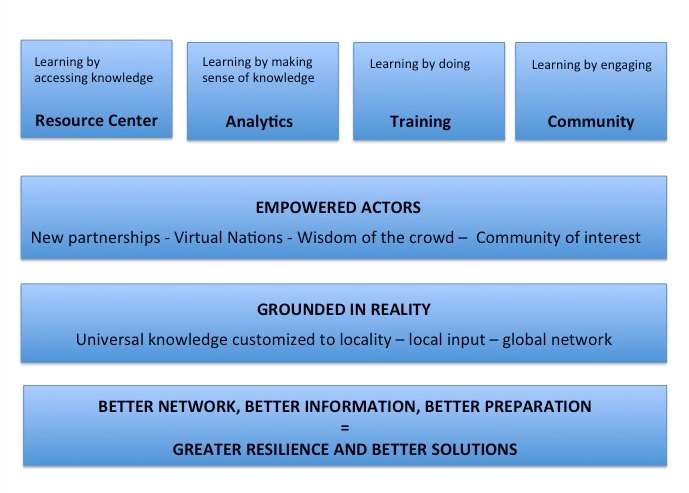
The network as the workshop conceived it. Geneva Launch Summary Report, p. 6.
September 16–17, 2015 · Geneva
The conference and the Declaration
At the Centre International de Conférences Genève, the Global Challenges Forum Foundation and UNITAR co-hosted the launch with the U.S. Department of Defense and the Middlebury Institute of International Studies. UNITAR’s Sally Fegan-Wyles and OSD’s Frank DiGiovanni co-chaired. Talal Abu-Ghazaleh delivered the inaugural keynote.
The delegates agreed that communities facing a complex emergency needed better ways to find knowledge, share it and act on it. The Geneva Declaration established the Global Resilience Readiness Initiative. It asked Walter, as Foundation chairman, to serve as executive director and consult cities, nations and international bodies about innovative learning and leadership. Walter and Talal signed the Declaration.
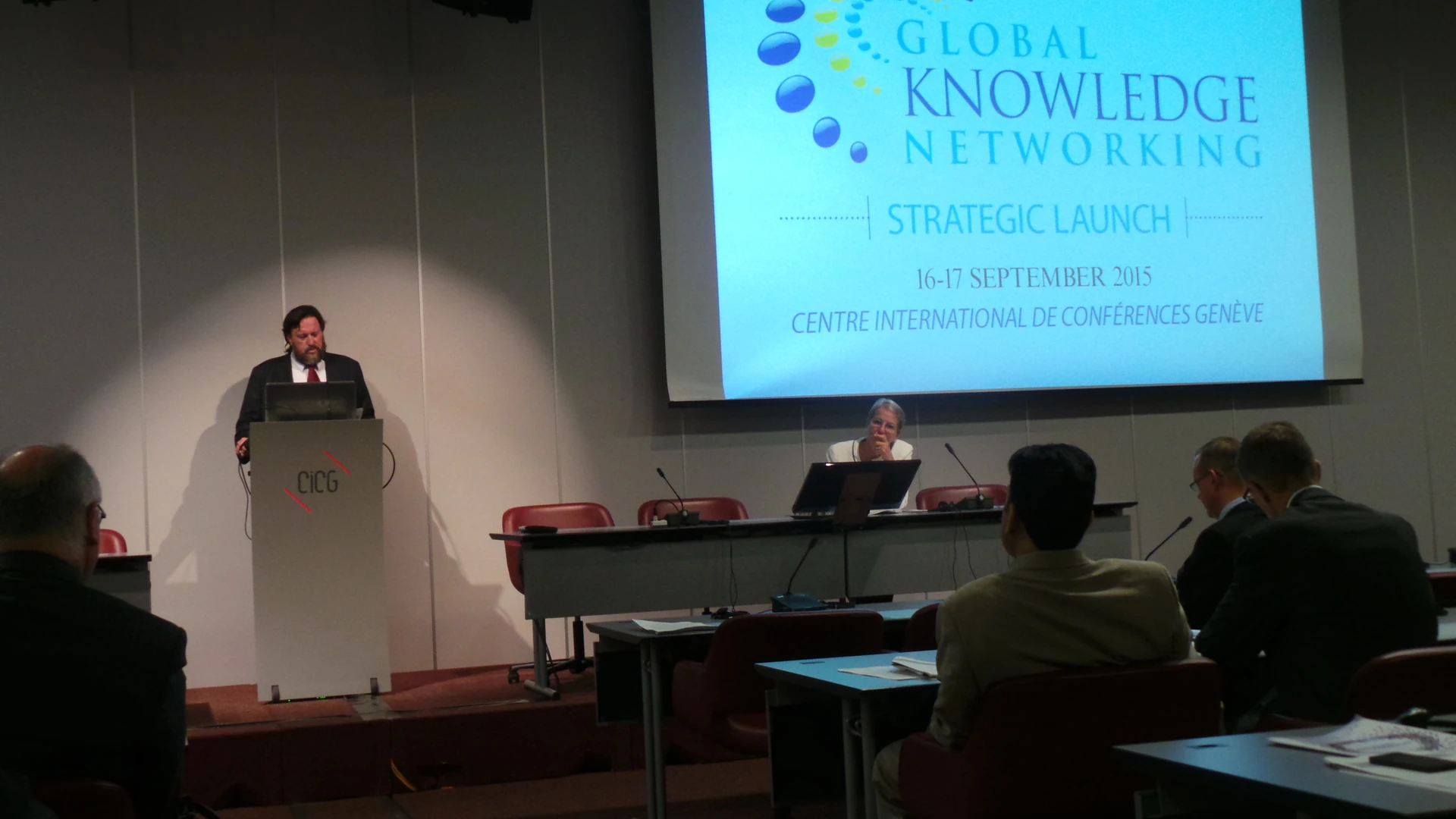
Walter L. Christman speaks at the launch of Global Knowledge Networking in Geneva, September 16, 2015. Photograph shared by Mohammad Farghal.
Impact in The Age of Convergence
What grew from Geneva
The trilogy traces a chain of decisions. The consulting project delivered a roadmap. Institutions and individuals then made their own commitments to carry the idea forward.
April 2018
A framework for cooperation
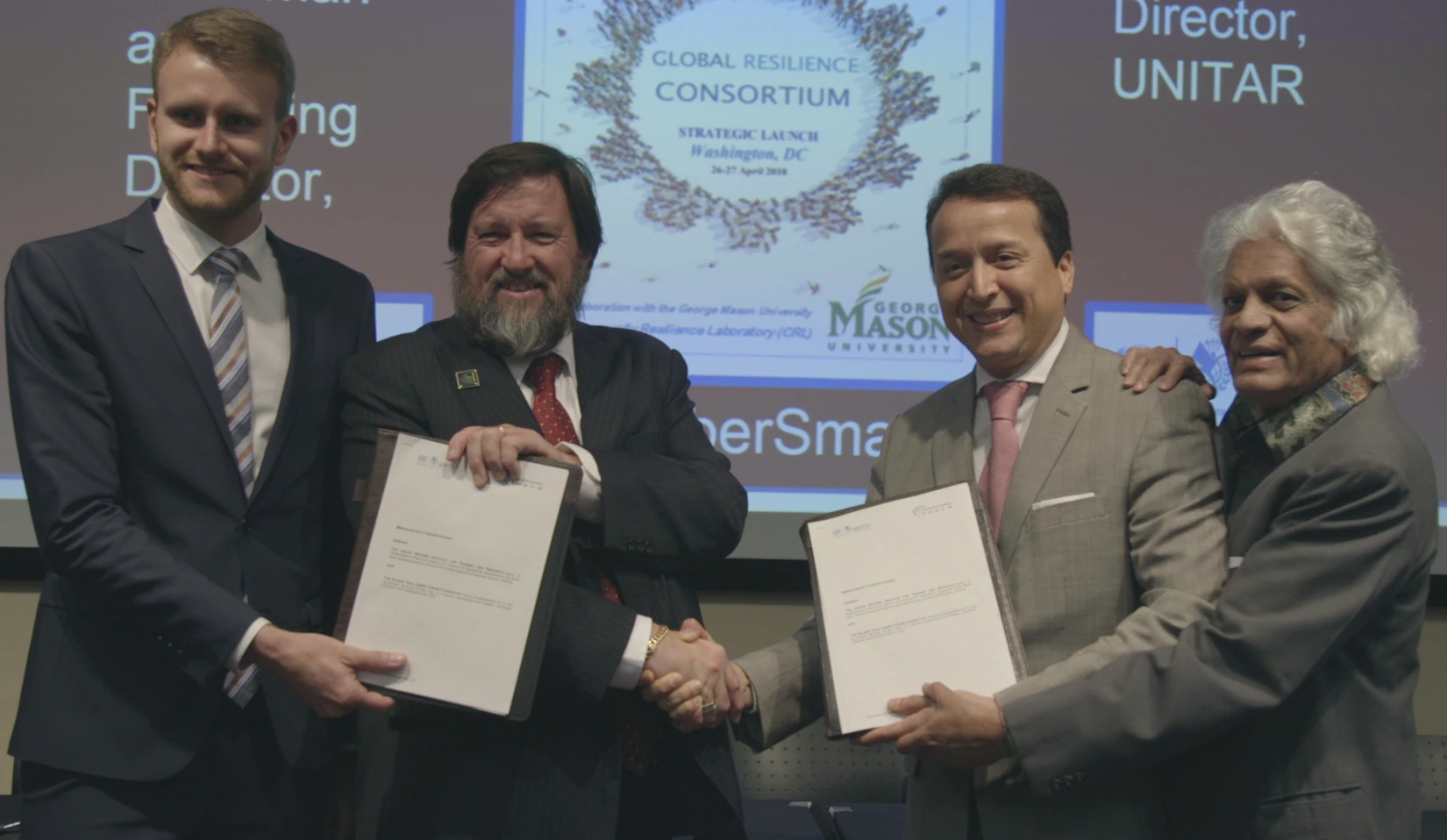
At the second Global Knowledge Networking symposium in Virginia, UNITAR and GCF signed an agreement on April 27 that explicitly supported the 2015 Declaration. It established a framework for shared learning and the Global Resilience Consortium.
October 2018
Delhi and Kathmandu
On October 3 the Delhi Proclamation called for one million youth leaders for sustainable development and asked partners to explore a Global Resilience University. Later that month in Kathmandu, Walter and Sebastian Hofbauer saw young people leading their own march. In Book III, Walter describes how that encounter changed the founders’ understanding of who should lead.
September 2019
A public launch led by young people
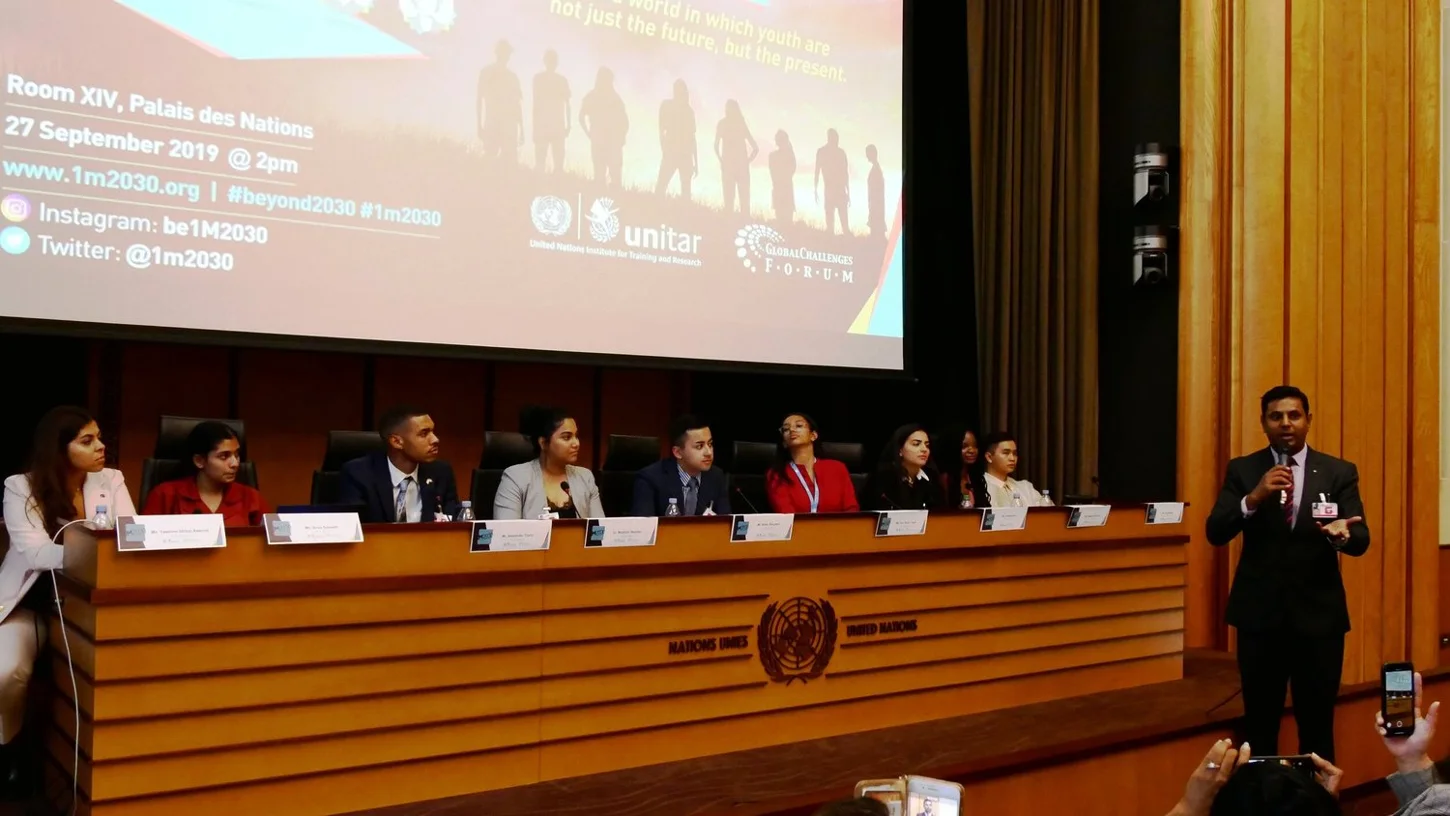
GCF and UNITAR launched 1M2030 at the Palais des Nations in Geneva on September 27. Nine speakers from seven countries presented their own work. The million-leader figure expressed the scale of the ambition.
2020–24
Institutions take up the work
The 2020 Global Partnership Declaration in Amman extended the invitation to cooperate. The Consortium took shape as a distinct Swiss association. The 2021 Global Resilience Manifesto and the 2022 partnership model developed the roles of institutions and community networks. In 2024 the Foundation announced GCF India, with 1M2030 central to its work.
2025–26
From a declaration to a practice
Walter and Beatrice Bressan signed the Geneva Covenant of Mutual Obligation in August 2025. The July 4, 2026 Global Resilience Declaration asked how societies could preserve development gains through disruption. In the trilogy, GRU and the Covenant Table give people a way to act on those commitments: bring those who know, those who decide and those affected into a decision while it can still change.
Trilogy sources: The Apocalypse of Assumptions, chapter 14, pp. 216–218; Building Global Resilience, foreword and chapters 6 and 9; Empowering Change, chapters 12–14, “The Record Behind the Story,” and appendices B–H.
April 2018. From left, Sebastian Hofbauer, Walter Christman, UNITAR’s Alex Mejía and Ken Gnanakan.September 2019. The 1M2030 launch at the Palais des Nations in Geneva.