
Global Knowledge Networking · September 2015
Geneva launch conference report
The archival reading edition brings together the conference findings, plenary sessions, participant roster and signed Geneva Declaration.
Page 1 of 14
Read page 1 as text
GLOBAL KNOWLEDGE NETWORKING / GENEVA 2015
Geneva Launch Summary Report
Toward a Smart Century: Global Partnerships for Innovative Learning and Leader Development
September 16–17, 2015 · Centre International de Conférences Genève
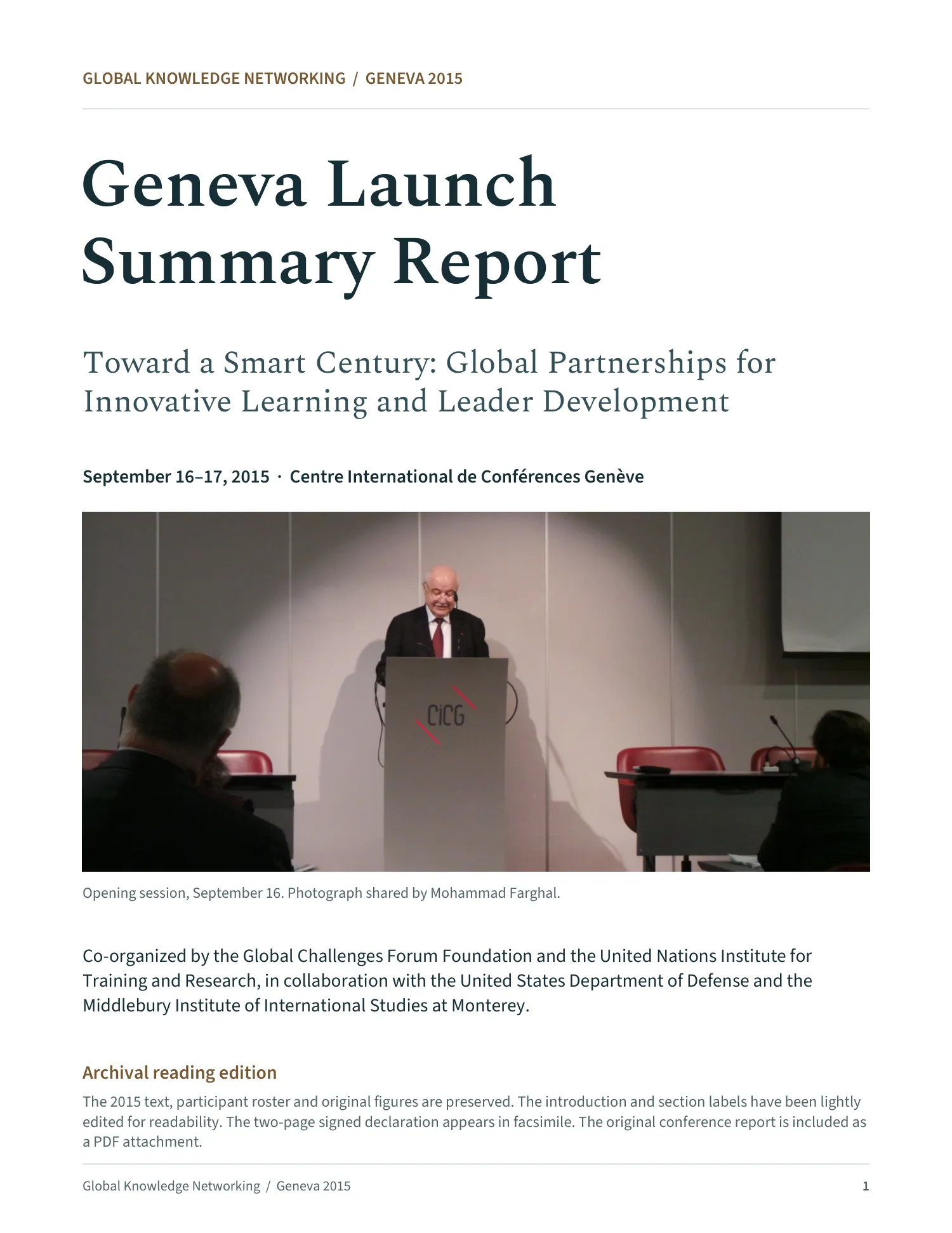
Opening session, September 16. Photograph shared by Mohammad Farghal.
Co-organized by the Global Challenges Forum Foundation and the United Nations Institute for Training and Research, in collaboration with the United States Department of Defense and the Middlebury Institute of International Studies at Monterey.
Archival reading edition
The 2015 text, participant roster and original figures are preserved. The introduction and section labels have been lightly edited for readability. The two-page signed declaration appears in facsimile. The original conference report is included as a PDF attachment.
Global Knowledge Networking / Geneva 2015 1
Page 2 of 14
Read page 2 as text
PROJECT RECORD
Conference overview
On 16-17 September 2015, the Global Challenges Forum Foundation and the United Nations Institute for Training and Research (UNITAR) co-organized the launch conference of the Global knowledge Networking Initiative: “Toward a Smart Century: Global Partnerships for Innovative Learning and Leader Development.”
Ms. Sally Fegan-Wyles, Assistant Secretary General of the United Nations, Executive Director, United Nations Institute for Training and Research and Mr. Frank DiGiovanni, Director of Force Readiness and Training, U.S. Office of the Under Secretary of Defense (Readiness), United States co-chaired the event.
The Inaugural Conference attended by leaders in education and training from around the world, launched the Global Knowledge Network Initiative (GKNI), a project for an innovative and dynamic educational and training hub that fosters creativity, imagination, knowledge-sharing, cross-discipline, and networking. The objective of this development hub is to equip future leaders and stakeholders with the tools necessary to stimulate societal resilience in the face of increasingly complex and disruptive emergencies and threats.
The conference report covers four elements.
• A visioning exercise on the transformative potential of networking people, ideas, and technologies to enhance human security. Annex 1 gives the results.
• Plenary sessions on complex security challenges and opportunities for global partnerships to respond to them. Annex 2 gives the annotated agenda and highlights of panel comments.
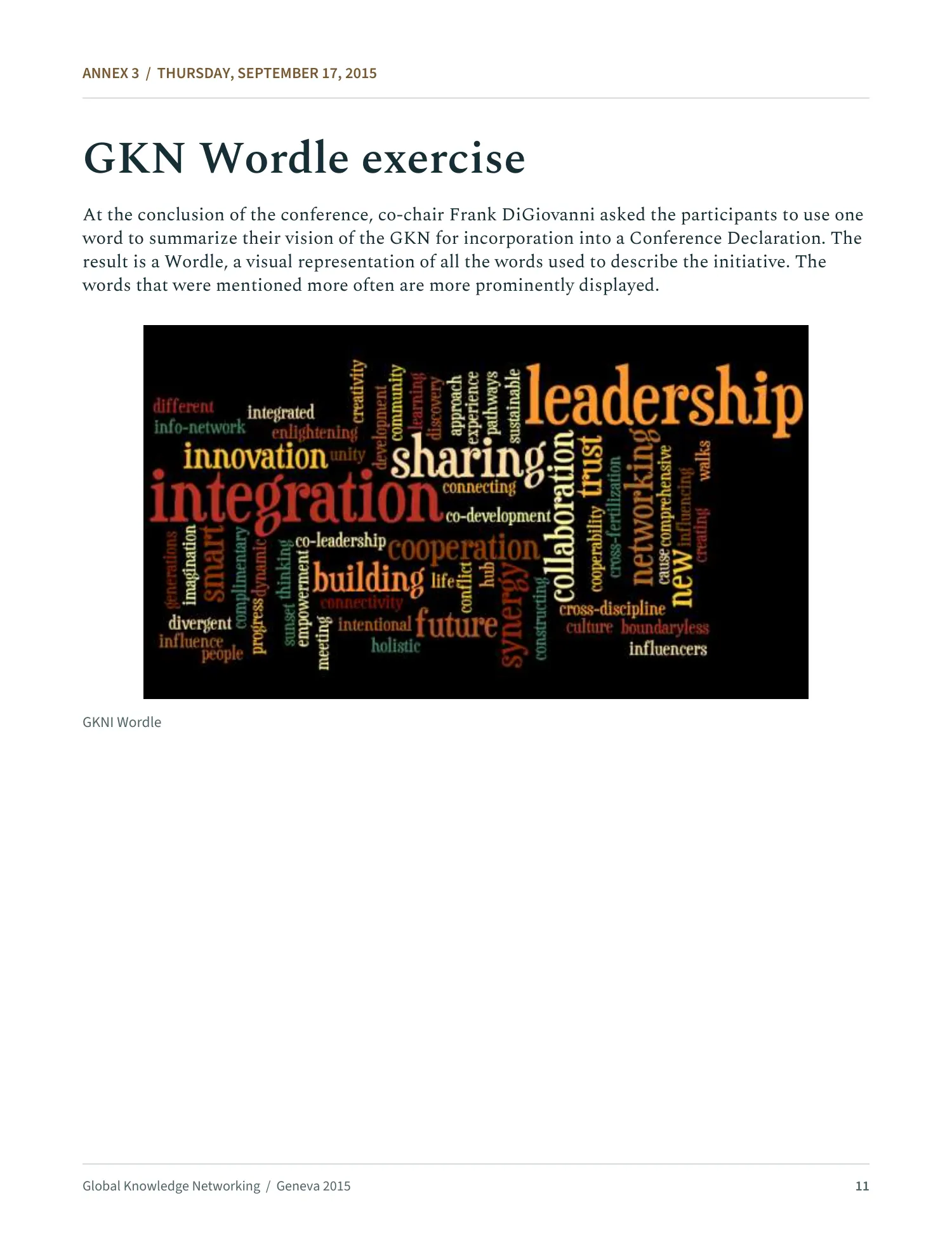
• A facilitated discussion in which each participant proposed one word for the conference declaration. Annex 3 reproduces the resulting word cloud.
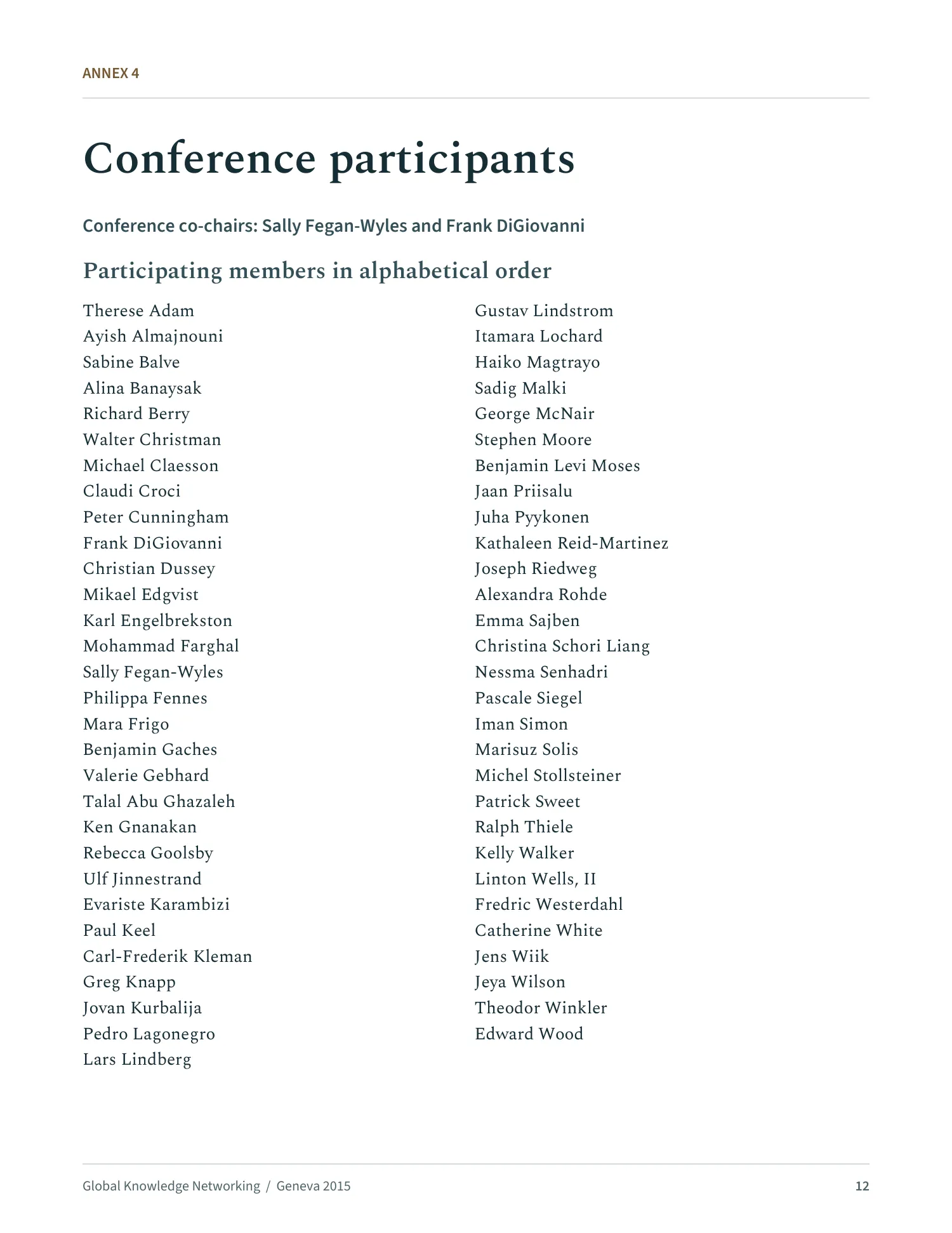
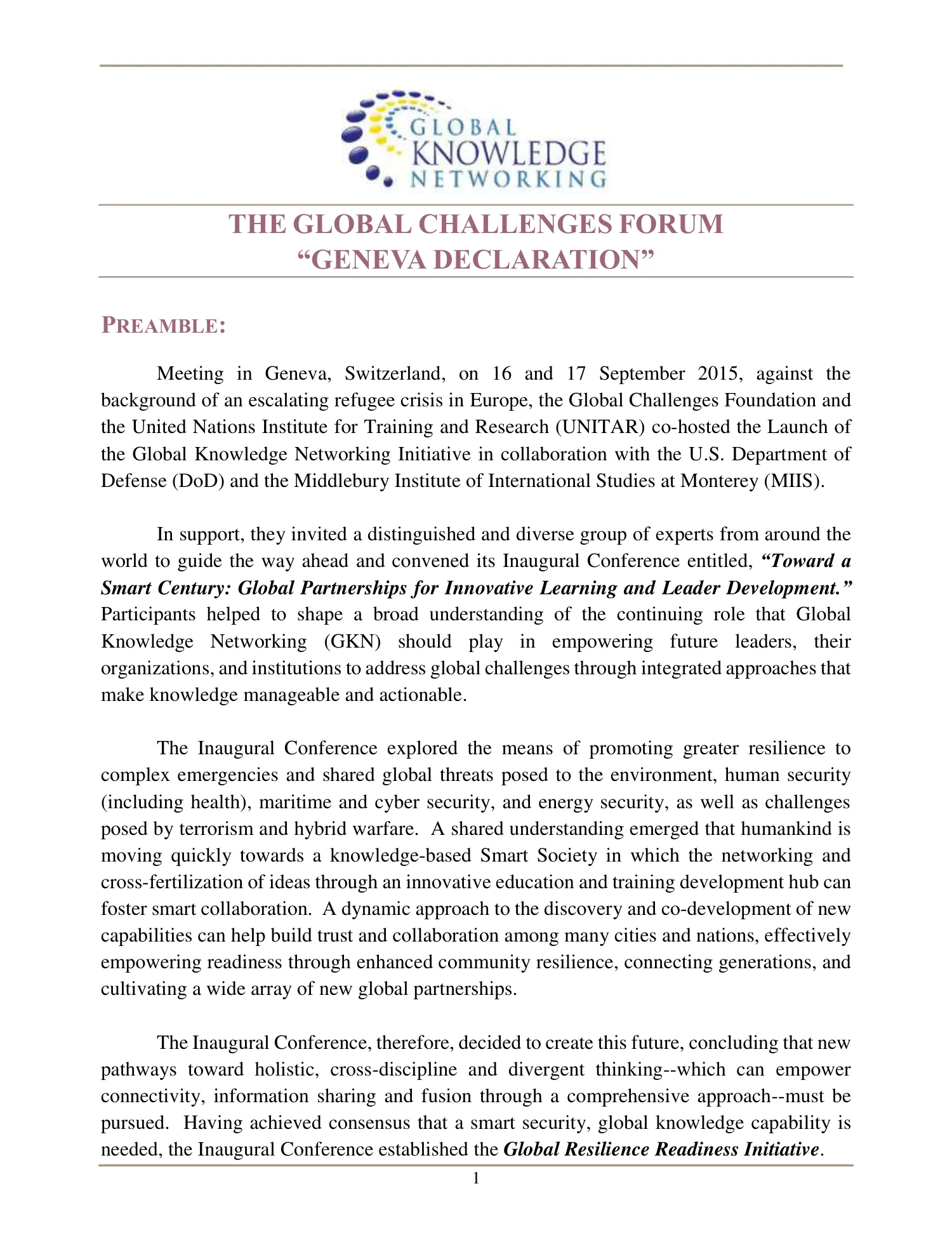
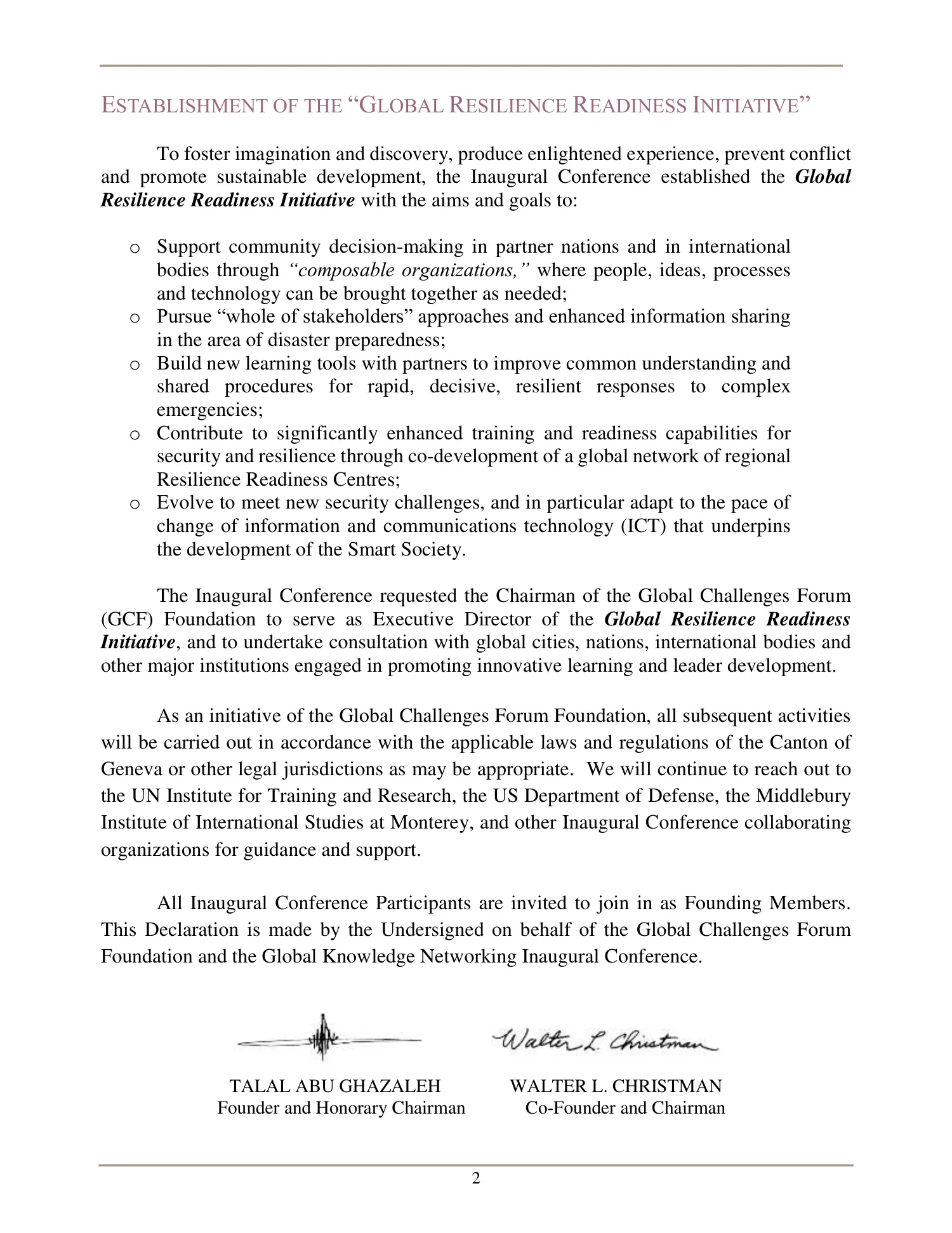
• A Geneva Declaration to guide follow-on activity. Annex 4 lists the participants invited to join as founding members. The signed declaration follows the annexes in this edition.
Guide to the record
Results from the visioning exercise 3
Highlights from the plenary sessions 6
Wordle exercise 11
Conference participants 12
Signed Geneva Declaration 13
Open the original 2015 conference report (embedded PDF)
Global Knowledge Networking / Geneva 2015 2
Page 3 of 14
Read page 3 as text
ANNEX 1 / THURSDAY, SEPTEMBER 17, 2015
Results from the visioning exercise
Vision statement
As we look ahead, it is increasingly clear that the solutions to the complex, multi-faceted challenges the world faces are beyond the scope of single actor (be it the military) or a single nation or multilateral organization. As humankind moves toward a knowledge-based smart society, successful solutions will require new partnerships, new approaches, and new skills leveraging new technologies to build trust and foster the kind of smart collaboration necessary to fuel a new level of resilience.
The Global Knowledge Networking Initiative (GKNI) was envisioned by participants to be a co-developed, inter-connected, global educational and training hub linking centers of excellence around the world to create a uniquely integrated learning experience. This developmental focal point will seek to generate new global partnerships by constructing new pathways, building trust, facilitating cooperation and synergies, developing holistic approaches and cross-boundary information-sharing and promoting unity of cause.
Participants further envisioned GKNI to be an adaptable, flexible distributed network where people, ideas, processes, and technologies are brought together through “composable organizations” and collaboration enables whole-of-stakeholder approaches to build greater resilience in the face of increasingly complex challenges.
Target audience
The GKNI is primarily envisioned as an education and training environment for tomorrow’s leaders and practitioners of global security. This vision is rooted in the belief that global challenges will require more than the traditional stakeholders of global security (governments, military and diplomacy, international organizations, and non-governmental organizations), but rather a mobilization of all partners of good will, big and small, public and private, foreign or domestic, and for profit and not-for-profit. It is through the continuous interactions and integration of all these actors that we can develop a new culture of smart collaboration that will enable greater resilience.
It is also rooted in the belief that the nature of leadership is changing. Rather than a matter of authority and hierarchy, leadership is increasingly a matter of influence. In the first case, leadership is partly exercised through coercive measures (such as incentives, rewards, and threats). In the second case, leadership is mostly exercised through soft skills, such as influence, conviction, and the ability to inspire rather than the power to command.
How to recruit these future leaders will require refinement as the project moves along. Preliminary discussions highlighted that knowing how to identify future leaders is extremely difficult, even in institutions that train leaders such as the military. A first step in that process should be to develop an online community of interest to nurture and develop a large pool of willing partners, which will form the backbone of tomorrow’s leadership.
To foster such a community of interest, an independent sponsor with high credibility on the international, conflict-resolution, and peace-building scene is critical.
Global Knowledge Networking / Geneva 2015 3
Page 4 of 14
Read page 4 as text
ANNEX 1 / VISIONING EXERCISE
Initial organizing principle
The GKNI concept asserts that military and civilians, including non-governmental organizations, share responsibility to co-evolve organization, command concepts, and doctrine among many nations in order to take advantage of advances in technology and promote an “interoperability of the mind.”
The GKNI is envisioned as a nimble virtual hub that will offer a large range of integrated services to enable participants to share knowledge, collaborate, plan and execute together, grow communities of practice to bring about rapid, decisive responses to complex emergencies.
To that effect, it was recommended that the GKNI neither replicates nor duplicates existing networks or platforms. Rather, it is suggested that it becomes an integrator of existing platforms and networks. There is no need for additional centers of excellence or islands of knowledge. There is however, a greater need for increased connectivity and systems thinking that allows for better outcomes. This will allow the GKN to be a nimble integrated architecture that evolves more easily along with the commercial technological market and is more adaptive to stakeholders’ needs. By this principle, the GKNI’s added value stems from the trust and collaboration developing as a result of the synergy created between technologies, people, and ideas and enabling the management of new partnerships better able to bring swift resolution to complex crises.
The GKNI vision is predicated upon two ideas. First, we can better leverage the vast amount of existing (and future) knowledge through open, accessible, interactive, and persistent networks that allow people to access what they need when they need to enhance their situational awareness. Second, the need for collaboration is no longer simply about information sharing, deliberation or reaching consensus. It is about fostering unity of effort through actual integrated action between multi-stakeholder partnerships.
It is therefore currently envisioned that the GKNI present the following characteristics:
• Build and develop trust between participants who are considered equal co-developers in the network;
• Promote interactivity to facilitate stakeholder’s engagement and nurture social learning;
• Promote common interests, understanding, approaches, and standards to enhance the community’s ability to respond to challenges;
• Favor the need-to-share as opposed to the need-to-know.
Global Knowledge Networking / Geneva 2015 4
Page 5 of 14
Read page 5 as text
ANNEX 1 / VISIONING EXERCISE
Initial components
To achieve the ambitious agenda of promoting new global partnerships to enhance resilience and bring about rapid, decisive responses to complex emergencies, participants envisioned the following key features for the GKNI. These should be envisioned as elements of a nimble composable organization that can be modified or reorganized based on the needs of the moment.
The network should offer a resource center where key knowledge can be easily accessed. Participants insisted that considering the rapid speed at which knowledge accumulates, an actionable resource center should be designed with the goal of making the right content available to the right person at the right time. Here, knowledge curation through artificial intelligence, automated multi-lingual capabilities, and universal knowledge grounded in localized experience are key desirable technical features.
It should also offer a strong analytics and visualization component to help users rapidly make sense of the vast knowledge available. With the increasing amount of knowledge available and the volume of data available, having information/data at one’s fingertips can lead to information overload. Having the ability to make sense of it through data analytics and visualization is key to making knowledge actionable. Analytics and visualization can also help break down information silos and bring about holistic and systems approach necessary to imagine the creative solutions to tomorrow’s challenges. It is fundamental to anticipating, detecting, and understanding the problems.
A third component of the network should focus on training modules that allow users to learn by doing. Training is the component that allows users to get better through practice, self-perfection, and minor innovations and adjustments, otherwise designed as the learning curve. Past experiences in NATO (with the Partnership for Peace) attest to the robustness and validity of such approach.
The fourth component should be the development and nurturing of a vibrant community of interest composed of engaged users allowed to share, discuss, and debate issues. The community will be able to foster social learning through engagement and exchanges, data sharing, and resource providing. The maintenance of the community of interest is no small feat. It requires a Social Media component that allows the community to remain engaged over time in a sustainable manner. It requires administrators, sub-administrators, and moderators who can keep the interactions flowing both from a technical and from a social engagement standpoint. It also requires intrinsic motivators to keep the community engaged over time.
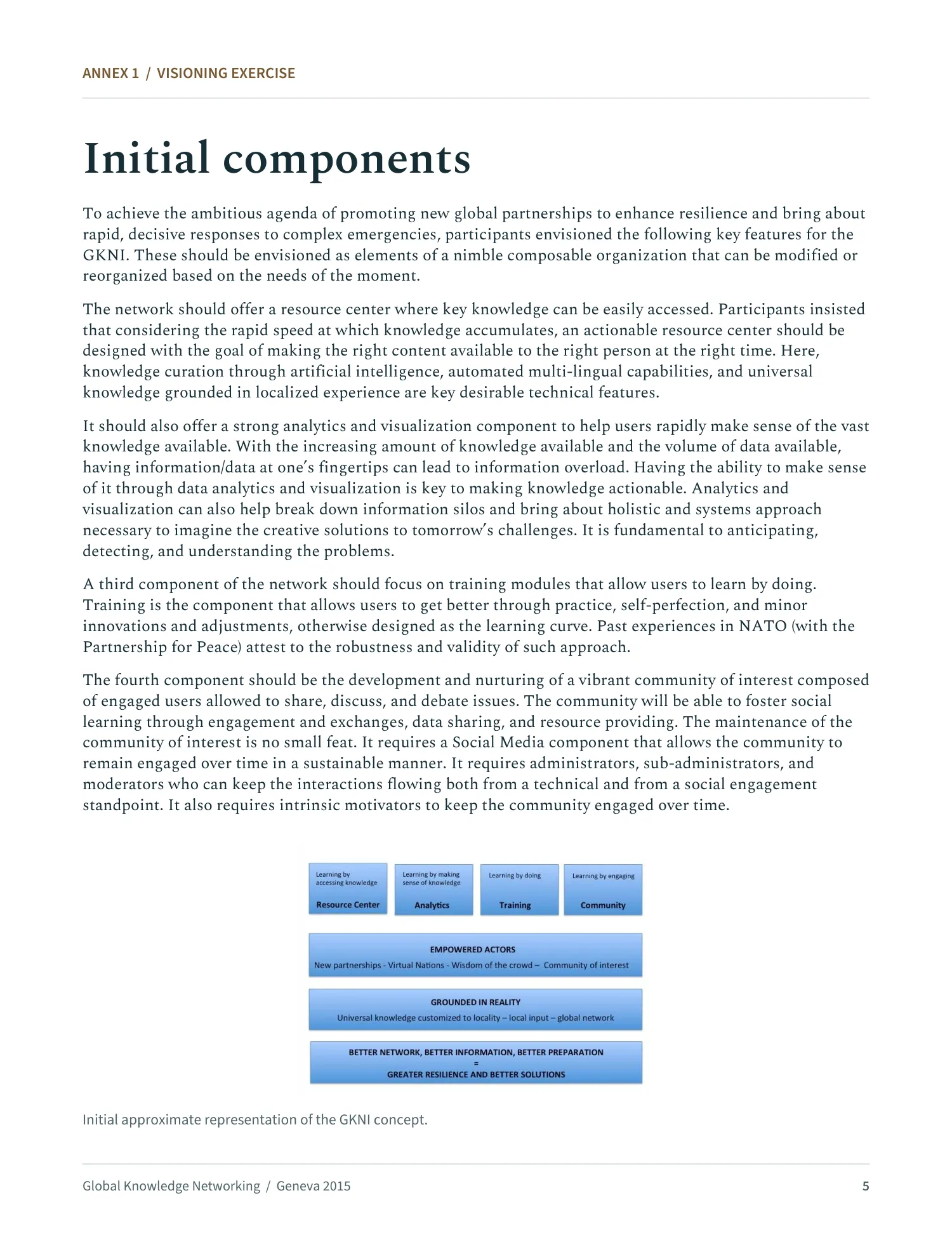
Initial approximate representation of the GKNI concept.
Global Knowledge Networking / Geneva 2015 5
The diagram connects four ways of learning: accessing knowledge through a resource center, making sense of knowledge through analytics, learning by doing through training, and engaging through community. Empowered actors form new partnerships, virtual nations, the wisdom of the crowd and a community of interest. Universal knowledge is customized to local reality. A better network, better information and better preparation support greater resilience and better solutions.
Page 6 of 14
Read page 6 as text
ANNEX 2 / HIGHLIGHTS FROM THE PLENARY SESSIONS
Reception and opening keynote
Tuesday, September 15 · Speakers’ reception at the Maison de la Paix
Ms. Sally Fegan-Wyles, Assistant Secretary General of the United Nations, Executive Director, United Nations Institute for Training and Research
Today’s security challenges cannot be tackled unless we all work together. There can no longer be a security solution resting solely on the shoulders of the military as security is becoming multi-faceted. With the complexity of today’s security, we need new approaches, new processes, and new skills leveraging the technologies of the new century.
Ambassador Dr. Theodor Winkler, Director, Center for the Democratic Control of the Armed Forces, Geneva
La Maison de la Paix is delighted to host this meeting. This meeting is very fitting because la Maison de la Paix wants to be a hub for meetings, cooperation, analysis, NGOs, and for action. We are now facing new challenges and in this new era, the recipes of the past no longer work. We need new types of approaches, activities, insights, and new knowledge. We need networks, and networks of networks. The real question is: how do we access these networks in a timely fashion to retrieve the relevant and accurate information we need.
Wednesday, September 16 · Session one: Challenges
Inaugural Keynote Speech: H.E. Dr. Talal Abu-Ghazaleh, Co-Founder and Honorary Chairman, Global Challenges Forum Foundation and UN Chairman, Global Alliance for Sustainable Urbanization.
On TAGIUNI: Democratizing world class education Education is a fundamental right and global aspiration as well as the substrata upon which economic progress is built. However, universal access to quality education remains a great challenge globally. The future lies in world-class online borderless and technology-driven education, provided online education finds a sustainable business model and people grow more comfortable with it. The TAGIUNI program is a unique initiative designed to bring world-class online education from highly reputable institutions to the Arab world.
Global Knowledge Networking / Geneva 2015 6
Page 7 of 14
Read page 7 as text
ANNEX 2 / WEDNESDAY, SEPTEMBER 16, 2015
Session one: Challenges
Global Challenges: Addressing Shared Risks and Threats
Gustav Lindstrom, GCSP Emerging Security Challenges (Moderator) Mr. Ralph Thiele, Political Military Society, Berlin, Dr. Itamara Lochard, Middlebury Institute of International Studies (MIIS), Monterey, Dr. Christina Schori Liang, Geneva Centre for Security Policy, Geneva Dr. Richard Berry, U.S. Pacific Command, United States Today’s security challenges are complex: They are not about resources or borders, but mainly about human security. Complex hybrid threats that blur traditional lines are emerging. Threats against human security proliferate (refugees). Some of these threats (Daesh for example) pose existential risks to existing countries. Global partnerships have shown their limits in handling/solving these complex challenges. Other threats, such as cyber threats, are not uniformly tackled and much more needs to be done to develop effective policies. As of now, only 15 nations in the world have cyber policies. Cyber-security education is lacking among the general population and particularly among the youth.
Learning at the Edge: Confronting Adaptive Challenges
Ms. Pascale C. Siegel, Insight Through Analysis, LLC (Moderator) Amb. Christian Dussey, Geneva Centre for Security Policy, Geneva Dr. Ken Gnanakan, Chairman, ACTS Group, Bangalore, India Mr. Greg Knapp, Former Executive Director, U.S. Joint Warfighting Center Ms. Kelly Walker, Global Studies Teacher, Virginia Beach, Virginia Education and training need to be revolutionized to provide leaders and practitioners the tools they need to manage complex challenges. The unpredictability of crises, the insufficient preparation of key actors, and the need for rapid responses are three key aspects that need to be addressed. The target should be on increasing individual, team, and organizational agility, creativity, adaptability, and resilience. It should also be about nurturing different kind of skills (collaborative, creative and critical thinking, and active listening), and different kind of leaders, as well as modernizing the training of trainers. One key challenge is responding to the need for holistic, systemic, and multi-disciplinary approaches as knowledge is increasingly specialized and fragmented. Another challenge is to triage the vast amount of knowledge available into actionable insights.
Focus Region: Challenges Facing the Arab World and the GCC Region
Dr. Walter Christman, Founder, Gulf Knowledge Network Initiative, Switzerland (Moderator) Mr. Ralph Thiele, Chairman, C4ISR Summit, Abu Dhabi MG (ret.) Ayish Almajnouni, Saudi Arabia Defense Academy, Saudi Arabia MG (ret.) Mohammad Farghal, Center for Strategic Studies, Jordan The Arab World is facing daunting challenges today, including deep socio-economic problems and extremism fueling terrorism. There are nuggets of excellent education in the region. Moreover, the GCC countries are currently growing their training and education systems as they face new and challenging security threats. What is needed now is greater connectivity and networking so that these Centers of Excellence become part of the solution. With good leadership, expanded partnerships (not limited to the military), acceptance and respect for local cultural norms, and by seizing on urgent issues (such as Yemen), there is space in the Gulf region for participating in an initiative like GKN.
Global Knowledge Networking / Geneva 2015 7
Page 8 of 14
Read page 8 as text
ANNEX 2 / WEDNESDAY, SEPTEMBER 16, 2015
Session two: Opportunities
Keynote Speaker: Mr. Frank DiGiovanni, Director, Force Readiness and Training, U.S. Office of the Under Secretary of Defense (Readiness), United States
The world has not gotten more complex. Instead, we are hearing more voices that we did not hear before. We have to develop a system in which these voices can be heard and leveraged. This is what GKN is about. It is about spurring unity of effort through unity of belief and unity of cause. It is about getting people together, getting them to talk to each other, and share knowledge so they can spur into action. It is an innovative process. The idea is there. The question now is to get people to adopt the idea and act on it (that’s 90% of the work in any innovative process). The more important part of this process is not the technology, but the learner. It is about identifying and leveraging the tools that will be conducive to learners’ individual and social learning. Technology is only the enabler of that process. Technology is an important component as it can provide the right tools (knowledge curation, sorting through info-fatigue, artificial intelligence, intrinsic motivators) that will empower the learner to succeed. However, in the end, it is the result on the human (e.g. the learner) that is most important.
Focus Opportunity: The Global Cyber Future
Dr. Itamara Lochard, Director, Cyber Initiative, Middlebury Institute of International Studies at Monterey (Moderator) Dr. Rebecca Goolsby, U.S. Office of Naval Research, Washington DC Mr. Jean Prisalu, Senior Fellow, NATO Cooperative Cyber Defense CoE, Estonia Dr. Linton Wells, Senior Distinguished Fellow, Middlebury Institute of International Studies at Monterrey, California The cyberspace is both a huge opportunity and a terrible risk. It profoundly changes our behaviors, although we do not completely capture how. E-learning, done right can make people more socially engaged and spur collective action (for example in favor of climate mitigation). In military education, cyberspace can be leveraged to create on-call, real-time, composable organizations or training events that emulate crises and complex emergencies. However, there are also threats lurking from cyberspace. The first one is criminality; the second one is espionage; and the third one is support to kinetic operations. There is a great need for cyber education and cyber-hygiene. There are ways to leverage the cyberspace for good (increased coordination and cooperation as in NATO and the PfP) to deliver services that are otherwise unavailable. To harness that power, we need to continue working on developing a global trade regime applicable to cyber, protections, and dispute settlement system.
Global Knowledge Networking / Geneva 2015 8
Page 9 of 14
Read page 9 as text
ANNEX 2 / SESSION TWO CONTINUED
Next-generation military education
Roundtable on Next Generation Military Education and Training
Mr. Frank DiGiovanni, Co-Chairman, NATO Training Group (Moderator) Mr. Solis, NATO International Staff, Deputy for Defense Education Enhancement BG Claesson, Viking Exercise Director, Swedish Armed Forces BG Juha Pyykönen, Partnership Interoperability Advocacy Group, NATO HQ, Brussels MG (Ret.) Mohammad Farghal, Director General, Centre for Strategic Studies, Jordan MG (Ret.) Ayish Almajnouni, Saudi National Defense Academy Military education has to deal with key issues. The first one is managing the amount of information available. All panelists agree that artificial intelligence and automation are key to triage information because the amount of information available is beyond human management capabilities. The second one is how to cultivate good leaders. Leadership is changing. Even in the military, good leaders do not simply rely on command; they have influence. These will be increasingly true as the culture of new entrants is worldlier and more critical. There was debate as to whether the military needs different levels of leadership skills for each of its operational levels. The third one is how to make knowledge actionable. Although information is made available more quickly, information sharing remains an endemic problem. The fourth one is how to learn to operate in a multi-lateral context. The experiences of NATO and the PfP show that developing cooperation through mutually beneficial processes is key to getting buy-in and facilitates the adoption of common norms. The experience and processes (such as the PIAG or the Viking Exercises) can be leveraged and replicated or expanded elsewhere.
Ms. Sabine Balve, Founder and President of the World Leaders Forum, Dubai
The complex, multi-faceted challenges we now face require new responses. As the crises accumulate, we can see that our current institutions, processes, and ways of doing things are simply outdated. We need to rise to the challenge to create a planet where a sustainable future for all is a reality, not a distant dream. This is where high-level networking is key. New institutions such as the World Leader Forum Dubai can be leveraged to bring leaders with a proven record of success in government, business, and other domains to form the critical mass needed to bring solutions to vexing enduring problems and short-term crises.
Global Knowledge Networking / Geneva 2015 9
Page 10 of 14
Read page 10 as text
ANNEX 2 / THURSDAY, SEPTEMBER 17, 2015
Session three: Solutions
Global Voices Roundtable: Leadership Education for Smart Decision-Making
Dr. Walter Christman, Global Challenges Forum Foundation (Moderator) Dr. Jovan Kurbalija, DiploFoundation, Geneva Mr. Evariste Karambezi, Director, Peacekeeping Training Programme, UNITAR Mr. Edward Wood, Genesis Energy Center, Pune, India Dr. Sadig Malki, King Abdulaziz University, Saudi Arabia Ambassador (ret.) Therese Adam, Switzerland Tomorrow’s leadership will be less about hierarchy, command, and authority, and more about influence. It will be less about ordering people than convincing them to do the right thing. It will also be about justifying choices and rationales to subordinates who will be increasingly prone to questioning. Leadership will be more about good stewardship of issues, empathy, and emotional intelligence. It will be about detecting future good leaders. The consensus here is that leaders are not born, but some people show the pre-dispositions toward leadership. It will be about detecting these people and training them to have the wisdom to be good leaders, e.g. to understand the issues holistically, make the right choices, and generate unity of action. Good leadership is supported by information sharing, endurance, consistency and routine in training (maybe through certification), integrated learning, and holistic perspectives.
Keynote Speaker: Major-General Karl Engelbrektson, Director, Training and Education, Swedish Armed Forces. On the Role of Leadership on Different Levels.
Good leaders are those who are able to look beyond their own little silos for the greater good and those who understand the big picture to make the relevant and successful trade-offs to get the job done. The skills required for leaders at the tactical, operational, and strategic-political levels are different. The first two levels are more limited in scope and the skills are easier to teach. Moreover, they operate within parameters fixed at the higher level and can always get guidance back from the higher level. The strategic-political leadership level is a different ballgame. It is a different type of skillset because it is about the big picture. At that level, we spend too little time picking up the right person for the job.
Global Knowledge Networking / Geneva 2015 10
Page 11 of 14
Read page 11 as text
ANNEX 3 / THURSDAY, SEPTEMBER 17, 2015
GKN Wordle exercise
At the conclusion of the conference, co-chair Frank DiGiovanni asked the participants to use one word to summarize their vision of the GKN for incorporation into a Conference Declaration. The result is a Wordle, a visual representation of all the words used to describe the initiative. The words that were mentioned more often are more prominently displayed.
GKNI Wordle
Global Knowledge Networking / Geneva 2015 11
The conference word cloud gives prominence to the words leadership, integration and sharing.
Page 12 of 14
Read page 12 as text
ANNEX 4
Conference participants
Conference co-chairs: Sally Fegan-Wyles and Frank DiGiovanni
Participating members in alphabetical order
Therese Adam Gustav Lindstrom Ayish Almajnouni Itamara Lochard Sabine Balve Haiko Magtrayo Alina Banaysak Sadig Malki Richard Berry George McNair Walter Christman Stephen Moore Michael Claesson Benjamin Levi Moses Claudi Croci Jaan Priisalu Peter Cunningham Juha Pyykonen Frank DiGiovanni Kathaleen Reid-Martinez Christian Dussey Joseph Riedweg Mikael Edgvist Alexandra Rohde Karl Engelbrekston Emma Sajben Mohammad Farghal Christina Schori Liang Sally Fegan-Wyles Nessma Senhadri Philippa Fennes Pascale Siegel Mara Frigo Iman Simon Benjamin Gaches Marisuz Solis Valerie Gebhard Michel Stollsteiner Talal Abu Ghazaleh Patrick Sweet Ken Gnanakan Ralph Thiele Rebecca Goolsby Kelly Walker Ulf Jinnestrand Linton Wells, II Evariste Karambizi Fredric Westerdahl Paul Keel Catherine White Carl-Frederik Kleman Jens Wiik Greg Knapp Jeya Wilson Jovan Kurbalija Theodor Winkler Pedro Lagonegro Edward Wood Lars Lindberg
Global Knowledge Networking / Geneva 2015 12
Page 13 of 14
Read page 13 as text
1
THE GLOBAL CHALLENGES FORUM
“GENEVA DECLARATION”
PREAMBLE:
Meeting in Geneva, Switzerland, on 16 and 17 September 2015, against the background of an escalating refugee crisis in Europe, the Global Challenges Foundation and the United Nations Institute for Training and Research (UNITAR) co-hosted the Launch of the Global Knowledge Networking Initiative in collaboration with the U.S. Department of Defense (DoD) and the Middlebury Institute of International Studies at Monterey (MIIS).
In support, they invited a distinguished and diverse group of experts from around the world to guide the way ahead and convened its Inaugural Conference entitled, “Toward a Smart Century: Global Partnerships for Innovative Learning and Leader Development.” Participants helped to shape a broad understanding of the continuing role that Global Knowledge Networking (GKN) should play in empowering future leaders, their organizations, and institutions to address global challenges through integrated approaches that make knowledge manageable and actionable.
The Inaugural Conference explored the means of promoting greater resilience to complex emergencies and shared global threats posed to the environment, human security (including health), maritime and cyber security, and energy security, as well as challenges posed by terrorism and hybrid warfare. A shared understanding emerged that humankind is moving quickly towards a knowledge-based Smart Society in which the networking and cross-fertilization of ideas through an innovative education and training development hub can foster smart collaboration. A dynamic approach to the discovery and co-development of new capabilities can help build trust and collaboration among many cities and nations, effectively empowering readiness through enhanced community resilience, connecting generations, and cultivating a wide array of new global partnerships.
The Inaugural Conference, therefore, decided to create this future, concluding that new pathways toward holistic, cross-discipline and divergent thinking--which can empower connectivity, information sharing and fusion through a comprehensive approach--must be pursued. Having achieved consensus that a smart security, global knowledge capability is needed, the Inaugural Conference established the Global Resilience Readiness Initiative.
Page 14 of 14
Read page 14 as text
2
ESTABLISHMENT OF THE “GLOBAL RESILIENCE READINESS INITIATIVE”
To foster imagination and discovery, produce enlightened experience, prevent conflict and promote sustainable development, the Inaugural Conference established the Global Resilience Readiness Initiative with the aims and goals to:
o Support community decision-making in partner nations and in international
bodies through “composable organizations,” where people, ideas, processes and technology can be brought together as needed; o Pursue “whole of stakeholders” approaches and enhanced information sharing
in the area of disaster preparedness; o Build new learning tools with partners to improve common understanding and
shared procedures for rapid, decisive, resilient responses to complex emergencies; o Contribute to significantly enhanced training and readiness capabilities for
security and resilience through co-development of a global network of regional Resilience Readiness Centres; o Evolve to meet new security challenges, and in particular adapt to the pace of
change of information and communications technology (ICT) that underpins the development of the Smart Society.
The Inaugural Conference requested the Chairman of the Global Challenges Forum (GCF) Foundation to serve as Executive Director of the Global Resilience Readiness Initiative, and to undertake consultation with global cities, nations, international bodies and other major institutions engaged in promoting innovative learning and leader development.
As an initiative of the Global Challenges Forum Foundation, all subsequent activities will be carried out in accordance with the applicable laws and regulations of the Canton of Geneva or other legal jurisdictions as may be appropriate. We will continue to reach out to the UN Institute for Training and Research, the US Department of Defense, the Middlebury Institute of International Studies at Monterey, and other Inaugural Conference collaborating organizations for guidance and support.
All Inaugural Conference Participants are invited to join in as Founding Members. This Declaration is made by the Undersigned on behalf of the Global Challenges Forum Foundation and the Global Knowledge Networking Inaugural Conference.
TALAL ABU GHAZALEH WALTER L. CHRISTMAN Founder and Honorary Chairman Co-Founder and Chairman