After retiring from U.S. government service in 2014, Walter built a consulting and research practice around a question he had faced as a public official and a teacher. How can people with different responsibilities learn enough from one another to make a better decision?
Public service
From Army Special Forces to the Pentagon
Walter enlisted in the U.S. Army in 1975 and served on a Special Forces A-Team. At Duke he earned an Army Reserve commission. As a congressional staff member he worked for Representative Doug Bereuter. Later, as a civilian in the Office of the Secretary of Defense, he helped former Cold War adversaries build institutions where their officials could work together.
His assignments included the State Department and the White House National Security Council, where he directed the Marshall Legacy Initiative. He served for twelve years as a U.S. diplomat in the international community in Geneva, Switzerland, where he earned his PhD in international relations. He also worked with U.S. Joint Forces Command and international partners, including NATO and the United Nations.
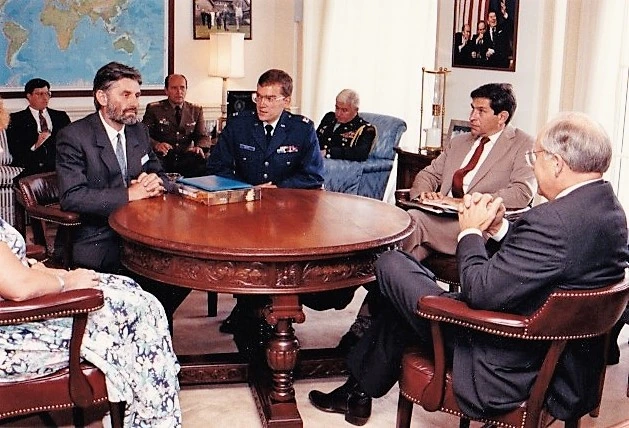
Walter takes notes at the right as Secretary of Defense Dick Cheney meets with a Hungarian delegation.
Defense cooperation
Three initiatives received presidential endorsement
Walter was principal architect of seven Secretary of Defense initiatives. Three drew the support of Presidents George H. W. Bush and Bill Clinton.
1993 · George H. W. Bush
A school for former adversaries
President Bush’s National Security Strategy singled out the newly established George C. Marshall European Center for Security Studies as an example of defense cooperation. Walter helped conceive and establish the Center while serving in the Pentagon.
While detailed to the National Security Council, Walter organized the symposium to consider how Americans could build partnerships with Europe’s new democracies. President Clinton invited him personally and sent a letter that was read at the symposium.
At the Washington Summit, President Clinton joined allied leaders in endorsing the outline for stronger partnership training and education. Walter helped design the policy. It linked defense academies and security studies institutes, exercise simulation and training centers.
Walter earned a bachelor’s degree at Duke University, a Master of International Affairs at Columbia University and a Master of Public Administration at Harvard’s Kennedy School of Government. He completed his doctorate in International Relations at Geneva’s Graduate Institute. The University of Geneva awarded the degree in 2007.
He has lived in Geneva, Riyadh and Manila. His work and travels have taken him to nearly 60 countries.
Teaching and research
The institutions behind the practice
Walter completed his federal career as an associate professor of global public policy at the Naval Postgraduate School. He taught officers how to examine a global issue from the perspectives of people who experience it differently.
His academic appointments also include visiting distinguished research fellow at National Defense University, adjunct faculty at Joint Special Operations University, senior global engagement fellow at the Middlebury Institute of International Studies, affiliated faculty at George Mason University’s C4I and Cyber Center, and visiting scholar at Shanghai Jiao Tong University. His work in Geneva led him to co-found the Global Challenges Forum Foundation and to develop programs with UNITAR.
Biography and archive
Walter’s life’s work
His personal website follows the people, places and decisions behind his service, teaching, partnerships and writing. The professional biography includes photographs, award citations and original documents.