


Global Strategic Analysis · GSA practice guide
Partnership development and capacity building
The business edition of the Covenant Tables in Practice paper, with a Partnership Design Council, Partnership Implementation Lab and Design-to-Delivery Brief.
Page 1 of 15
Read page 1 as text
G L O B A L S T R A T E G I C A N A L Y S I S CLIENT PRACTICE GUIDE
GLOBAL STRATEGIC RESOURCES, LLC 1
CONSULTING AND COMMISSIONED RESEARCH Partnership Development and Capacity Building
A field guide for people who have to make a shared decision and account
for what happens next.
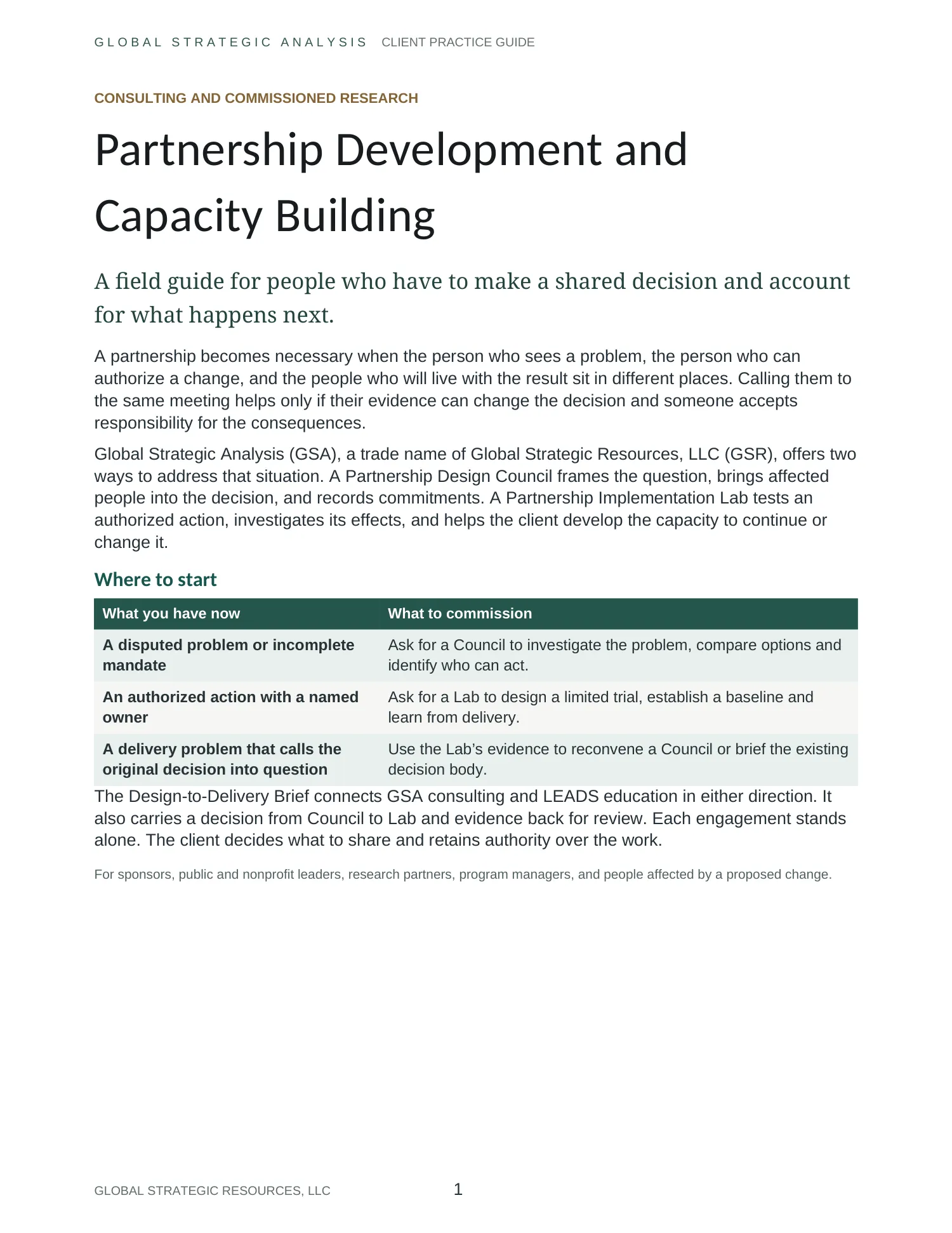
A partnership becomes necessary when the person who sees a problem, the person who can authorize a change, and the people who will live with the result sit in different places. Calling them to the same meeting helps only if their evidence can change the decision and someone accepts responsibility for the consequences.
Global Strategic Analysis (GSA), a trade name of Global Strategic Resources, LLC (GSR), offers two ways to address that situation. A Partnership Design Council frames the question, brings affected people into the decision, and records commitments. A Partnership Implementation Lab tests an authorized action, investigates its effects, and helps the client develop the capacity to continue or change it.
Where to start
What you have now What to commission
A disputed problem or incomplete mandate
Ask for a Council to investigate the problem, compare options and identify who can act.
An authorized action with a named owner
Ask for a Lab to design a limited trial, establish a baseline and learn from delivery.
A delivery problem that calls the original decision into question
Use the Lab’s evidence to reconvene a Council or brief the existing decision body.
The Design-to-Delivery Brief connects GSA consulting and LEADS education in either direction. It also carries a decision from Council to Lab and evidence back for review. Each engagement stands alone. The client decides what to share and retains authority over the work.
For sponsors, public and nonprofit leaders, research partners, program managers, and people affected by a proposed change.
Page 2 of 15
Read page 2 as text
G L O B A L S T R A T E G I C A N A L Y S I S CLIENT PRACTICE GUIDE
GLOBAL STRATEGIC RESOURCES, LLC 2
COMMISSIONING THE WORK Choose the engagement
Begin with the decision the client needs to make and the people whose
authority or experience could change it.
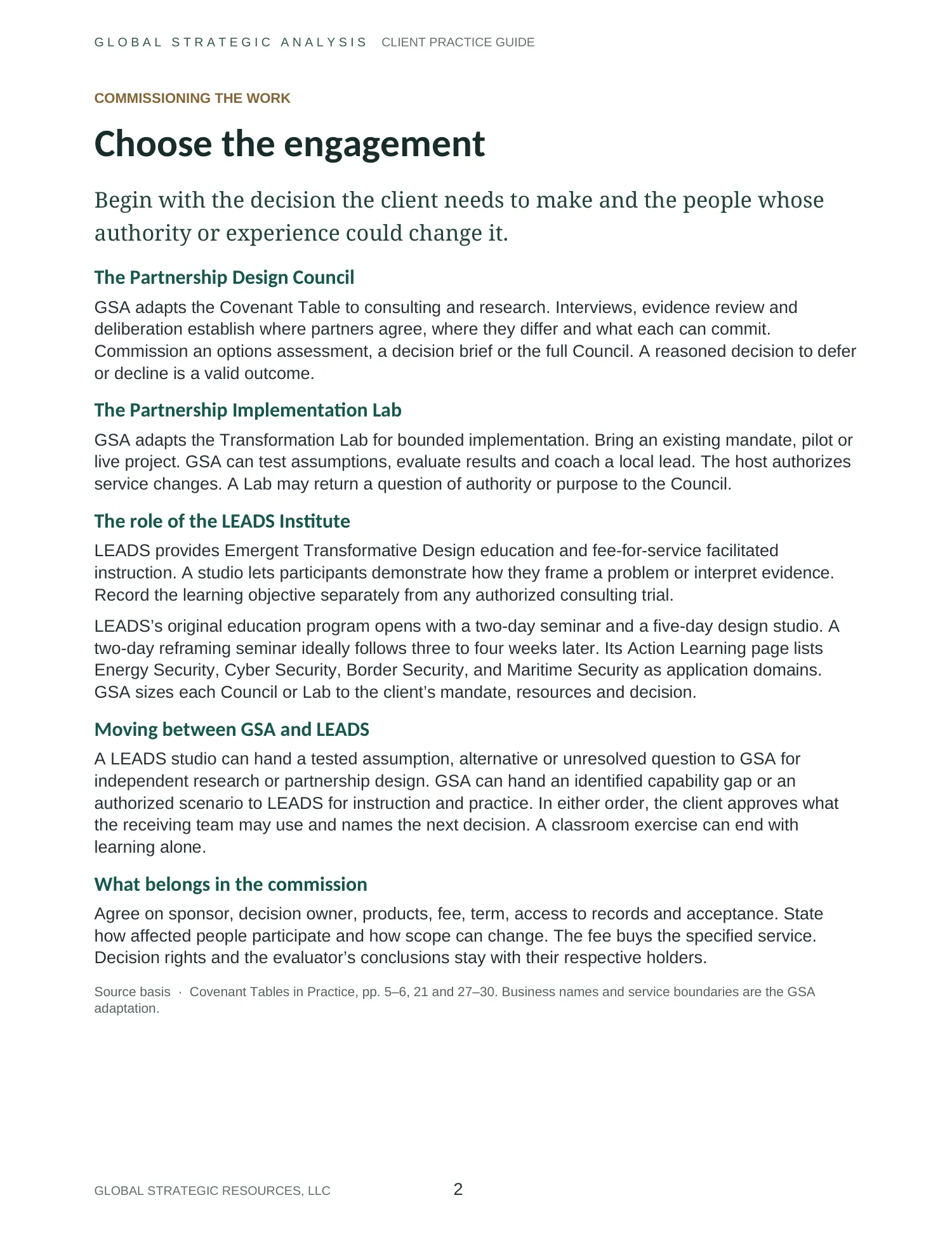
The Partnership Design Council
GSA adapts the Covenant Table to consulting and research. Interviews, evidence review and deliberation establish where partners agree, where they differ and what each can commit. Commission an options assessment, a decision brief or the full Council. A reasoned decision to defer or decline is a valid outcome.
The Partnership Implementation Lab
GSA adapts the Transformation Lab for bounded implementation. Bring an existing mandate, pilot or live project. GSA can test assumptions, evaluate results and coach a local lead. The host authorizes service changes. A Lab may return a question of authority or purpose to the Council.
The role of the LEADS Institute
LEADS provides Emergent Transformative Design education and fee-for-service facilitated instruction. A studio lets participants demonstrate how they frame a problem or interpret evidence. Record the learning objective separately from any authorized consulting trial.
LEADS’s original education program opens with a two-day seminar and a five-day design studio. A two-day reframing seminar ideally follows three to four weeks later. Its Action Learning page lists Energy Security, Cyber Security, Border Security, and Maritime Security as application domains. GSA sizes each Council or Lab to the client’s mandate, resources and decision.
Moving between GSA and LEADS
A LEADS studio can hand a tested assumption, alternative or unresolved question to GSA for independent research or partnership design. GSA can hand an identified capability gap or an authorized scenario to LEADS for instruction and practice. In either order, the client approves what the receiving team may use and names the next decision. A classroom exercise can end with learning alone.
What belongs in the commission
Agree on sponsor, decision owner, products, fee, term, access to records and acceptance. State how affected people participate and how scope can change. The fee buys the specified service. Decision rights and the evaluator’s conclusions stay with their respective holders.
Source basis · Covenant Tables in Practice, pp. 5–6, 21 and 27–30. Business names and service boundaries are the GSA adaptation.
Page 3 of 15
Read page 3 as text
G L O B A L S T R A T E G I C A N A L Y S I S CLIENT PRACTICE GUIDE
GLOBAL STRATEGIC RESOURCES, LLC 3
DESIGN COUNCIL / PREPARE Frame a question people can change
Start with a decision that matters to someone. Before drafting a solution,
speak with people who experience the difficulty and with the people who
operate the current arrangement.
Write a first question
Describe an observable condition, who experiences it, the relevant location or service, and how often it occurs. Mark assumptions in the sponsor’s account. Ask what explanation would also fit the facts, who would tell the story differently, and what evidence could distinguish the alternatives. Turn “Why will people not participate?” into “Which arrangements prevent or discourage participation, and for whom?”
Invite people with different standing
Recruit for lived experience, frontline knowledge, authority, resources and the ability to maintain an outcome. Ask each person whether they speak for themselves, their organization or a wider group, and who authorized that role. Identify people absent by choice or by exclusion. Offer an accessible alternate way to contribute, including confidential feedback. Budget time and participation support before asking for work.
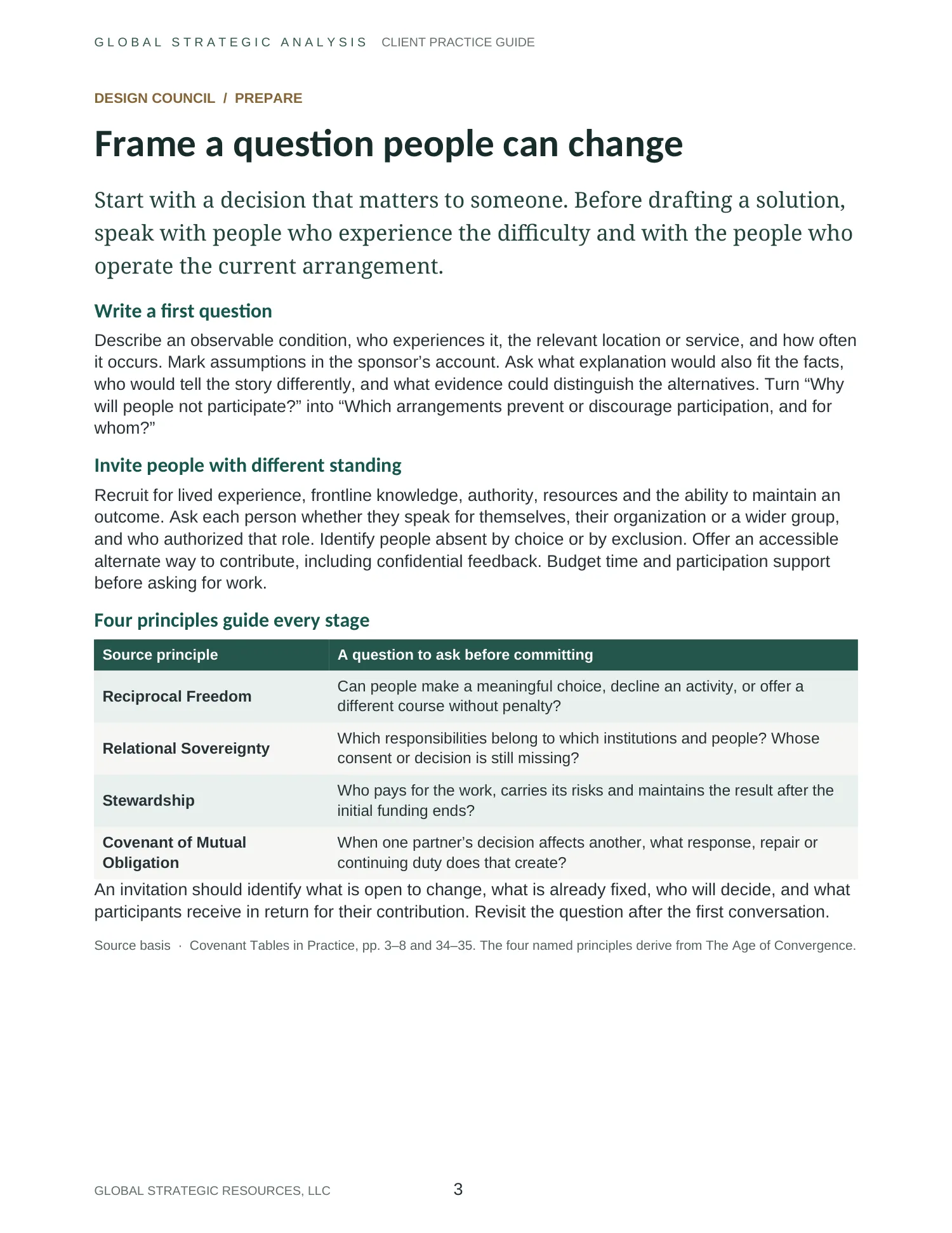
Four principles guide every stage
Source principle A question to ask before committing
Reciprocal Freedom Can people make a meaningful choice, decline an activity, or offer a different course without penalty?
Relational Sovereignty Which responsibilities belong to which institutions and people? Whose consent or decision is still missing?
Stewardship Who pays for the work, carries its risks and maintains the result after the initial funding ends?
Covenant of Mutual Obligation
When one partner’s decision affects another, what response, repair or continuing duty does that create?
An invitation should identify what is open to change, what is already fixed, who will decide, and what participants receive in return for their contribution. Revisit the question after the first conversation.
Source basis · Covenant Tables in Practice, pp. 3–8 and 34–35. The four named principles derive from The Age of Convergence.
Page 4 of 15
Read page 4 as text
G L O B A L S T R A T E G I C A N A L Y S I S CLIENT PRACTICE GUIDE
GLOBAL STRATEGIC RESOURCES, LLC 4
DESIGN COUNCIL / ORGANIZE Locate authority and capacity
An interested contact may identify a resource. Only the person with the
relevant authority can commit it.
Make the partnership visible
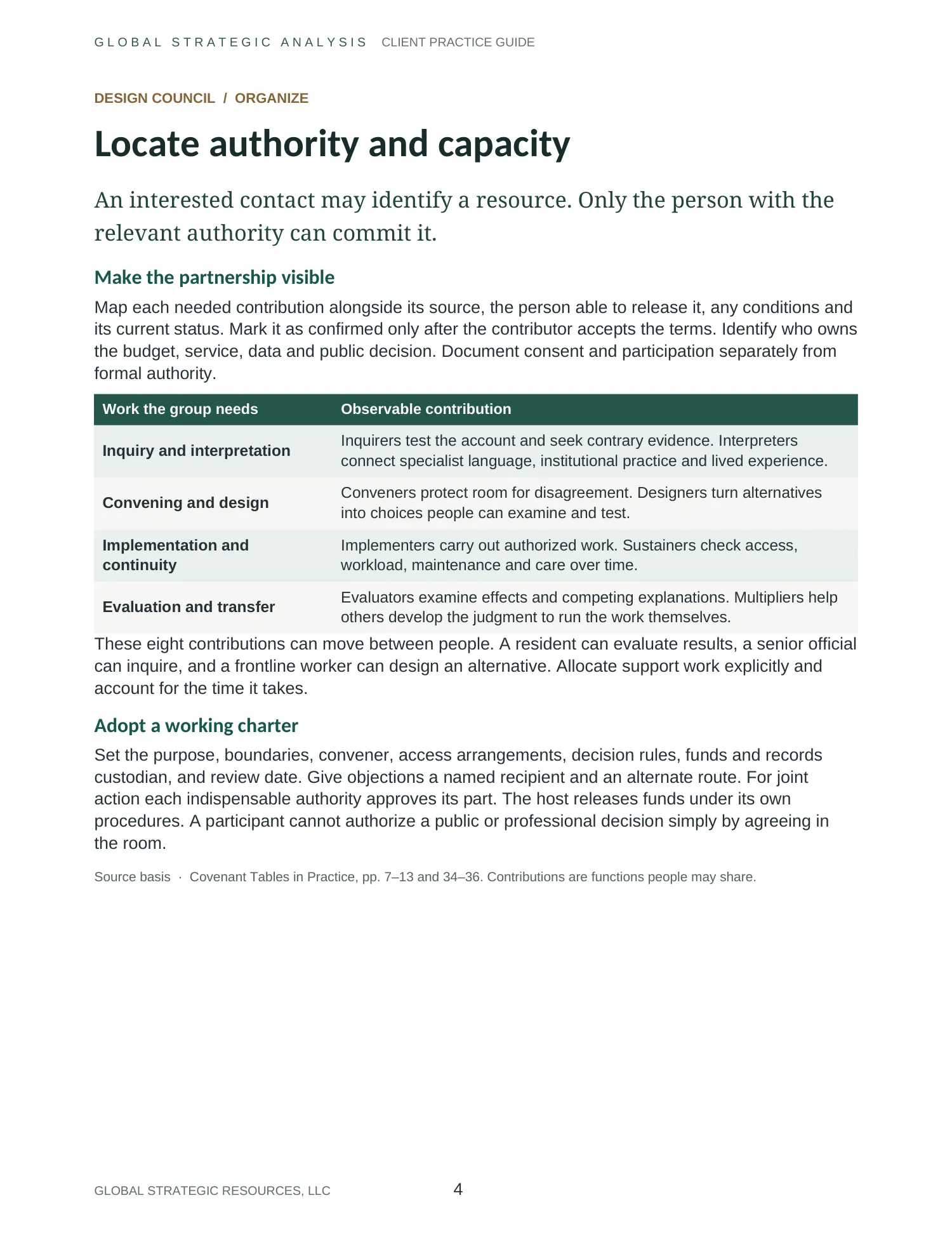
Map each needed contribution alongside its source, the person able to release it, any conditions and its current status. Mark it as confirmed only after the contributor accepts the terms. Identify who owns the budget, service, data and public decision. Document consent and participation separately from formal authority.
Work the group needs Observable contribution
Inquiry and interpretation Inquirers test the account and seek contrary evidence. Interpreters connect specialist language, institutional practice and lived experience.
Convening and design Conveners protect room for disagreement. Designers turn alternatives into choices people can examine and test.
Implementation and continuity
Implementers carry out authorized work. Sustainers check access, workload, maintenance and care over time.
Evaluation and transfer Evaluators examine effects and competing explanations. Multipliers help others develop the judgment to run the work themselves.
These eight contributions can move between people. A resident can evaluate results, a senior official can inquire, and a frontline worker can design an alternative. Allocate support work explicitly and account for the time it takes.
Adopt a working charter
Set the purpose, boundaries, convener, access arrangements, decision rules, funds and records custodian, and review date. Give objections a named recipient and an alternate route. For joint action each indispensable authority approves its part. The host releases funds under its own procedures. A participant cannot authorize a public or professional decision simply by agreeing in the room.
Source basis · Covenant Tables in Practice, pp. 7–13 and 34–36. Contributions are functions people may share.
Page 5 of 15
Read page 5 as text
G L O B A L S T R A T E G I C A N A L Y S I S CLIENT PRACTICE GUIDE
GLOBAL STRATEGIC RESOURCES, LLC 5
DESIGN COUNCIL / DELIBERATE Turn inquiry into a decision
Record the options people considered, the strongest objection and the
reasons the actual decision holder chose a course.
A first meeting
An initial ninety-minute conversation is one option. Open by asking affected participants to describe the difficulty in their own terms. Compare evidence and assumptions, identify missing voices, and let decision holders explain the limits of their authority. End with one modest next step, the person freely accepting it and the date on which others can see what happened. Allow enough time for interpretation and private objections.
Prepare an options brief
Give the decision holder the existing arrangement, one plausible alternative and a reasoned case for deferral. For each, identify people helped, people bearing costs, resources, uncertainties, dependencies and reversibility. Record disagreement in terms its author recognizes. Ask what evidence would change each advocate’s view. Give people time to correct the written account.
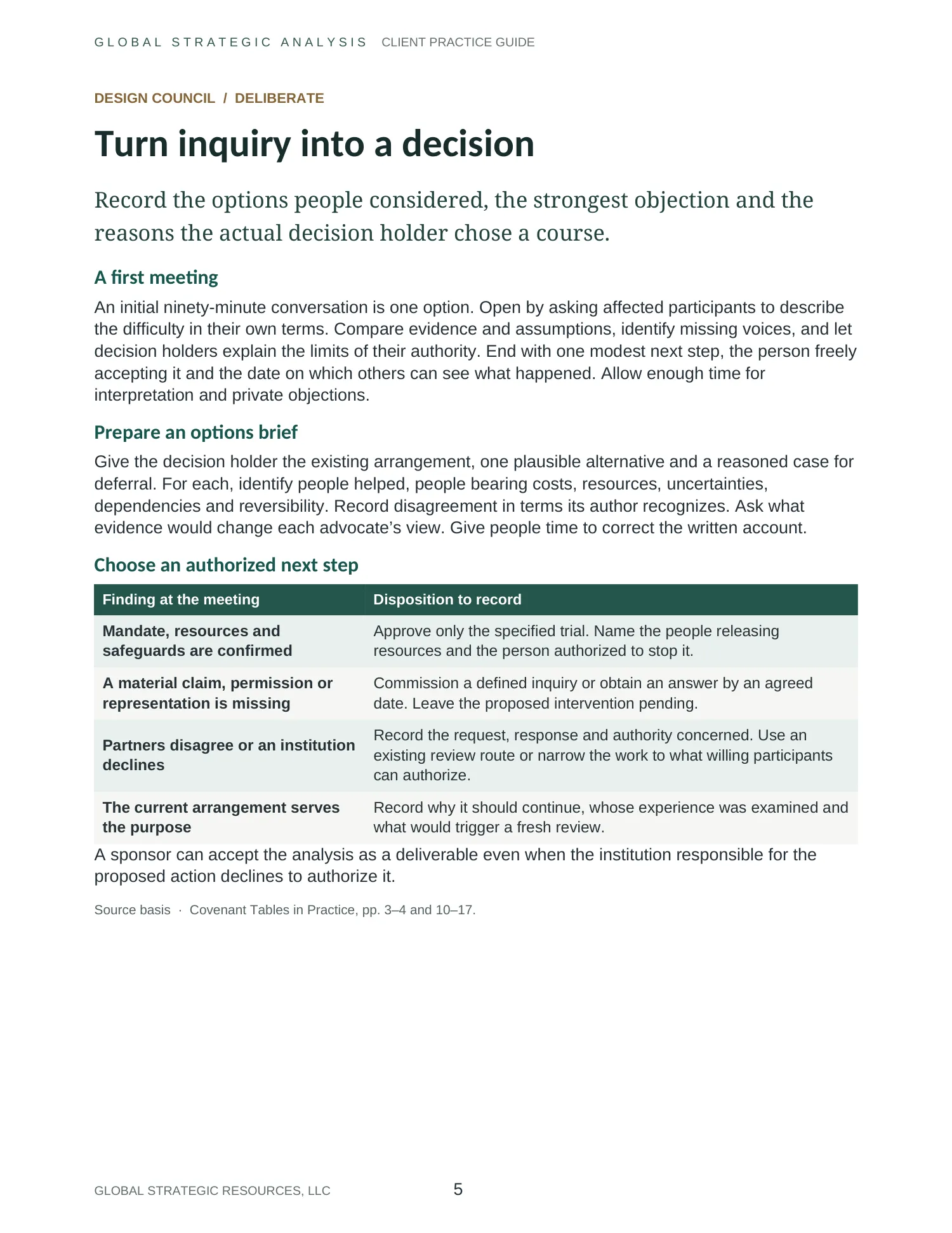
Choose an authorized next step
Finding at the meeting Disposition to record
Mandate, resources and safeguards are confirmed
Approve only the specified trial. Name the people releasing resources and the person authorized to stop it.
A material claim, permission or representation is missing
Commission a defined inquiry or obtain an answer by an agreed date. Leave the proposed intervention pending.
Partners disagree or an institution declines
Record the request, response and authority concerned. Use an existing review route or narrow the work to what willing participants can authorize.
The current arrangement serves the purpose
Record why it should continue, whose experience was examined and what would trigger a fresh review.
A sponsor can accept the analysis as a deliverable even when the institution responsible for the proposed action declines to authorize it.
Source basis · Covenant Tables in Practice, pp. 3–4 and 10–17.
Page 6 of 15
Read page 6 as text
G L O B A L S T R A T E G I C A N A L Y S I S CLIENT PRACTICE GUIDE
GLOBAL STRATEGIC RESOURCES, LLC 6
SHARED WORKING RECORD / TEMPLATE Using the Design-to-Delivery Brief
The Design-to-Delivery Brief connects LEADS education with GSA
consulting and research in either direction. Inside a GSA engagement it
also carries Council decisions into the Lab and returns evidence for
review.
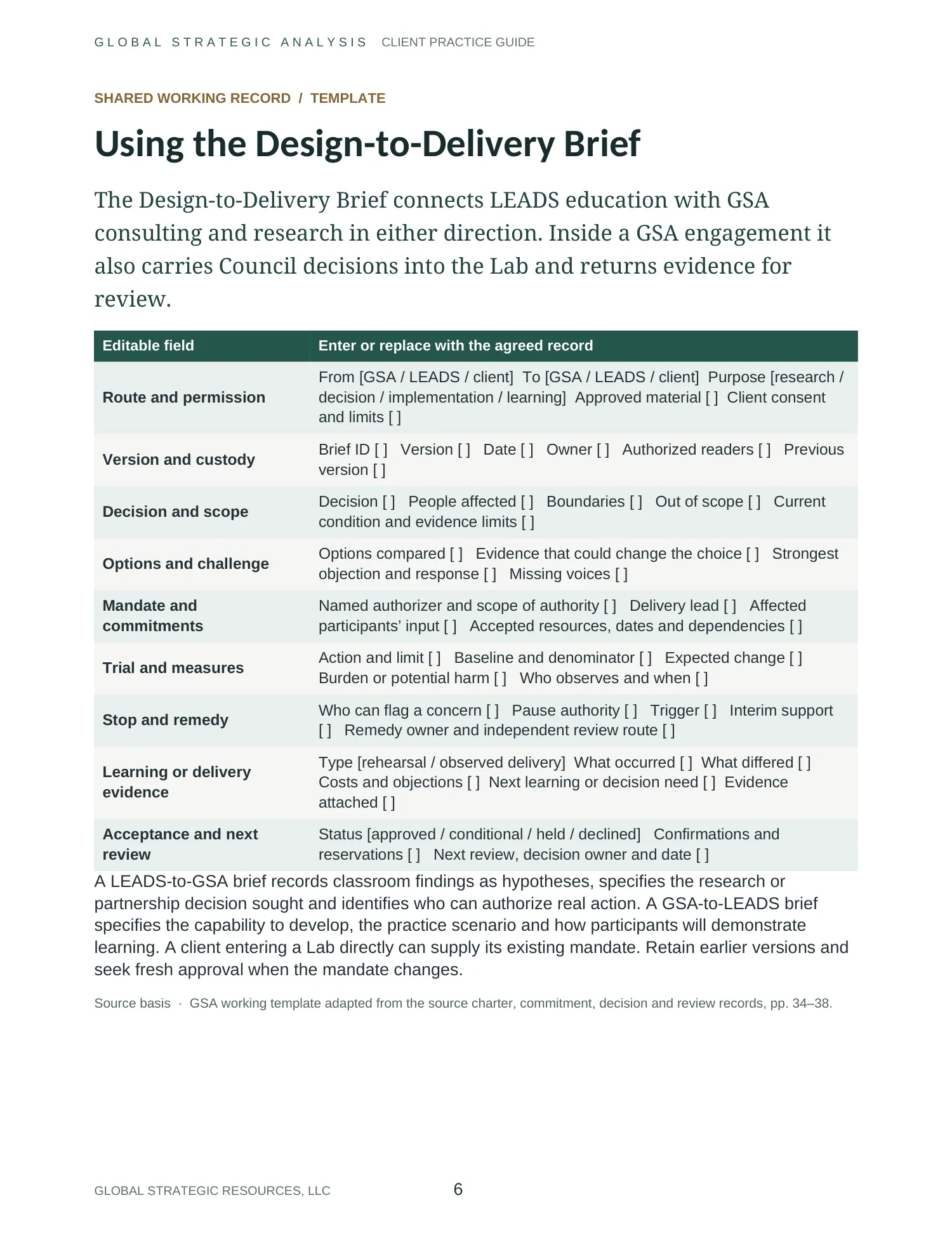
Editable field Enter or replace with the agreed record
Route and permission
From [GSA / LEADS / client] To [GSA / LEADS / client] Purpose [research / decision / implementation / learning] Approved material [ ] Client consent and limits [ ]
Version and custody Brief ID [ ] Version [ ] Date [ ] Owner [ ] Authorized readers [ ] Previous version [ ]
Decision and scope Decision [ ] People affected [ ] Boundaries [ ] Out of scope [ ] Current condition and evidence limits [ ]
Options and challenge Options compared [ ] Evidence that could change the choice [ ] Strongest objection and response [ ] Missing voices [ ]
Mandate and commitments
Named authorizer and scope of authority [ ] Delivery lead [ ] Affected participants’ input [ ] Accepted resources, dates and dependencies [ ]
Trial and measures Action and limit [ ] Baseline and denominator [ ] Expected change [ ] Burden or potential harm [ ] Who observes and when [ ]
Stop and remedy Who can flag a concern [ ] Pause authority [ ] Trigger [ ] Interim support [ ] Remedy owner and independent review route [ ]
Learning or delivery evidence
Type [rehearsal / observed delivery] What occurred [ ] What differed [ ] Costs and objections [ ] Next learning or decision need [ ] Evidence attached [ ]
Acceptance and next review
Status [approved / conditional / held / declined] Confirmations and reservations [ ] Next review, decision owner and date [ ]
A LEADS-to-GSA brief records classroom findings as hypotheses, specifies the research or partnership decision sought and identifies who can authorize real action. A GSA-to-LEADS brief specifies the capability to develop, the practice scenario and how participants will demonstrate learning. A client entering a Lab directly can supply its existing mandate. Retain earlier versions and seek fresh approval when the mandate changes.
Source basis · GSA working template adapted from the source charter, commitment, decision and review records, pp. 34–38.
Page 7 of 15
Read page 7 as text
G L O B A L S T R A T E G I C A N A L Y S I S CLIENT PRACTICE GUIDE
GLOBAL STRATEGIC RESOURCES, LLC 7
IMPLEMENTATION LAB / TEST Run a bounded trial
A credible first test is small enough to stop and consequential enough to
tell the decision holder something they could not learn from another
meeting.
Check readiness at the point of action
The delivery lead verifies the authorized population, dates, staff, cash, access to information, comparison or baseline, pause triggers and remedy. Ask a frontline operator and an affected participant to walk through the proposed change. Rehearsal can expose an inaccessible step, an unworkable handoff or a missing permission before anyone is asked to rely on it.
Separate execution failure from a faulty assumption
For every attempt record what was meant to happen, what actually happened, and which conditions differed. A missed handoff may call for a revised procedure. A perfectly executed procedure can also reveal that the initial explanation was wrong. Ask people who received no benefit and people who withdrew. Preserve contrary accounts and dates before revising the method.
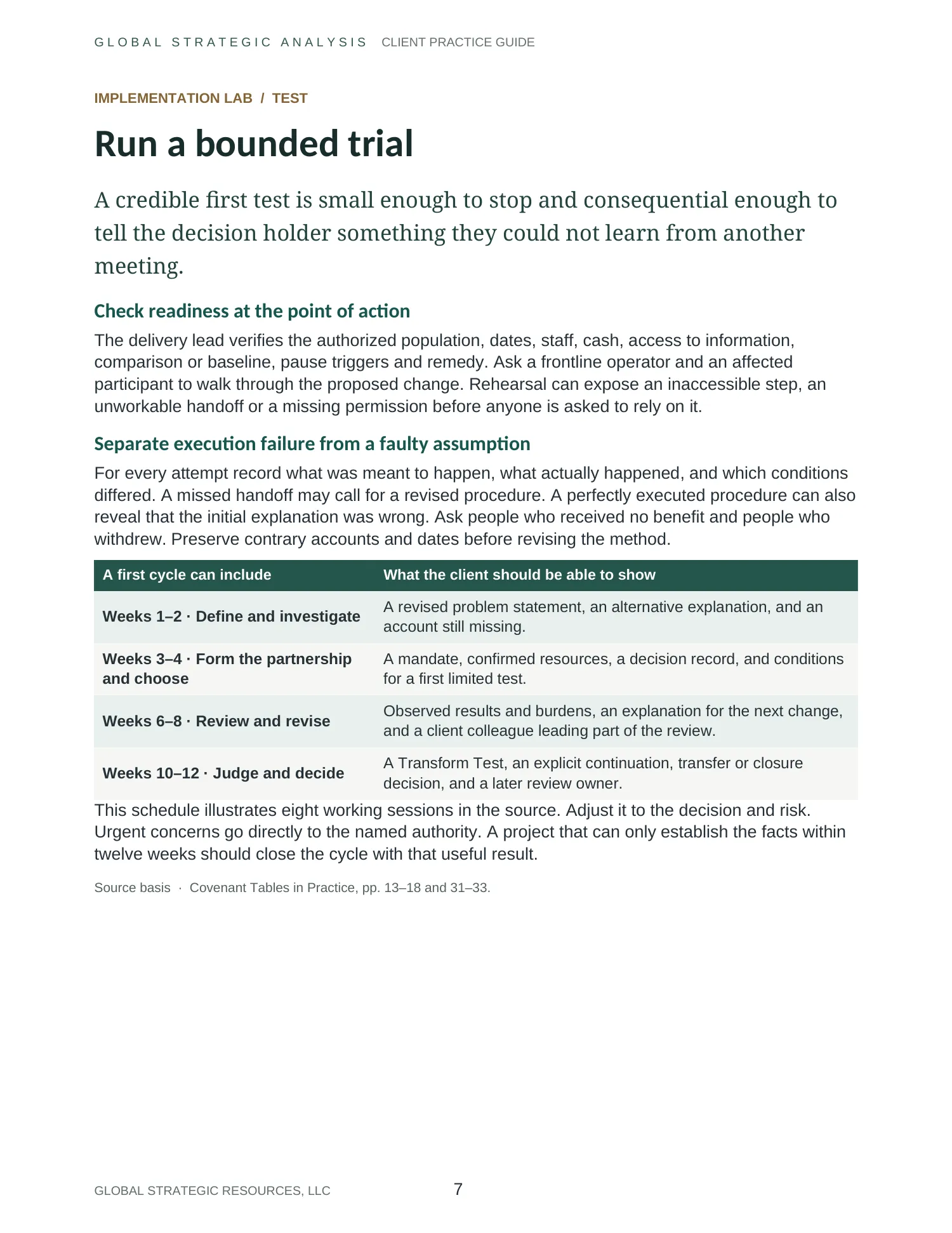
A first cycle can include What the client should be able to show
Weeks 1–2 · Define and investigate A revised problem statement, an alternative explanation, and an account still missing.
Weeks 3–4 · Form the partnership and choose
A mandate, confirmed resources, a decision record, and conditions for a first limited test.
Weeks 6–8 · Review and revise Observed results and burdens, an explanation for the next change, and a client colleague leading part of the review.
Weeks 10–12 · Judge and decide A Transform Test, an explicit continuation, transfer or closure decision, and a later review owner.
This schedule illustrates eight working sessions in the source. Adjust it to the decision and risk. Urgent concerns go directly to the named authority. A project that can only establish the facts within twelve weeks should close the cycle with that useful result.
Source basis · Covenant Tables in Practice, pp. 13–18 and 31–33.
Page 8 of 15
Read page 8 as text
G L O B A L S T R A T E G I C A N A L Y S I S CLIENT PRACTICE GUIDE
GLOBAL STRATEGIC RESOURCES, LLC 8
DELIVERY STEWARDSHIP Finance the work and transfer the capability
A partner can contribute time, language access, a room, trusted
relationships or decision authority. A resource belongs in the working
budget when its holder confirms the terms.
Count the cost people actually face
Separate meeting and research costs from implementation, participation support, maintenance and closure. Include staff preparation, interpretation, transport or scheduling support, recordkeeping and independent review. Record cash, in-kind commitments and unconfirmed offers separately. If a small team meets eight times, multiply the meeting hours by the number of participants. Discuss who can reasonably absorb the resulting cost.
Identify the financial host, spending limit, authorized purchaser, and the person who reconciles the record. Ask what will happen when a grant, seconded post or donated venue ends. Disclose interests in suppliers and evaluators. Accept specialist finance, procurement or technical advice from someone with the relevant responsibility when the work requires it.
Hand over judgment as well as documents
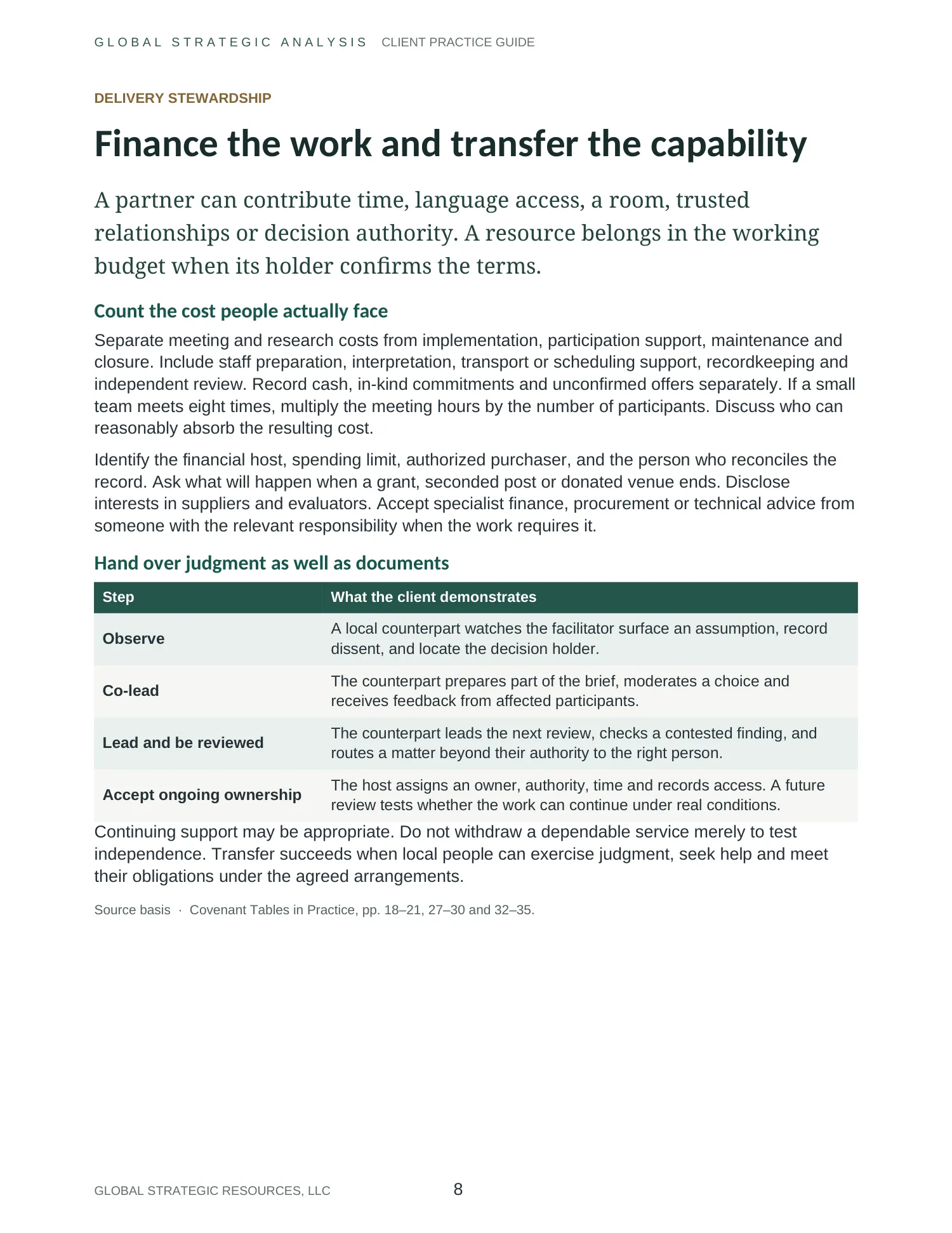
Step What the client demonstrates
Observe A local counterpart watches the facilitator surface an assumption, record dissent, and locate the decision holder.
Co-lead The counterpart prepares part of the brief, moderates a choice and receives feedback from affected participants.
Lead and be reviewed The counterpart leads the next review, checks a contested finding, and routes a matter beyond their authority to the right person.
Accept ongoing ownership The host assigns an owner, authority, time and records access. A future review tests whether the work can continue under real conditions.
Continuing support may be appropriate. Do not withdraw a dependable service merely to test independence. Transfer succeeds when local people can exercise judgment, seek help and meet their obligations under the agreed arrangements.
Source basis · Covenant Tables in Practice, pp. 18–21, 27–30 and 32–35.
Page 9 of 15
Read page 9 as text
G L O B A L S T R A T E G I C A N A L Y S I S CLIENT PRACTICE GUIDE
GLOBAL STRATEGIC RESOURCES, LLC 9
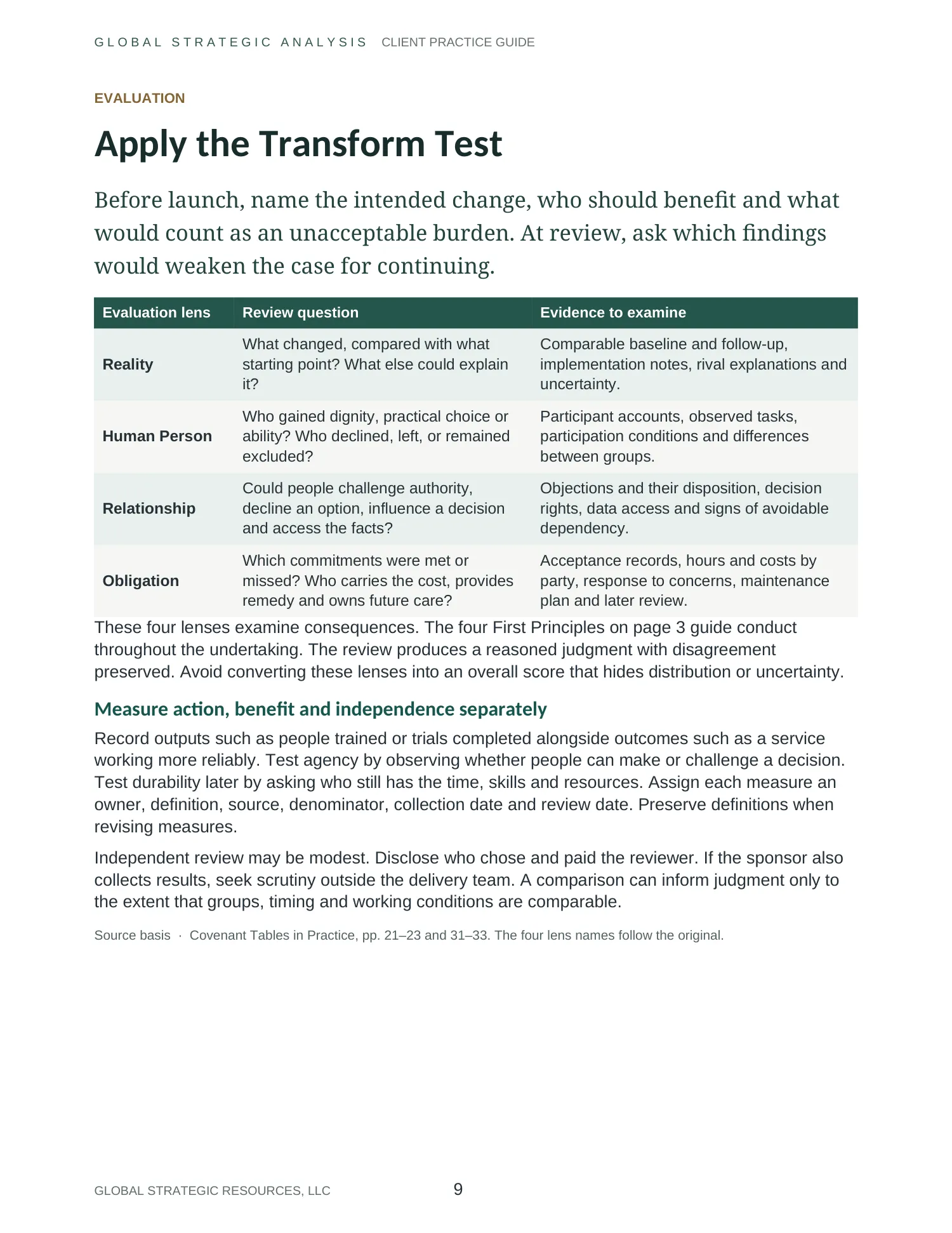
EVALUATION Apply the Transform Test
Before launch, name the intended change, who should benefit and what
would count as an unacceptable burden. At review, ask which findings
would weaken the case for continuing.
Evaluation lens Review question Evidence to examine
Reality
What changed, compared with what starting point? What else could explain it?
Comparable baseline and follow-up, implementation notes, rival explanations and uncertainty.
Human Person
Who gained dignity, practical choice or ability? Who declined, left, or remained excluded?
Participant accounts, observed tasks, participation conditions and differences between groups.
Relationship
Could people challenge authority, decline an option, influence a decision and access the facts?
Objections and their disposition, decision rights, data access and signs of avoidable dependency.
Obligation
Which commitments were met or missed? Who carries the cost, provides remedy and owns future care?
Acceptance records, hours and costs by party, response to concerns, maintenance plan and later review.
These four lenses examine consequences. The four First Principles on page 3 guide conduct throughout the undertaking. The review produces a reasoned judgment with disagreement preserved. Avoid converting these lenses into an overall score that hides distribution or uncertainty.
Measure action, benefit and independence separately
Record outputs such as people trained or trials completed alongside outcomes such as a service working more reliably. Test agency by observing whether people can make or challenge a decision. Test durability later by asking who still has the time, skills and resources. Assign each measure an owner, definition, source, denominator, collection date and review date. Preserve definitions when revising measures.
Independent review may be modest. Disclose who chose and paid the reviewer. If the sponsor also collects results, seek scrutiny outside the delivery team. A comparison can inform judgment only to the extent that groups, timing and working conditions are comparable.
Source basis · Covenant Tables in Practice, pp. 21–23 and 31–33. The four lens names follow the original.
Page 10 of 15
Read page 10 as text
G L O B A L S T R A T E G I C A N A L Y S I S CLIENT PRACTICE GUIDE
GLOBAL STRATEGIC RESOURCES, LLC 10
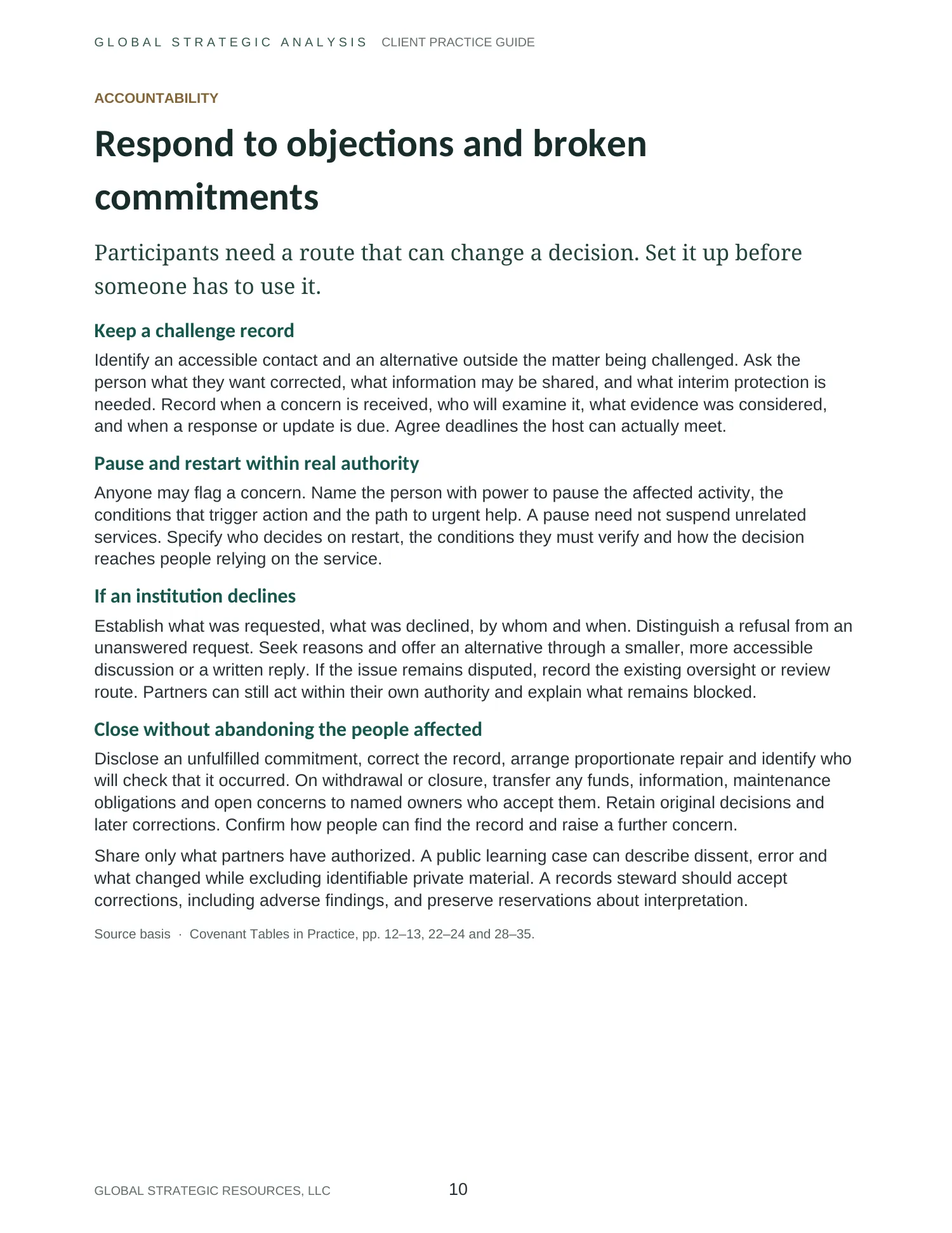
ACCOUNTABILITY Respond to objections and broken commitments
Participants need a route that can change a decision. Set it up before
someone has to use it.
Keep a challenge record
Identify an accessible contact and an alternative outside the matter being challenged. Ask the person what they want corrected, what information may be shared, and what interim protection is needed. Record when a concern is received, who will examine it, what evidence was considered, and when a response or update is due. Agree deadlines the host can actually meet.
Pause and restart within real authority
Anyone may flag a concern. Name the person with power to pause the affected activity, the conditions that trigger action and the path to urgent help. A pause need not suspend unrelated services. Specify who decides on restart, the conditions they must verify and how the decision reaches people relying on the service.
If an institution declines
Establish what was requested, what was declined, by whom and when. Distinguish a refusal from an unanswered request. Seek reasons and offer an alternative through a smaller, more accessible discussion or a written reply. If the issue remains disputed, record the existing oversight or review route. Partners can still act within their own authority and explain what remains blocked.
Close without abandoning the people affected
Disclose an unfulfilled commitment, correct the record, arrange proportionate repair and identify who will check that it occurred. On withdrawal or closure, transfer any funds, information, maintenance obligations and open concerns to named owners who accept them. Retain original decisions and later corrections. Confirm how people can find the record and raise a further concern.
Share only what partners have authorized. A public learning case can describe dissent, error and what changed while excluding identifiable private material. A records steward should accept corrections, including adverse findings, and preserve reservations about interpretation.
Source basis · Covenant Tables in Practice, pp. 12–13, 22–24 and 28–35.
Page 11 of 15
Read page 11 as text
G L O B A L S T R A T E G I C A N A L Y S I S CLIENT PRACTICE GUIDE
GLOBAL STRATEGIC RESOURCES, LLC 11
WORKED EXAMPLE / ILLUSTRATIVE When a booked room stays locked
This constructed example shows how a partnership design decision can
be tested and revised. The organizations, events, figures and results are
invented for instruction.
The question changes
A library district, a facilities team and neighborhood organizers use the same rooms for evening meetings. A sponsor describes repeated delays as organizers arriving late. An organizer produces a booking confirmation showing the stated arrival time. A desk employee describes a different problem. A booking can be confirmed before anyone accepts responsibility for opening the room. Some organizers have limited access to the district’s digital notices.
The Council changes the question. For confirmed evening bookings, how often can the organizer enter the room within ten minutes of the promised opening time, and who owns the handoff when they cannot? It invites organizers from two neighborhoods, staff on the late shift, the booking manager and facilities supervisor. One organizer sends comments privately rather than attending.
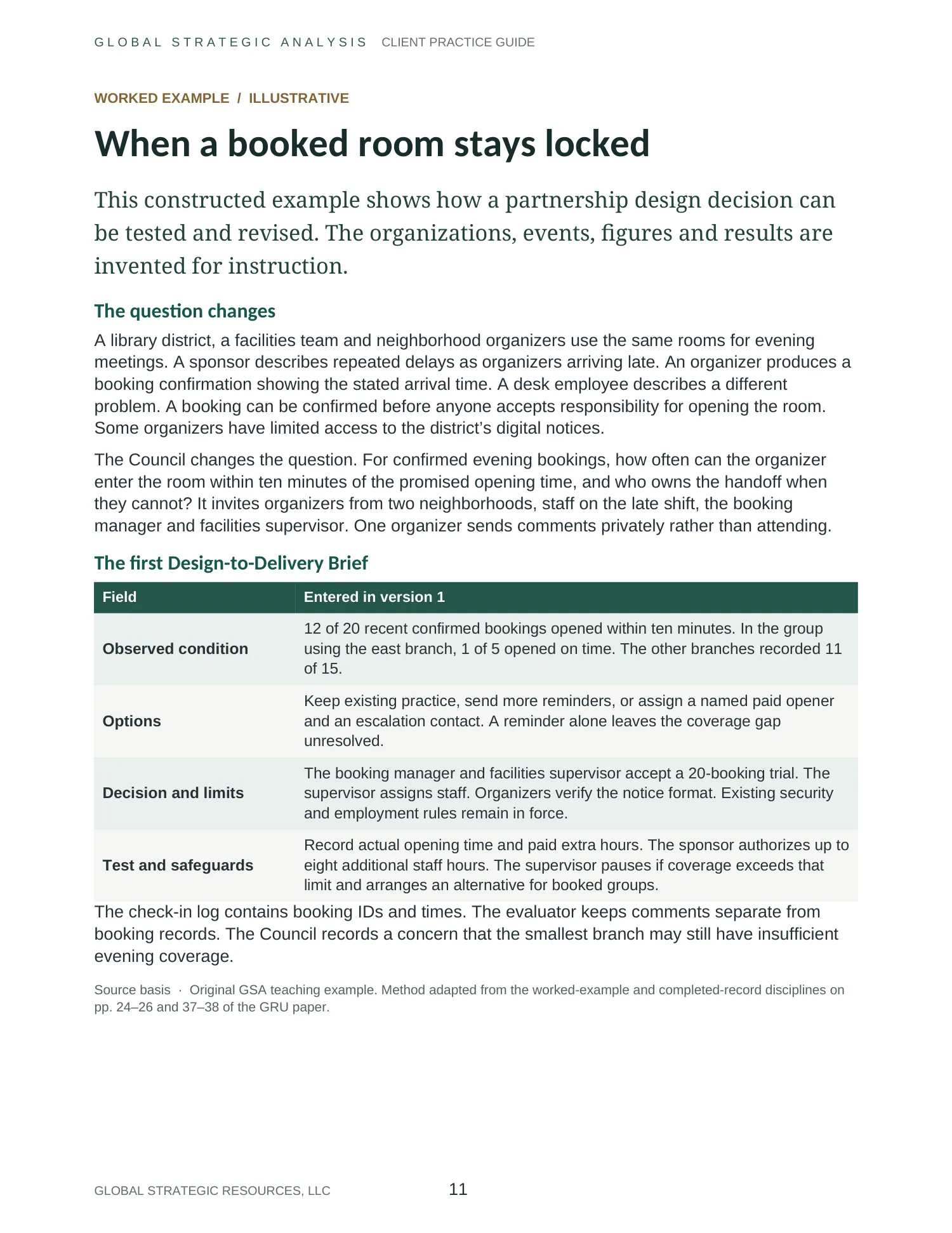
The first Design-to-Delivery Brief
Field Entered in version 1
Observed condition
12 of 20 recent confirmed bookings opened within ten minutes. In the group using the east branch, 1 of 5 opened on time. The other branches recorded 11 of 15.
Options
Keep existing practice, send more reminders, or assign a named paid opener and an escalation contact. A reminder alone leaves the coverage gap unresolved.
Decision and limits
The booking manager and facilities supervisor accept a 20-booking trial. The supervisor assigns staff. Organizers verify the notice format. Existing security and employment rules remain in force.
Test and safeguards
Record actual opening time and paid extra hours. The sponsor authorizes up to eight additional staff hours. The supervisor pauses if coverage exceeds that limit and arranges an alternative for booked groups.
The check-in log contains booking IDs and times. The evaluator keeps comments separate from booking records. The Council records a concern that the smallest branch may still have insufficient evening coverage.
Source basis · Original GSA teaching example. Method adapted from the worked-example and completed-record disciplines on pp. 24–26 and 37–38 of the GRU paper.
Page 12 of 15
Read page 12 as text
G L O B A L S T R A T E G I C A N A L Y S I S CLIENT PRACTICE GUIDE
GLOBAL STRATEGIC RESOURCES, LLC 12
WORKED EXAMPLE / ILLUSTRATIVE What the trial sends back
All observations below belong to the same constructed example. They
illustrate a decision process and establish no consulting results.
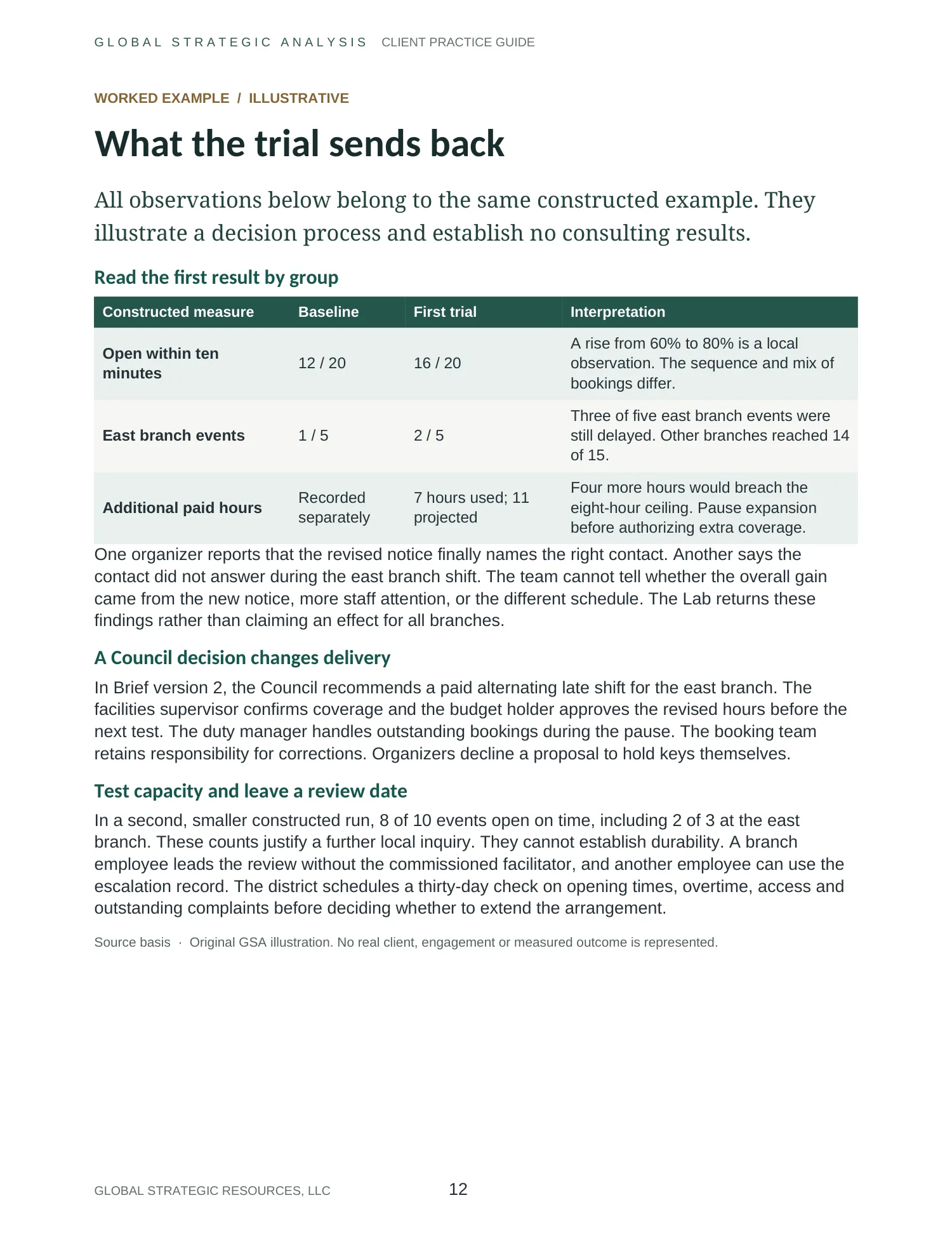
Read the first result by group
Constructed measure Baseline First trial Interpretation
Open within ten minutes 12 / 20 16 / 20
A rise from 60% to 80% is a local observation. The sequence and mix of bookings differ.
East branch events 1 / 5 2 / 5
Three of five east branch events were still delayed. Other branches reached 14 of 15.
Additional paid hours Recorded separately
7 hours used; 11 projected
Four more hours would breach the eight-hour ceiling. Pause expansion before authorizing extra coverage.
One organizer reports that the revised notice finally names the right contact. Another says the contact did not answer during the east branch shift. The team cannot tell whether the overall gain came from the new notice, more staff attention, or the different schedule. The Lab returns these findings rather than claiming an effect for all branches.
A Council decision changes delivery
In Brief version 2, the Council recommends a paid alternating late shift for the east branch. The facilities supervisor confirms coverage and the budget holder approves the revised hours before the next test. The duty manager handles outstanding bookings during the pause. The booking team retains responsibility for corrections. Organizers decline a proposal to hold keys themselves.
Test capacity and leave a review date
In a second, smaller constructed run, 8 of 10 events open on time, including 2 of 3 at the east branch. These counts justify a further local inquiry. They cannot establish durability. A branch employee leads the review without the commissioned facilitator, and another employee can use the escalation record. The district schedules a thirty-day check on opening times, overtime, access and outstanding complaints before deciding whether to extend the arrangement.
Source basis · Original GSA illustration. No real client, engagement or measured outcome is represented.
Page 13 of 15
Read page 13 as text
G L O B A L S T R A T E G I C A N A L Y S I S CLIENT PRACTICE GUIDE
GLOBAL STRATEGIC RESOURCES, LLC 13
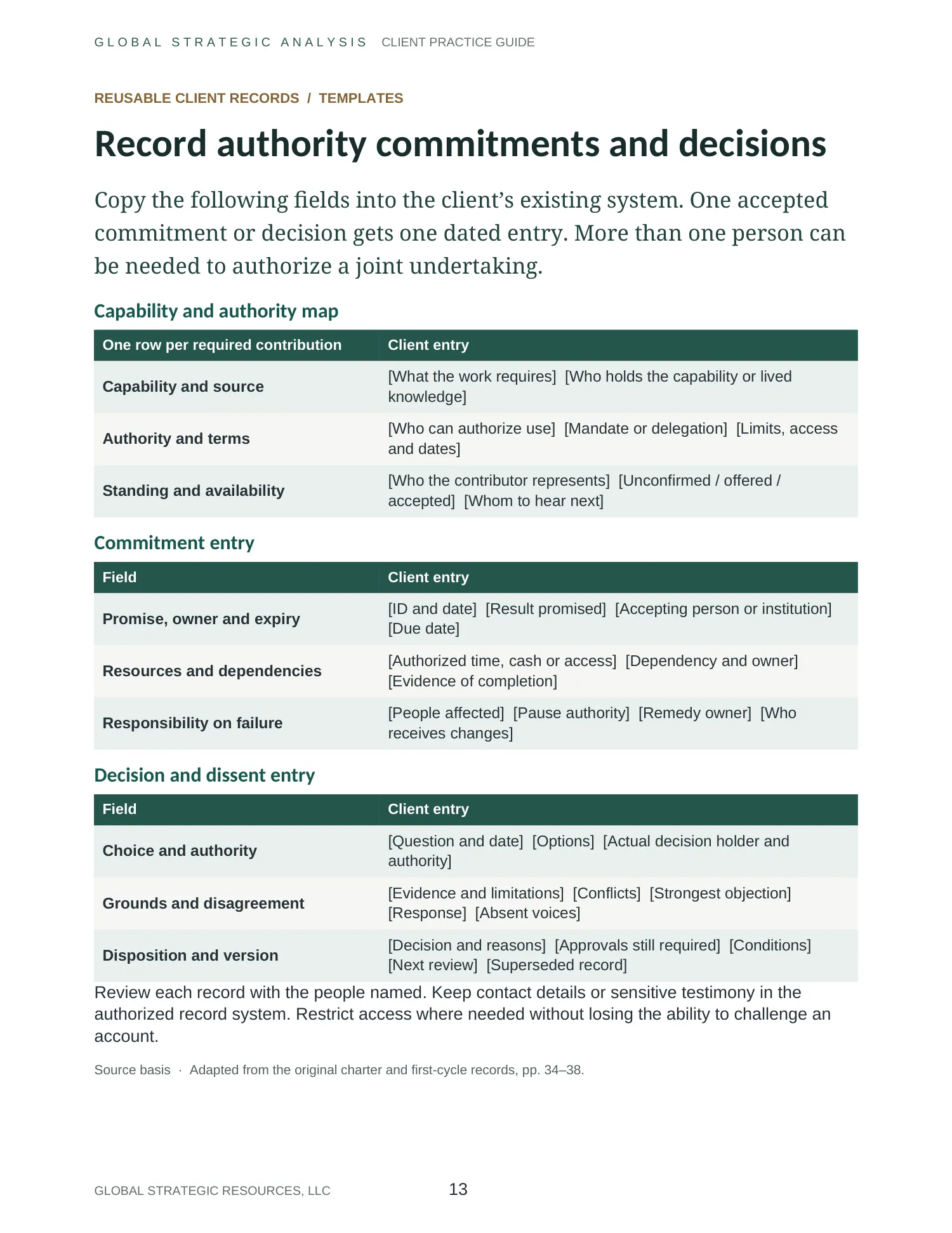
REUSABLE CLIENT RECORDS / TEMPLATES Record authority commitments and decisions
Copy the following fields into the client’s existing system. One accepted
commitment or decision gets one dated entry. More than one person can
be needed to authorize a joint undertaking.
Capability and authority map
One row per required contribution Client entry
Capability and source [What the work requires] [Who holds the capability or lived knowledge]
Authority and terms [Who can authorize use] [Mandate or delegation] [Limits, access and dates]
Standing and availability [Who the contributor represents] [Unconfirmed / offered / accepted] [Whom to hear next]
Commitment entry
Field Client entry
Promise, owner and expiry [ID and date] [Result promised] [Accepting person or institution] [Due date]
Resources and dependencies [Authorized time, cash or access] [Dependency and owner] [Evidence of completion]
Responsibility on failure [People affected] [Pause authority] [Remedy owner] [Who receives changes]
Decision and dissent entry
Field Client entry
Choice and authority [Question and date] [Options] [Actual decision holder and authority]
Grounds and disagreement [Evidence and limitations] [Conflicts] [Strongest objection] [Response] [Absent voices]
Disposition and version [Decision and reasons] [Approvals still required] [Conditions] [Next review] [Superseded record]
Review each record with the people named. Keep contact details or sensitive testimony in the authorized record system. Restrict access where needed without losing the ability to challenge an account.
Source basis · Adapted from the original charter and first-cycle records, pp. 34–38.
Page 14 of 15
Read page 14 as text
G L O B A L S T R A T E G I C A N A L Y S I S CLIENT PRACTICE GUIDE
GLOBAL STRATEGIC RESOURCES, LLC 14
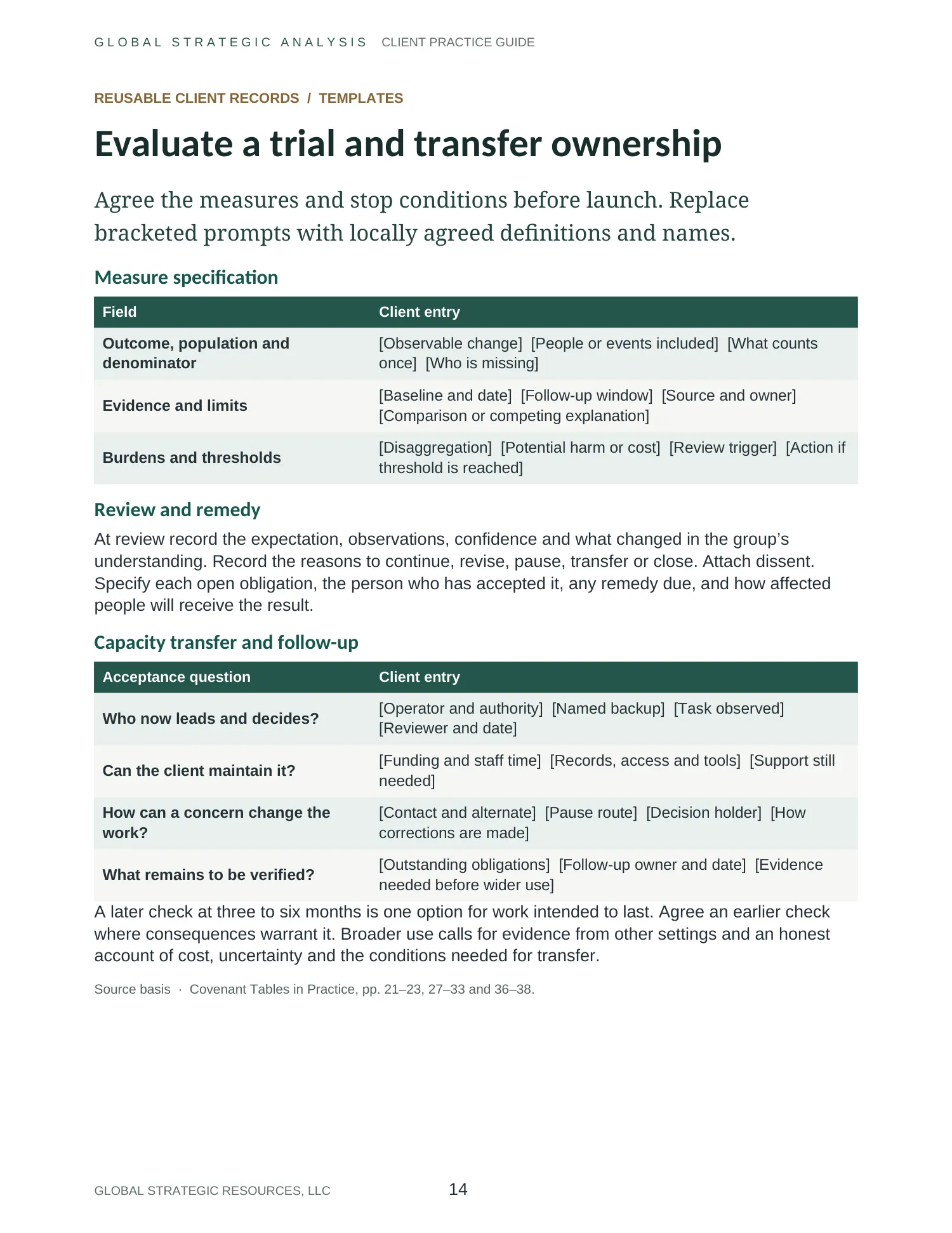
REUSABLE CLIENT RECORDS / TEMPLATES Evaluate a trial and transfer ownership
Agree the measures and stop conditions before launch. Replace
bracketed prompts with locally agreed definitions and names.
Measure specification
Field Client entry
Outcome, population and denominator
[Observable change] [People or events included] [What counts once] [Who is missing]
Evidence and limits [Baseline and date] [Follow-up window] [Source and owner] [Comparison or competing explanation]
Burdens and thresholds [Disaggregation] [Potential harm or cost] [Review trigger] [Action if threshold is reached]
Review and remedy
At review record the expectation, observations, confidence and what changed in the group’s understanding. Record the reasons to continue, revise, pause, transfer or close. Attach dissent. Specify each open obligation, the person who has accepted it, any remedy due, and how affected people will receive the result.
Capacity transfer and follow-up
Acceptance question Client entry
Who now leads and decides? [Operator and authority] [Named backup] [Task observed] [Reviewer and date]
Can the client maintain it? [Funding and staff time] [Records, access and tools] [Support still needed]
How can a concern change the work?
[Contact and alternate] [Pause route] [Decision holder] [How corrections are made]
What remains to be verified? [Outstanding obligations] [Follow-up owner and date] [Evidence needed before wider use]
A later check at three to six months is one option for work intended to last. Agree an earlier check where consequences warrant it. Broader use calls for evidence from other settings and an honest account of cost, uncertainty and the conditions needed for transfer.
Source basis · Covenant Tables in Practice, pp. 21–23, 27–33 and 36–38.
Page 15 of 15
Read page 15 as text
G L O B A L S T R A T E G I C A N A L Y S I S CLIENT PRACTICE GUIDE
GLOBAL STRATEGIC RESOURCES, LLC 15
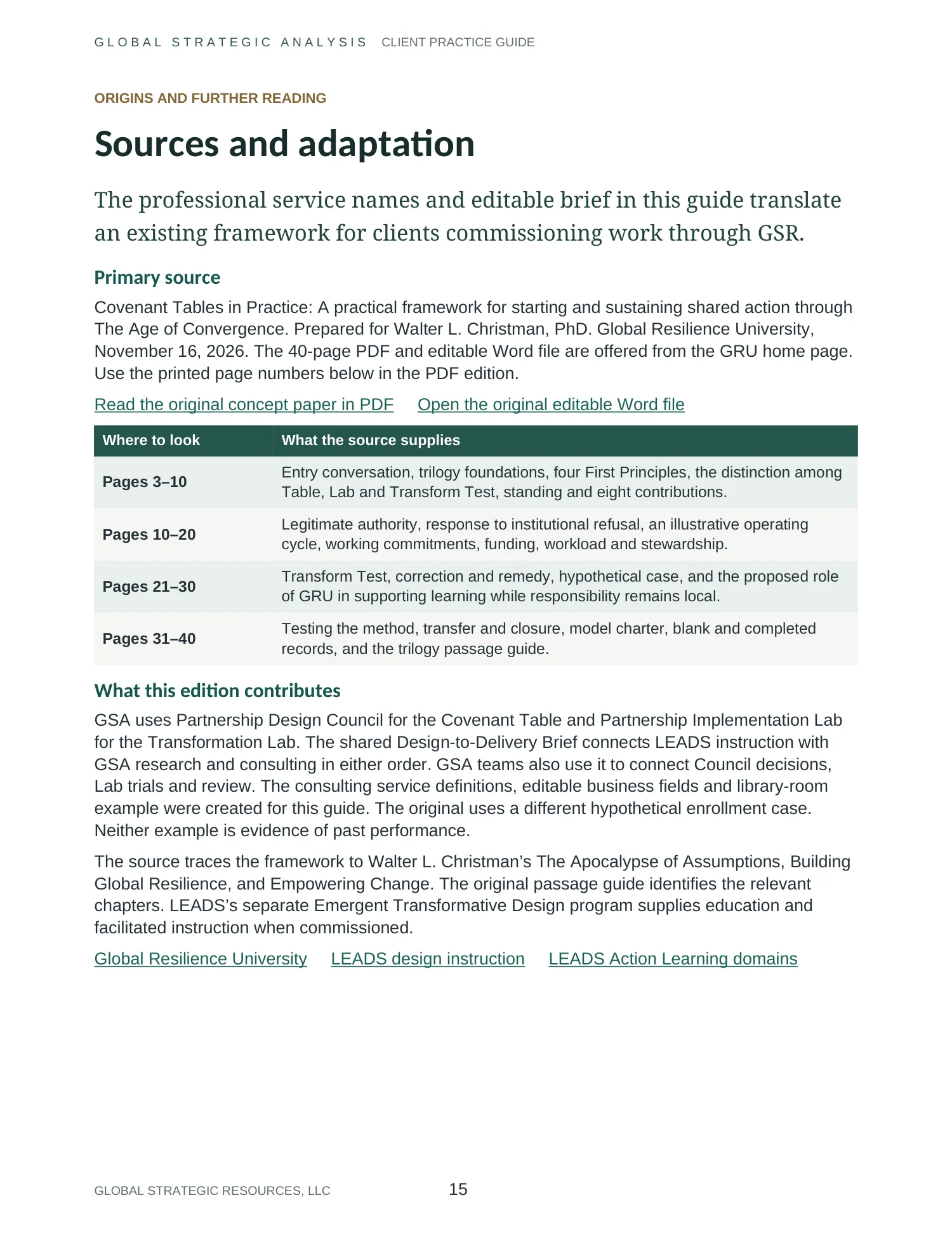
ORIGINS AND FURTHER READING Sources and adaptation
The professional service names and editable brief in this guide translate
an existing framework for clients commissioning work through GSR.
Primary source
Covenant Tables in Practice: A practical framework for starting and sustaining shared action through The Age of Convergence. Prepared for Walter L. Christman, PhD. Global Resilience University, November 16, 2026. The 40-page PDF and editable Word file are offered from the GRU home page. Use the printed page numbers below in the PDF edition.
Read the original concept paper in PDF Open the original editable Word file
Where to look What the source supplies
Pages 3–10 Entry conversation, trilogy foundations, four First Principles, the distinction among Table, Lab and Transform Test, standing and eight contributions.
Pages 10–20 Legitimate authority, response to institutional refusal, an illustrative operating cycle, working commitments, funding, workload and stewardship.
Pages 21–30 Transform Test, correction and remedy, hypothetical case, and the proposed role of GRU in supporting learning while responsibility remains local.
Pages 31–40 Testing the method, transfer and closure, model charter, blank and completed records, and the trilogy passage guide.
What this edition contributes
GSA uses Partnership Design Council for the Covenant Table and Partnership Implementation Lab for the Transformation Lab. The shared Design-to-Delivery Brief connects LEADS instruction with GSA research and consulting in either order. GSA teams also use it to connect Council decisions, Lab trials and review. The consulting service definitions, editable business fields and library-room example were created for this guide. The original uses a different hypothetical enrollment case. Neither example is evidence of past performance.
The source traces the framework to Walter L. Christman’s The Apocalypse of Assumptions, Building Global Resilience, and Empowering Change. The original passage guide identifies the relevant chapters. LEADS’s separate Emergent Transformative Design program supplies education and facilitated instruction when commissioned.
Global Resilience University LEADS design instruction LEADS Action Learning domains