

Naval Postgraduate School · Fall 2013
Global Change and International Governance
Walter Christman’s syllabus for Global Public Policy 3100 includes the course objectives, reading schedule and assignments.
Page 1 of 14
Read page 1 as text
1
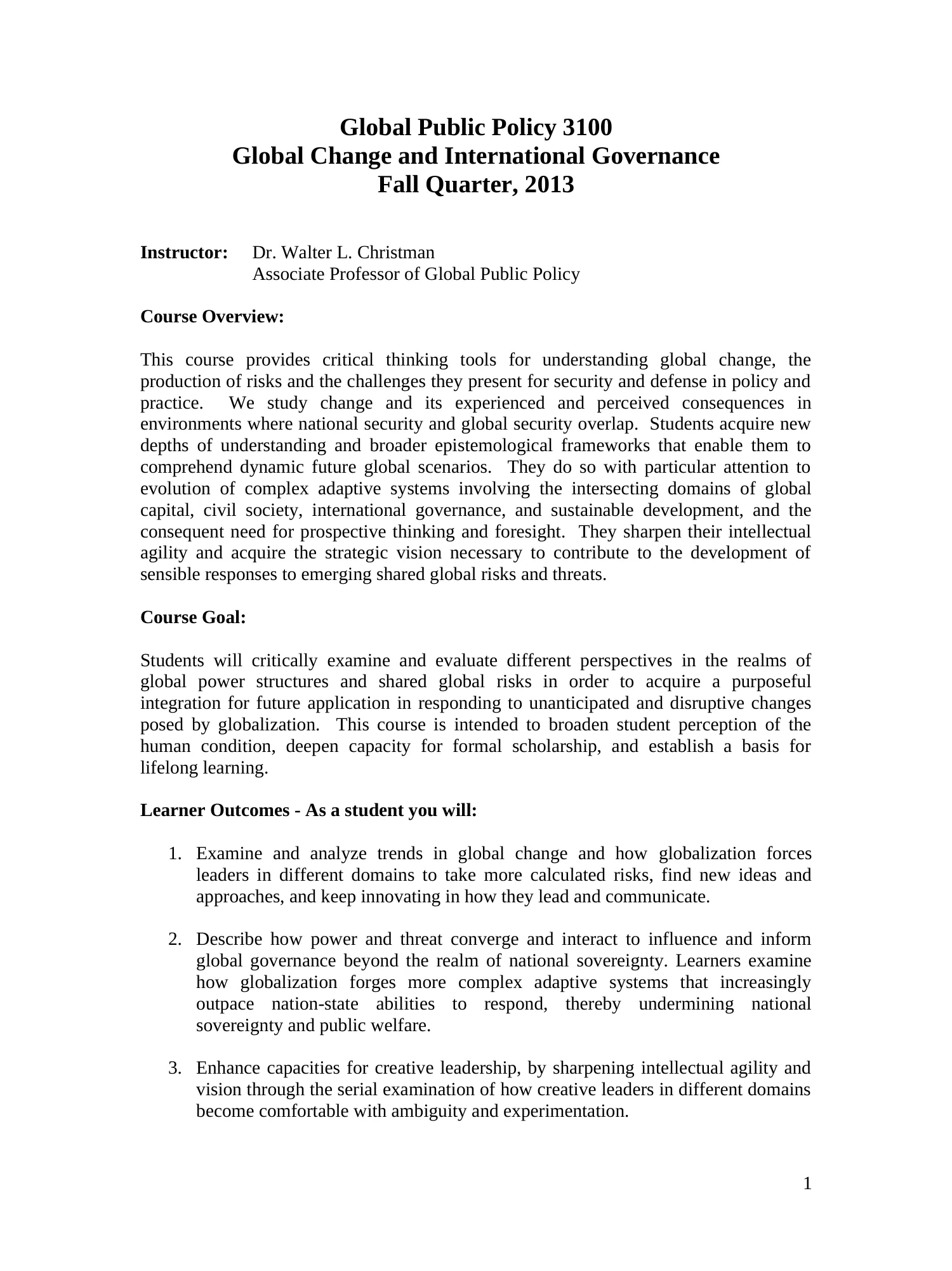
Global Public Policy 3100 Global Change and International Governance
Fall Quarter, 2013
Instructor: Dr. Walter L. Christman
Associate Professor of Global Public Policy
Course Overview:
This course provides critical thinking tools for understanding global change, the production of risks and the challenges they present for security and defense in policy and practice. We study change and its experienced and perceived consequences in environments where national security and global security overlap. Students acquire new depths of understanding and broader epistemological frameworks that enable them to comprehend dynamic future global scenarios. They do so with particular attention to evolution of complex adaptive systems involving the intersecting domains of global capital, civil society, international governance, and sustainable development, and the consequent need for prospective thinking and foresight. They sharpen their intellectual agility and acquire the strategic vision necessary to contribute to the development of sensible responses to emerging shared global risks and threats.
Course Goal:
Students will critically examine and evaluate different perspectives in the realms of global power structures and shared global risks in order to acquire a purposeful integration for future application in responding to unanticipated and disruptive changes posed by globalization. This course is intended to broaden student perception of the human condition, deepen capacity for formal scholarship, and establish a basis for lifelong learning.
Learner Outcomes - As a student you will:
1. Examine and analyze trends in global change and how globalization forces
leaders in different domains to take more calculated risks, find new ideas and approaches, and keep innovating in how they lead and communicate.
2. Describe how power and threat converge and interact to influence and inform
global governance beyond the realm of national sovereignty. Learners examine how globalization forges more complex adaptive systems that increasingly outpace nation-state abilities to respond, thereby undermining national sovereignty and public welfare.
3. Enhance capacities for creative leadership, by sharpening intellectual agility and
vision through the serial examination of how creative leaders in different domains become comfortable with ambiguity and experimentation.
Page 2 of 14
Read page 2 as text
2
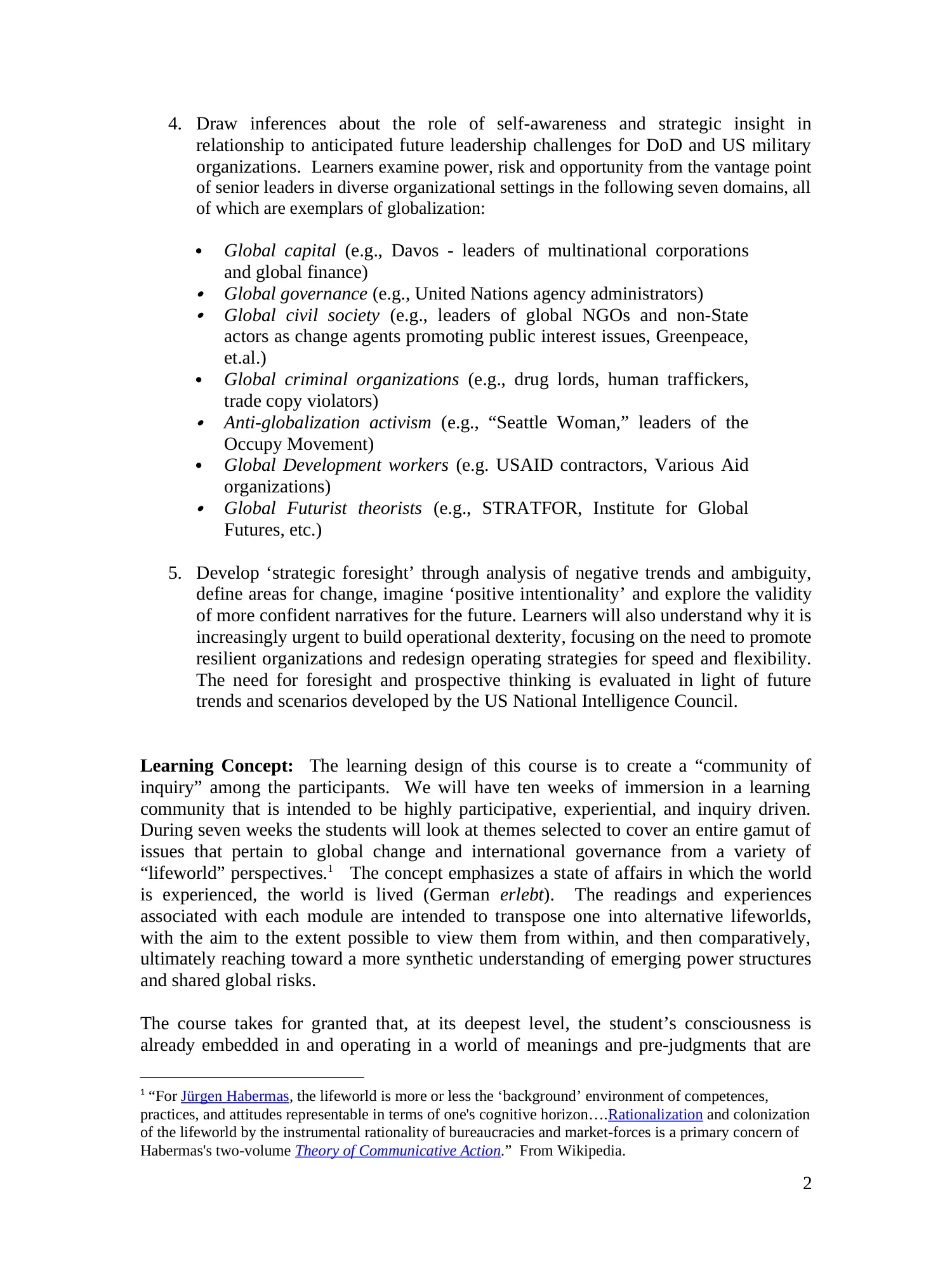
4. Draw inferences about the role of self-awareness and strategic insight in
relationship to anticipated future leadership challenges for DoD and US military organizations. Learners examine power, risk and opportunity from the vantage point of senior leaders in diverse organizational settings in the following seven domains, all of which are exemplars of globalization:
Global capital (e.g., Davos - leaders of multinational corporations and global finance) Global governance (e.g., United Nations agency administrators) Global civil society (e.g., leaders of global NGOs and non-State actors as change agents promoting public interest issues, Greenpeace, et.al.) Global criminal organizations (e.g., drug lords, human traffickers, trade copy violators) Anti-globalization activism (e.g., “Seattle Woman,” leaders of the Occupy Movement) Global Development workers (e.g. USAID contractors, Various Aid organizations) Global Futurist theorists (e.g., STRATFOR, Institute for Global Futures, etc.)
5. Develop ‘strategic foresight’ through analysis of negative trends and ambiguity,
define areas for change, imagine ‘positive intentionality’ and explore the validity of more confident narratives for the future. Learners will also understand why it is increasingly urgent to build operational dexterity, focusing on the need to promote resilient organizations and redesign operating strategies for speed and flexibility. The need for foresight and prospective thinking is evaluated in light of future trends and scenarios developed by the US National Intelligence Council.
Learning Concept: The learning design of this course is to create a “community of inquiry” among the participants. We will have ten weeks of immersion in a learning community that is intended to be highly participative, experiential, and inquiry driven. During seven weeks the students will look at themes selected to cover an entire gamut of issues that pertain to global change and international governance from a variety of “lifeworld” perspectives.1 The concept emphasizes a state of affairs in which the world is experienced, the world is lived (German erlebt). The readings and experiences associated with each module are intended to transpose one into alternative lifeworlds, with the aim to the extent possible to view them from within, and then comparatively, ultimately reaching toward a more synthetic understanding of emerging power structures and shared global risks. The course takes for granted that, at its deepest level, the student’s consciousness is already embedded in and operating in a world of meanings and pre-judgments that are
1 “For Jürgen Habermas, the lifeworld is more or less the ‘background’ environment of competences, practices, and attitudes representable in terms of one's cognitive horizon….Rationalization and colonization of the lifeworld by the instrumental rationality of bureaucracies and market-forces is a primary concern of Habermas's two-volume Theory of Communicative Action.” From Wikipedia.
Page 3 of 14
Read page 3 as text
3
socially, culturally, and historically constituted. It is assumed that any student, including military officers, have highly constructed identities, and we will proceed in accord with Socrates’ famous dictum that “The unexamined life is not worth living.”
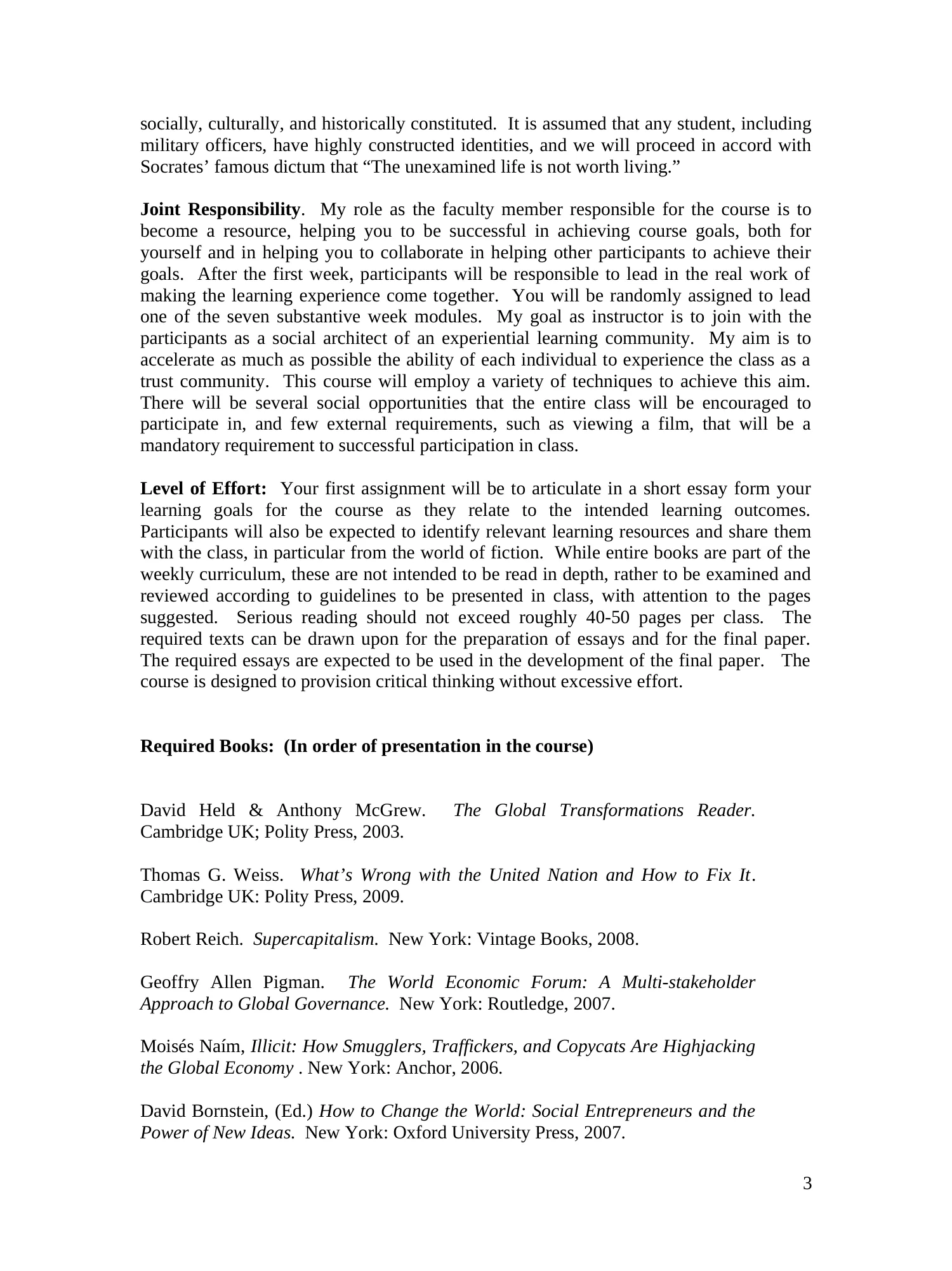
Joint Responsibility. My role as the faculty member responsible for the course is to become a resource, helping you to be successful in achieving course goals, both for yourself and in helping you to collaborate in helping other participants to achieve their goals. After the first week, participants will be responsible to lead in the real work of making the learning experience come together. You will be randomly assigned to lead one of the seven substantive week modules. My goal as instructor is to join with the participants as a social architect of an experiential learning community. My aim is to accelerate as much as possible the ability of each individual to experience the class as a trust community. This course will employ a variety of techniques to achieve this aim. There will be several social opportunities that the entire class will be encouraged to participate in, and few external requirements, such as viewing a film, that will be a mandatory requirement to successful participation in class.
Level of Effort: Your first assignment will be to articulate in a short essay form your learning goals for the course as they relate to the intended learning outcomes. Participants will also be expected to identify relevant learning resources and share them with the class, in particular from the world of fiction. While entire books are part of the weekly curriculum, these are not intended to be read in depth, rather to be examined and reviewed according to guidelines to be presented in class, with attention to the pages suggested. Serious reading should not exceed roughly 40-50 pages per class. The required texts can be drawn upon for the preparation of essays and for the final paper. The required essays are expected to be used in the development of the final paper. The course is designed to provision critical thinking without excessive effort.
Required Books: (In order of presentation in the course)
David Held & Anthony McGrew. The Global Transformations Reader. Cambridge UK; Polity Press, 2003.
Thomas G. Weiss. What’s Wrong with the United Nation and How to Fix It. Cambridge UK: Polity Press, 2009.
Robert Reich. Supercapitalism. New York: Vintage Books, 2008.
Geoffry Allen Pigman. The World Economic Forum: A Multi-stakeholder Approach to Global Governance. New York: Routledge, 2007.
Moisés Naím, Illicit: How Smugglers, Traffickers, and Copycats Are Highjacking the Global Economy . New York: Anchor, 2006.
David Bornstein, (Ed.) How to Change the World: Social Entrepreneurs and the Power of New Ideas. New York: Oxford University Press, 2007.
Page 4 of 14
Read page 4 as text
4
Naomi Klein. No Logo. New York: Picador, 2002.
Dambisa Moyo. Dead Aid: Why Aid Is Not Working and How There Is a Better Way for Africa. New York: Farrar, Straus and Giroux, 2009.
Joshua Cooper Ramo, The Age of the Unthinkable. New York: Little Brown, 2009.
Additional Required Video: Procure DVD Video “Black Gold” from Independent Lens. http://www.pbs.org/independentlens/blackgold/film.html
Graded Requirements:
Class Participation. There will be three short essay requirements assigned during the course, one due every three weeks. Kenneth Waltz’s famous book, “Man, the State and War,” addressed the explanation of the causes of war at three levels: human nature; the nature of the state; and, the nature of the international system. Your analysis should take a similar level of analysis approach, with each essay examining a different level. The first essay will be a short 2-3 page reflection addressing the power and risk perspectives of a particular character and from the vantage-point of an adopted position of someone operating within one of the major domains (e.g to illustrate, Davos Man, Seattle Woman, UN Bureaucrat, Aid Worker, Drug Lord, and so forth). Imagine yourself like the actor in the former TV series “Quantum Leap” jumping into the body of a protagonist and describe the world you see from that vantage point.
The second essay of 5-6 pages will highlight negative trends and ambiguity within the chosen domain from the vantage point of challenges to nation state sovereignty and the dilemmas to governance they pose. The third essay of 5-6 pages will explore the same domain from the perspective of the global system, identifying positive intentionality leading toward more confident narratives for the future.
All three essays can be used in the development of the final paper, but will be expected to result in a higher synthesis of understanding. Grading standards will generally center on the students ability to grasp the inherent nature of a complex adaptive system, using skills that are also typically employed in the development of military leadership. Those preparing class discussion will focus primarily on drawing out these issues, giving attention to alternative scenarios of confrontation, compromise, and cooperation, within a paradigm of contending power and risk. The three essays and class participation count for 40 percent of the course grade.
Mid-Term Assignment . The mid-term examination requirement is a book review not to exceed 7-10 page double spaced pages by the student of any work of fiction, biography,
Page 5 of 14
Read page 5 as text
5
or auto-biography from one of the seven substantive domains under discussion. The review of the chosen text should describe how power and threat interact to influence and inform global governance. It should evaluate the book from the identity perspective of a global citizen, assessing the elements of power and risks portrayed by the protagonists, as well as the background roles and responsibilities of any key leading individuals and organizations. Quite obviously, the selection of the work of fiction or biography by the student will greatly aid or hinder the ability to carry out the analysis and assessment. The mid-term assignment will count for 20 percent of the grade.
Final Examination Assignment. The final exam requirement will be an independently written paper not to exceed 25 double spaced pages in length that addresses the issues of power and risk bringing together the three levels of analysis addressed in the three course essays. The paper is intended to be an extended thought piece, addressing the power and risk perspectives of participants in the lifeworld under consideration, from your own point of view, assessing what you have learned in the exchange. Papers are graded based upon the participant’s ability to demonstrate ‘strategic foresight’ through analysis that illustrates critical thinking tools for understanding global change, the production of risks, challenges and opportunities that it presents to national defense in policy and practice. This final paper should also briefly consider how these changes and their experienced and perceived consequences will impact the student’s career as a future senior leader within the US military and national security arena. The final exam paper will count for 40 percent of the grade.
Page 6 of 14
Read page 6 as text
6
Course Syllabus
INTRODUCTION
CRITICAL QUESTIONS:
Why is it important to have a course on global change?
How do we identify and clarify our base assumptions and evaluate the fit with changing circumstances?
How do we become aware of our own awareness?
What do you think when I say, “globally sustainable development?”
What about our education and experiences? Is what we “be-know-do” counter to a just and sustainable world?
Are we caught in a cultural trance?
What are the different dimensions of globalization?
What, if anything, is different about the character of globalization today from past eras?
What is the appropriate “lens” (analytical, theoretical, conceptual, strategic) with which to explain, analyze, and evaluate the impact globalization has on contemporary security issues?
How can one describe globalization from a “system of systems” perspective?
WEEK 1: Introduction to Globalization and America in the global competition of ideas
(October 1, 3)
READINGS AND RESOURCES:
o Moises Naim, “The Five Wars of Globalization,” Foreign Policy, No. 134 (January/February 2003), pp. 28-37. Can be downloaded at: http://web.clas.ufl.edu/users/zselden/Course%20Readings/Naim.pdf
o Robert O. Keohane and Joseph S. Nye, Jr., “Globalization: What’s New? What’s Not? (And So What?),” Foreign Policy, No. 118 (Spring 2000), pp. 104-119.
Page 7 of 14
Read page 7 as text
7
o Stanley Hoffmann, “The Clash of Globalizations,” Foreign Affairs, Vol. 81, No. 4 (July/August 2002), pp. 104-115.
(Both Keohane/Nye and Hoffman articles can be found in primary text, David Held & Anthony McGrew, The Global Transformations Reader. Cambridge UK; Polity Press, 2003.)
TED Talks: James Stavridis – A Navy Admiral’s Thoughts on Global Security. http://www.ted.com/talks/ james_stavridis_how_nato_s_supreme_commander_thinks_about_global_security.html
Mary Kaldor. “Prof. Mary Kaldor on Human Security and Global Governance.” Uploaded by Global Policy Journal, 7 July 2010. http://www.youtube.com/watch?v=vo7_X-67peo&feature=youtube_gdata_player
Global Risk Report, World Economic Forum, 2013 Eighth edition available to download at: http://www.weforum.org/issues/global-risks
Louis Diamond, Global Systems Initiative, Twelve Rules. http://www.globalsystemsinitiatives.net/initiatives.html
GLOBAL TRANSITION
CRITICAL QUESTIONS:
How do power and threat interact (converge, conflict, reconcile) to form global governance?
How do students evaluate their own experiences within the confluence of these two forces?
What do we think the future looks like? How does globalization affect your future career path as a military officer?
What does it mean to be transformative in your work?
Page 8 of 14
Read page 8 as text
8
WEEK 2: Perspective taking on issues of global change and power
(October 8, 10)
READINGS AND RESOURCES:
o David Held and Anthony McGrew, “The Great Globalization Debate: An Introduction,” in The Global Transformations Reader,” Polity Press, (2007) pp. 1-53.
o Ulrich Beck. “Introduction: New Critical Theory with Cosmopolitan Intent,” in Power in the Global Age, Polity Press (2007), pp. 1-34. (class handout)
Paul Raskin, PhD. Harvard lecture on Global Futures – The Great Transition Alternative. http://www.tellus.org/video.html
TED Talks: Paddy Ashdown: The Global Power Shift http://www.ted.com/talks/paddy_ashdown_the_global_power_shift.html
TED Talks: Johan Rockstrom on Planetary Boundaries. http://rs.resalliance.org/2010/08/31/johan-rockstrom-at-ted-on-planetary-boundaries/
Prof. David Held on Challenges to Global Governance. http://www.youtube.com/watch?v=e8Y4f1c6VSI&feature=relmfu
GLOBAL GOVERNANCE
CRITICAL QUESTIONS:
What constitutes a challenge and a crisis for a nation state?
How do states fail in both the developed and developing world? (e.g., Greece and Somalia) What does this mean for future military planning?
Who runs the world? Who broke the UN?
Can International Organizations reinvent themselves?
What problems of management in the UN are similar to those of DoD?
Page 9 of 14
Read page 9 as text
9
WEEK 3: Crisis of Global Modernity: Alternative Future World Scenarios
(October 15, 17)
READINGS AND RESOURCES:
National Intelligence Council Report – Global Trends 2030 – Alternative Worlds. Download from: http://www.dni.gov/index.php/about/organization/national-intelligence-council-global- trends
Failed States Index, Foreign Policy http://www.foreignpolicy.com/failedstates
TED Talks: Parag Khanna Maps the Future of Countries, http://www.ted.com/talks/parag_khanna_maps_the_future_of_countries.html
Poetry and Globalization: http://www.boloji.com/index.cfm? md=Content&sd=PoemArticle&PoemArticleID=75
NOTE: No class on 15 October. It is a “shift day,” following Veteran’s holiday – Monday schedule substitutes.
On October 17 is a Guest Lecture with Professor Marcos Berger on the Crisis of Global Modernity)
WEEK 4: International Intergovernmental Organization
(October 22, 24) – Domain #1
READINGS AND RESOURCES:
Thomas G. Weiss. What’s Wrong with the United Nation and How to Fix It. Cambridge UK: Polity Press, 2009. Read Chapters 1, 3, 5, 7, 8 and Conclusion
Johnstone, “The Role of the UN Secretary-General: The Power of Persuasion Based on Law,” Global Governance, 9 (2003), pp. 451-458. (Class handout)
A More Secure World: Our Shared Responsibility, Report of the UN Secretary General’s High-level Panel on Threats, Challenges and Change (2004) Download at www. un .org/secureworld/report2.pdf
Page 10 of 14
Read page 10 as text
10
GLOBAL CAPITAL
CRITICAL QUESTIONS:
What are the key drivers of economic globalization?
Should we think about the world in terms of abundance or scarcity?
Have global economic structures of power escaped from the control of public governance?
Do you believe that Transnational Corporations or corporations in general have an ultimate responsibility to their shareholders eg. making profit, or to the societies they operate in?
How do these organizations address risk, find new ideas and approaches, and keeping innovating in how they lead and communicate?
WEEK 5: Global Corporations and Global Finance - “Davos Man” (October 29, 31) – Domain #2
READINGS AND RESOURCES:
Robert Reich. Supercapitalism. New York: Vintage Books, 2008. Read Chapters 2-4.
Geoffry Allen Pigman. The World Economic Forum: A Multi-stakeholder Approach to Global Governance. New York: Routledge, 2007.
Jan Aart Scholte, “Global Capital and the State,” International Affairs, v73, n3, 1997: pp. 427 -52. https://www.mtholyoke.edu/acad/intrel/scholte.htm
Watch Episode III: “The New Rules of the Game.” Commanding Heights, PBS series (2006). http://www.pbs.org/wgbh/commandingheights/hi/story/index.html.
TED Talks: Chrystia Freeland: The Rise of the New Global Super-rich http://www.ted.com/talks/ chrystia_freeland_the_rise_of_the_new_global_super_rich.html
Page 11 of 14
Read page 11 as text
11
WEEK 6: Global Inequity and Iniquity: Poverty and Criminal Organizations
(November 5, 7) Domain #3
READINGS AND RESOURCES:
Moisés Naím, Illicit: How Smugglers, Traffickers, and Copycats Are Highjacking the Global Economy (New York: Anchor, 2006). (Read selected chapters of own choosing)
TED Talks: Misha Glenny Investigages Global Crime Networks http://www.ted.com/talks/misha_glenny_investigates_global_crime_networks.html or http://www.youtube.com/watch?v=XO1Me-MY-Q0
TED Talks: Kevin Bales: How to Combat Modern Slavery http://www.ted.com/talks/kevin_bales_how_to_combat_modern_slavery.html
TED Talks: Charmian Gooch: Meet Global Corruption’s Hidden Players http://www.ted.com/talks/ charmian_gooch_meet_global_corruption_s_hidden_players.html
Email to Course Students from Professor Christman – Re: RV sales.
GLOBAL CIVIL SOCIETY
CRITICAL QUESTIONS:
Can the anti-globalization organizations of global civil society overcome their fragmentedness and internal conflicts?
What examples of operational dexterity do these organizations provide?
What are the leadership lessons for management of DoD organizations?
How do these examples force us to think about future national security planning?
Does the intentionality of your work include leaving a better legacy for the world?
WEEK 7: Local and Global Non-Governmental Organizations (NGO’s)
Page 12 of 14
Read page 12 as text
12
(November 12, 14) Domain #4
READINGS AND RESOURCES:
Watch Film “Black Gold” from Independent Lens. (Note: DVD required) Order From http://www.pbs.org/independentlens/blackgold/film.html
David Bornstein, (Ed.) How to Change the World: Social Entrepreneurs and the Power of New Ideas. New York: Oxford University Press, 2007. (Read selected chapters of own choosing)
TED Talks: Jamie Drummond: Let’s Crowdsource the World’s Goals http://www.ted.com/talks/jamie_drummond_how_to_set_goals_for_the_world.html
TED Talks: Jeremy Rifkin – The Empathetic Civilization. http://www.ted.com/talks/jeremy_rifkin_on_the_empathic_civilization.html
WEEK 8: Alternative Globalization: Global Environmentalism and the Global Justice Movement - “Seattle Woman”
(November 19, 21) Domain #5
READINGS AND RESOURCES:
Naomi Klein. No Logo. New York: Picador, 2002. (Read Chapter 9-18, Afterword)
Naomi Klein: “Neoliberalism” and “Are markets taking over traditional government functions?” http://www.youtube.com/watch?v=sKTmwu3ynOY and http://www.youtube.com/watch?v=bcQJIQmasdo
1999 Seattle WTO protests http://en.wikipedia.org/wiki/1999_Seattle_WTO_protests
Port Alegre Call for Mobilization. 30 January 2001 http://www.france.attac.org/archives/spip.php/ecrire/spip.php?article2978
Declaration of Social Movements Assembly Porto Alegre (RS), Brazil, 31 January 2012 http://cadtm.org/Declaration-of-Social-Movements
Page 13 of 14
Read page 13 as text
13
GLOBALLY SUSTAINABLE DEVELOPMENT
CRITICAL QUESTIONS:
What will we need to do? How can analysis of alternative futures guide our thinking?
Why aren’t we doing it now? What obstacles stand in the way of moving forward?
What are the short term and long term consequences?
Will it get better if we do nothing?
Are we falling behind in doing the critically important things?
WEEK 9: Creating a consciousness that embraces a larger world: Challenges to Development; Failed Aid
(November 26 - No class on November 28, Thanksgiving) Domain #6
READINGS AND RESOURCES:
TED Talks: Gordon Brown – Wiring a Web for Global Good. http://www.ted.com/talks/gordon_brown.html
WEEK 10: Foresight and Global Futures Thinking - Building Resilient Structures and Societies
(December 3, 5) Domain #7
Dambisa Moyo. Dead Aid: Why Aid Is Not Working and How There Is a Better Way for Africa. New York: Farrar, Straus and Giroux, 2009. Read Chapter 1-5, 10.
Kates, et al, “What is Sustainable Development?” Environment, 47 (No 3, 2005), pp. 8- 21
Fukuda-Parr, “Millennium Development Goals: Why They Matter,” Global Governance, 10 (2004).
Page 14 of 14
Read page 14 as text
14
READINGS AND RESOURCES:
Joshua Cooper Ramo, The Age of the Unthinkable. New York: Little Brown, 2009. (Read Chapters 1-4, 6, 9-11.
Leon S. Fuerth, Anticipatory Practical Upgrades: Equipping the Executive Branch to Cope with Increasing Speed and Complexity of Major Challenges. http://www.gwu.edu/~igis/assets/docs/working_papers/Anticipatory_Governance_Practic al_Upgrades.pdf World Business Council on Sustainable Development (Vision 2050 Roadmap) http://www.wbcsd.org/Pages/EDocument/EDocumentDetails.aspx? ID=14922&NoSearchContextKey=true
Institute for Global Security. http://globalfuturist.com/
TED Talks: Ian Goldin: Navigating Our Global Future http://www.ted.com/talks/ian_goldin_navigating_our_global_future.html
WEEK 11: Independent Research and Review – Final Paper Due - December 13
Final paper preparation should include reflection drawing in commentary from the core text “The Global Transformations Reader” (ed. Held and McGrew) as relevant to your argument.
(December 10, 12)
GRADED REQUIREMENTS
Personal essay on your learning goals as they relate to course goals and what you are interested to achieve is due at the beginning of week 2. Reflection essays are due at the end of weeks 3, 6, and 9. These essays will address conceptual elements of the course that can be assimilated as foundational material for the final paper.
Mid-term paper is due at the end of week 5.
Final Exam paper is due the Friday of week 11.