

LEADS Institute · Course syllabus
Enabling Innovation Through Emergent Transformative Design™
The complete course syllabus sets out the opening seminar, design studio and reframing seminar, including daily objectives and learning activities.
Page 1 of 14
Read page 1 as text
COURSE SYLLABUS
Enabling Innovation Through Emergent Transformative Design™
The Challenge
Today’s global environment is increasingly networked and connected, presenting challenges and opportunities that simply didn’t exist a few short years ago. These challenges and opportunities exist in virtually every realm of human activity, whether economic, security, social, political, technological, or informational. Industrial and even Information Age models, processes and heuristics are insufficient to produce the innovative approaches necessary for success and resilience in the global environment of today and the near future. Emergent Transformative Design We must therefore design innovative solutions to the emergent problems and opportunities. The foundation for such a new approach to innovation must be learning: learning about environments, about contexts, about opportunities, about solutions, and about what might be solutions. New approaches to individual, team and organizational learning will result in new ways of thinking, new ways of problem solving and ultimately a culture that enables innovation. An emerging approach to such learning is Emergent Transformative Design™ (ETD). ETD is a learning, thinking and decision-making approach that enables innovation by integrating knowledge curation, connectivism, and action learning.
Page 2 of 14
Read page 2 as text
Triple Loop Learning In designing solutions for any environment, the learning challenges consistently lie in three areas, regardless of our perspective. This “rule of threes” suggests that for any set of challenges we must learn across all three domains: the psycho-motor, cognitive, and affective. This enables us to appreciate the physical, mental and moral to think through and innovate the what, why and how of our solutions. This also enables us to learn at the strategic, operational and tactical levels, and to consider physical, virtual and human aspects of our system. The rule of threes requires “triple loop learning.” Triple loop learning enables us to explore rules, principles and insights to change behaviors (Loop 1), change our thinking (Loop 2) and change our perceptions (Loop 3). This syllabus presents a reflective look at a pilot-project curriculum for a ten-day course to advance the state of affairs within the military cyber community to explore in a connected-fashion way of thinking to better address emergent security challenges and wicked problems.
It begins with the assumption that the act of designing is a learning process. However, academic design programs are seldom if ever founded on a structured design-friendly learning environment—a design pedagogy. This ten-day program in Emergent Transformative Design™ (ETD) involves the creative transformation of the student’s initial broad area of interest into specific design questions. It moves through three stages:
1) Knowledge Curation through Engagement and Immersion in which the learning objectives are at the “understand” level in Bloom’s taxonomy. The allegory of Plato’s Cave pairs well with the design journey, as students will begin not only to think differently, but to think about their thinking, and use design to provide novel insights that operate under often profoundly different and creative processes.
Knowledge curation is a collaborative approach that progresses through the learning taxonomy to understand the meaning found in new environments and contexts. Knowledge curation must account for generational differences in learning across the design team, recognizing that Baby Boomers, Gen Xers and Net Generation individuals have different learning theories, learning practice, learning locations, and reasoning approaches. For example, Net generation learners tend to learn primarily through on- line sources, whereas Baby Boomers and Gen Xers tend to seek more traditional sources such as books or lecture. Additionally, Net Generation learners are observed to employ abductive reasoning more often than their older counterparts, who were educated to employ deductive and inductive logic.
Page 3 of 14
Read page 3 as text
2) Connectivism by the exploration of Divergence and Convergence, with learning objectives at the “analyze” level in Bloom’s taxonomy. It culminates in initial Design Development, and presentation of the student’s initial conceptual framework for inquiry based upon an appreciation of context and stakeholder analysis. At the end of this phase participants will present a proposal for how the practical exercise will be undertaken.
Connectivism connects learners, planners and decision makers both internal and external to the organization to new sources of knowledge, develop new heuristics and create new understanding. Connectivism begins with the development of a personal learning network by each member of the design team, tailored individually to how they personally learn and their experience, expertise and interests. Innovators on the design team then connect their personal learning networks and additionally connect to other learners, designers and experts, as well as other sources to maximize the learning across the team.
3) Action Learning -- or the Innovation Stage – with learning objectives at the “create” level in Bloom’s taxonomy will be undertaken, completed and evaluated.
Action learning enables collaborative creation to produce innovative solutions to the problems and opportunities that emerge. Action learning requires mastery of thinking skills to translate learning into action. These thinking skills include: visual thinking, systems thinking, critical thinking, creative thinking, strategic thinking, and detailed thinking. Humans are visual learners and developing visual thinking skills promotes collaboration across the design team. Systems thinking enables us to appreciate complex environments in which we are immersed. Critical thinking allows us to derive the implications of those environments in terms of challenges and opportunities. Creative thinking leads to innovative solutions, while detailed thinking enables us to translate ideas into reality. The primary goal for the Innovation element of the program is for participants to begin to develop a Concept for a Cyber Design Laboratory with international partners and next generation cyber challenges on a continuing basis, which we will call: a “Cyber Knowledge Network” to address the challenges posed by “Virtual War.”
The practical exercise of developing a framework for “Virtual War” will serve as the focal point of throughout the two-week course. Participants will be asked to create a new approach to Cyber practice that can address any or all the following:
1. Supporting systemic interconnections across governmental agencies and
civilian organizations.
Page 4 of 14
Read page 4 as text
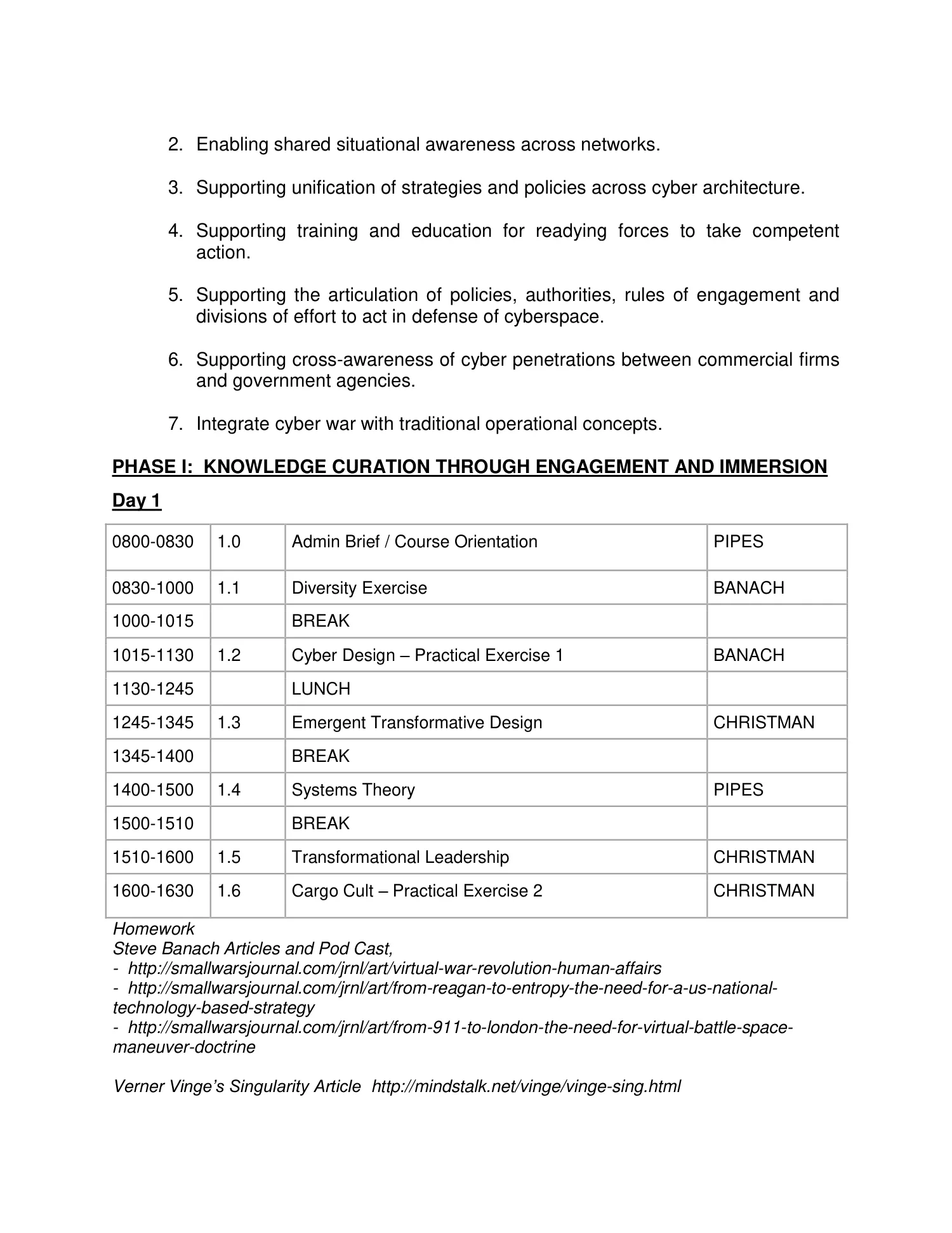
2. Enabling shared situational awareness across networks.
3. Supporting unification of strategies and policies across cyber architecture.
4. Supporting training and education for readying forces to take competent
action.
5. Supporting the articulation of policies, authorities, rules of engagement and
divisions of effort to act in defense of cyberspace.
6. Supporting cross-awareness of cyber penetrations between commercial firms
and government agencies.
7. Integrate cyber war with traditional operational concepts.
PHASE I: KNOWLEDGE CURATION THROUGH ENGAGEMENT AND IMMERSION
Day 1
0800-0830 1.0 Admin Brief / Course Orientation PIPES
0830-1000 1.1 Diversity Exercise BANACH
1000-1015 BREAK
1015-1130 1.2 Cyber Design – Practical Exercise 1 BANACH
1130-1245 LUNCH
1245-1345 1.3 Emergent Transformative Design CHRISTMAN
1345-1400 BREAK
1400-1500 1.4 Systems Theory PIPES
1500-1510 BREAK
1510-1600 1.5 Transformational Leadership CHRISTMAN
1600-1630 1.6 Cargo Cult – Practical Exercise 2 CHRISTMAN
Homework Steve Banach Articles and Pod Cast, - http://smallwarsjournal.com/jrnl/art/virtual-war-revolution-human-affairs - http://smallwarsjournal.com/jrnl/art/from-reagan-to-entropy-the-need-for-a-us-national- technology-based-strategy - http://smallwarsjournal.com/jrnl/art/from-911-to-london-the-need-for-virtual-battle-space- maneuver-doctrine Verner Vinge’s Singularity Article http://mindstalk.net/vinge/vinge-sing.html
Page 5 of 14
Read page 5 as text
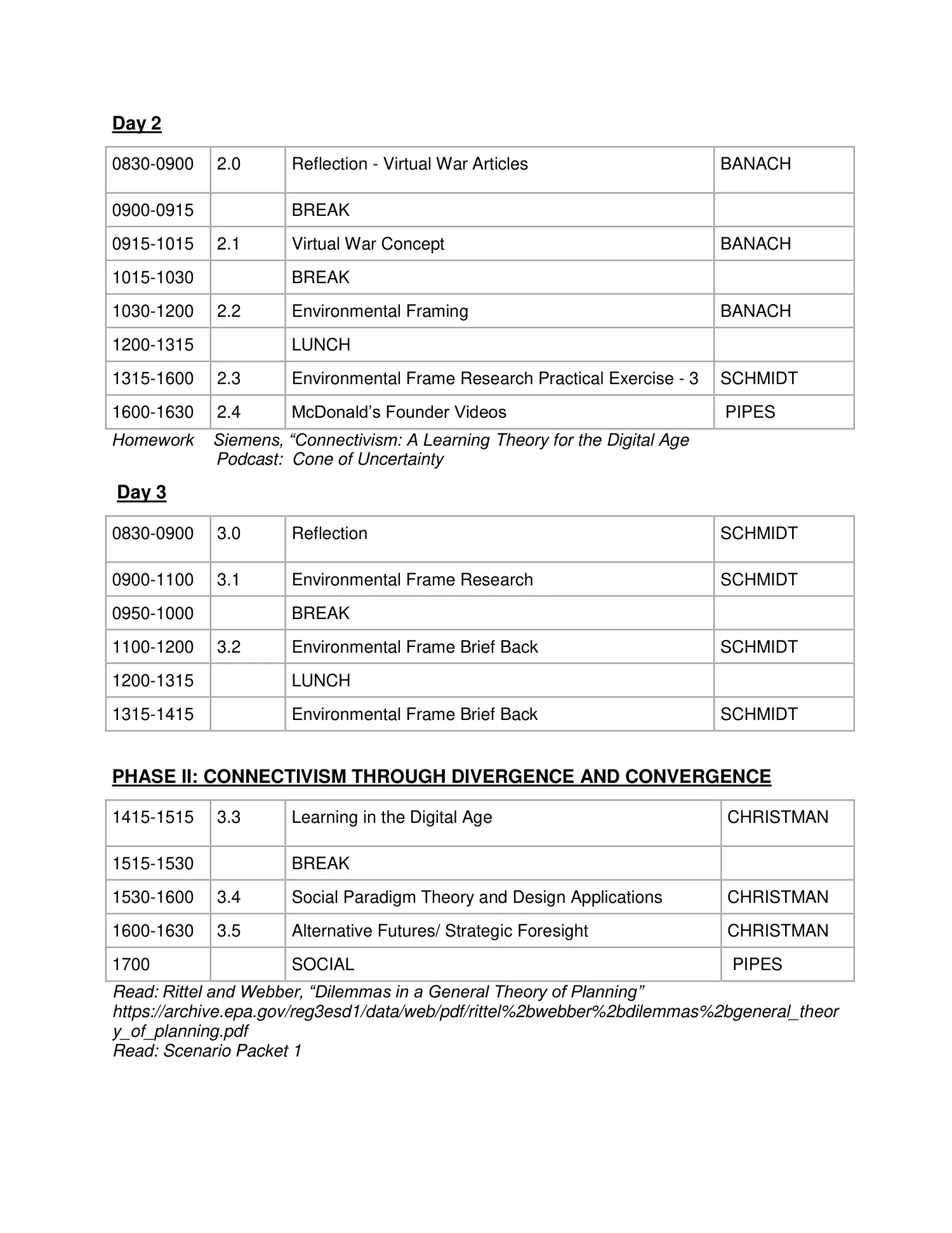
Day 2
0830-0900 2.0 Reflection - Virtual War Articles BANACH
0900-0915 BREAK
0915-1015 2.1 Virtual War Concept BANACH
1015-1030 BREAK
1030-1200 2.2 Environmental Framing BANACH
1200-1315 LUNCH
1315-1600 2.3 Environmental Frame Research Practical Exercise - 3 SCHMIDT
1600-1630 2.4 McDonald’s Founder Videos PIPES
Homework Siemens, “Connectivism: A Learning Theory for the Digital Age Podcast: Cone of Uncertainty
Day 3
0830-0900 3.0 Reflection SCHMIDT
0900-1100 3.1 Environmental Frame Research SCHMIDT
0950-1000 BREAK
1100-1200 3.2 Environmental Frame Brief Back SCHMIDT
1200-1315 LUNCH
1315-1415 Environmental Frame Brief Back SCHMIDT
PHASE II: CONNECTIVISM THROUGH DIVERGENCE AND CONVERGENCE
1415-1515 3.3 Learning in the Digital Age CHRISTMAN
1515-1530 BREAK
1530-1600 3.4 Social Paradigm Theory and Design Applications CHRISTMAN
1600-1630 3.5 Alternative Futures/ Strategic Foresight CHRISTMAN
1700 SOCIAL PIPES
Read: Rittel and Webber, “Dilemmas in a General Theory of Planning” https://archive.epa.gov/reg3esd1/data/web/pdf/rittel%2bwebber%2bdilemmas%2bgeneral_theor y_of_planning.pdf Read: Scenario Packet 1
Page 6 of 14
Read page 6 as text
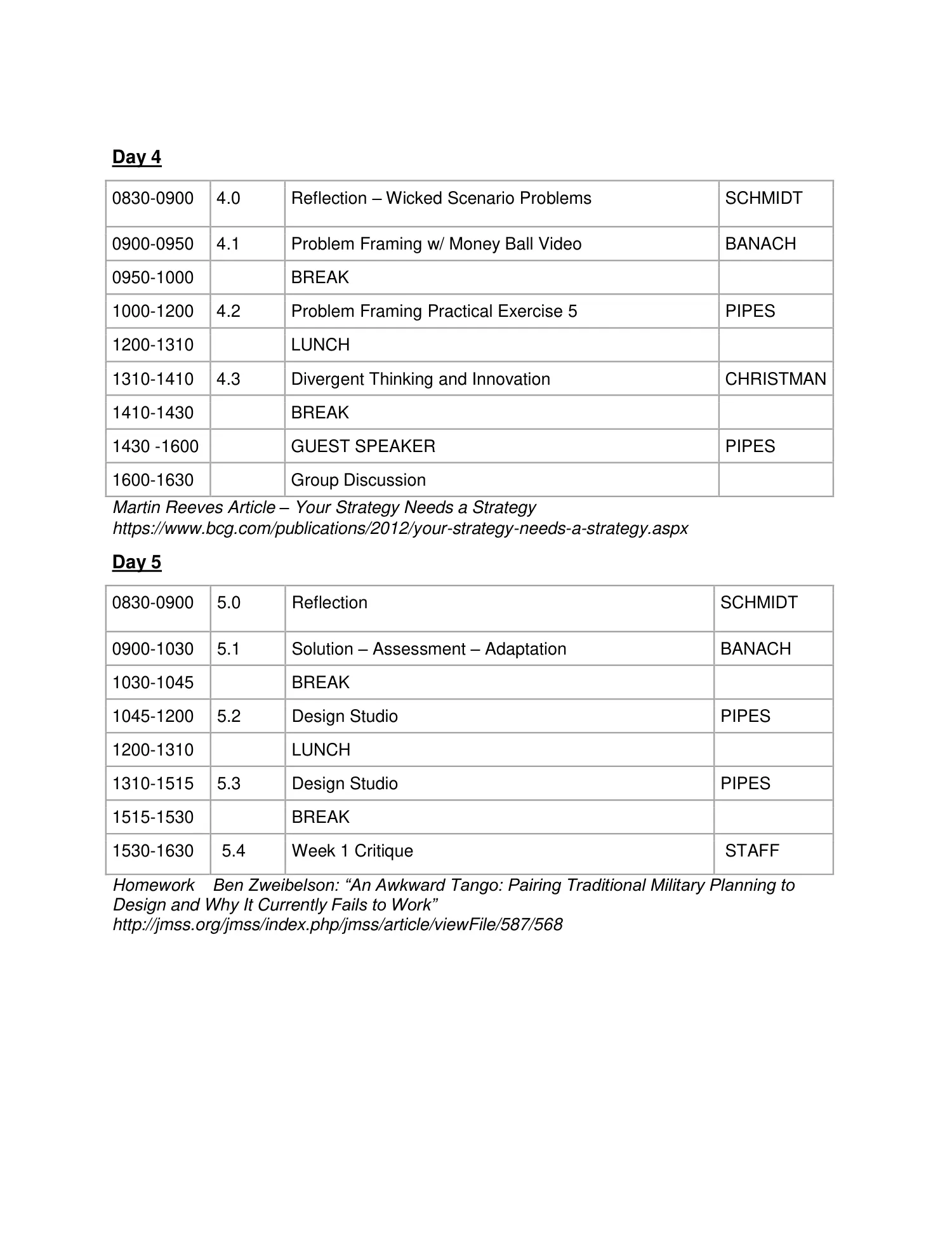
Day 4
0830-0900 4.0 Reflection – Wicked Scenario Problems SCHMIDT
0900-0950 4.1 Problem Framing w/ Money Ball Video BANACH
0950-1000 BREAK
1000-1200 4.2 Problem Framing Practical Exercise 5 PIPES
1200-1310 LUNCH
1310-1410 4.3 Divergent Thinking and Innovation CHRISTMAN
1410-1430 BREAK
1430 -1600 GUEST SPEAKER PIPES
1600-1630 Group Discussion
Martin Reeves Article – Your Strategy Needs a Strategy https://www.bcg.com/publications/2012/your-strategy-needs-a-strategy.aspx
Day 5
0830-0900 5.0 Reflection SCHMIDT
0900-1030 5.1 Solution – Assessment – Adaptation BANACH
1030-1045 BREAK
1045-1200 5.2 Design Studio PIPES
1200-1310 LUNCH
1310-1515 5.3 Design Studio PIPES
1515-1530 BREAK
1530-1630 5.4 Week 1 Critique STAFF
Homework Ben Zweibelson: “An Awkward Tango: Pairing Traditional Military Planning to Design and Why It Currently Fails to Work” http://jmss.org/jmss/index.php/jmss/article/viewFile/587/568
Page 7 of 14
Read page 7 as text
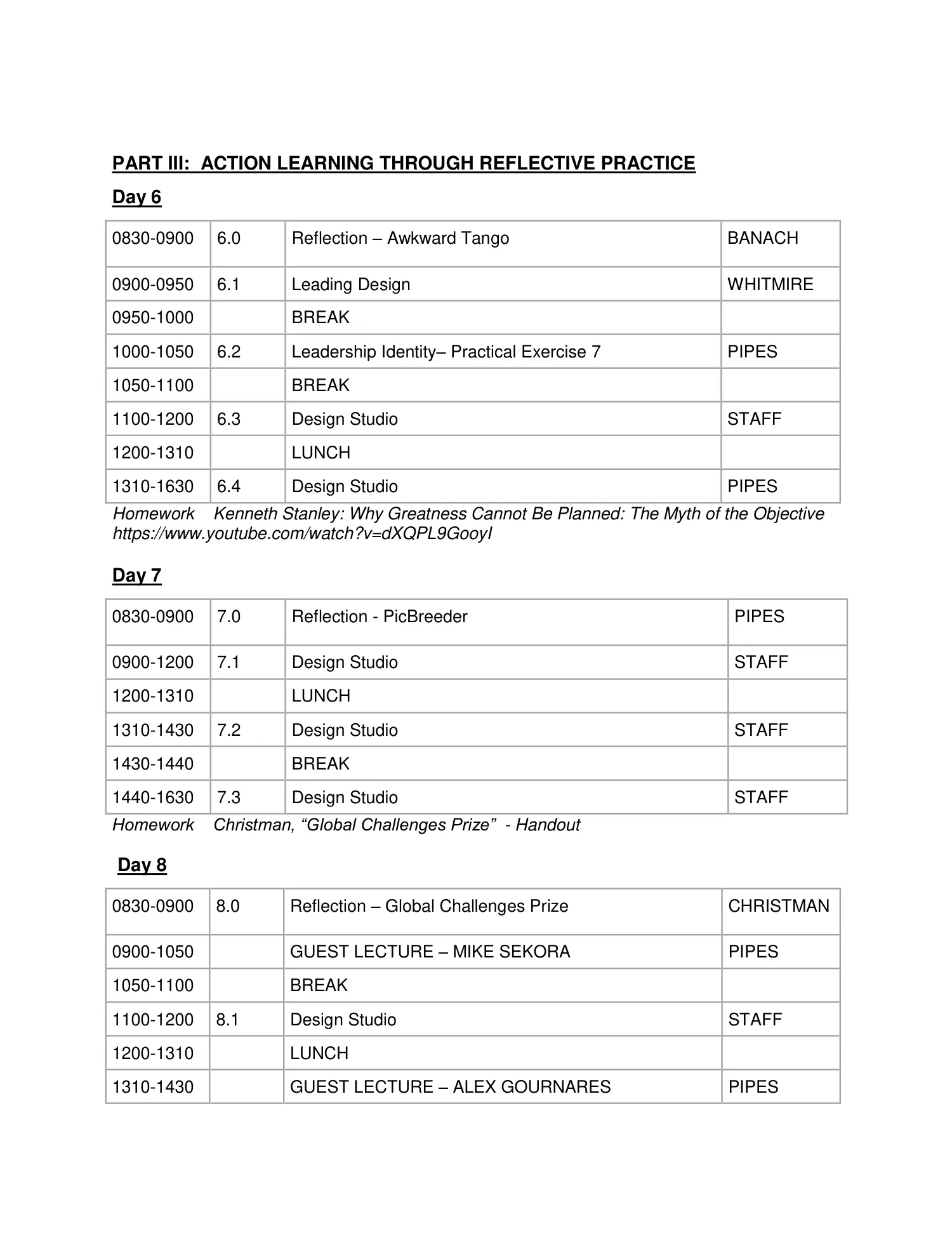
PART III: ACTION LEARNING THROUGH REFLECTIVE PRACTICE
Day 6
0830-0900 6.0 Reflection – Awkward Tango BANACH
0900-0950 6.1 Leading Design WHITMIRE
0950-1000 BREAK
1000-1050 6.2 Leadership Identity– Practical Exercise 7 PIPES
1050-1100 BREAK
1100-1200 6.3 Design Studio STAFF
1200-1310 LUNCH
1310-1630 6.4 Design Studio PIPES
Homework Kenneth Stanley: Why Greatness Cannot Be Planned: The Myth of the Objective https://www.youtube.com/watch?v=dXQPL9GooyI Day 7
0830-0900 7.0 Reflection - PicBreeder PIPES
0900-1200 7.1 Design Studio STAFF
1200-1310 LUNCH
1310-1430 7.2 Design Studio STAFF
1430-1440 BREAK
1440-1630 7.3 Design Studio STAFF
Homework Christman, “Global Challenges Prize” - Handout Day 8
0830-0900 8.0 Reflection – Global Challenges Prize CHRISTMAN
0900-1050 GUEST LECTURE – MIKE SEKORA PIPES
1050-1100 BREAK
1100-1200 8.1 Design Studio STAFF
1200-1310 LUNCH
1310-1430 GUEST LECTURE – ALEX GOURNARES PIPES
Page 8 of 14
Read page 8 as text
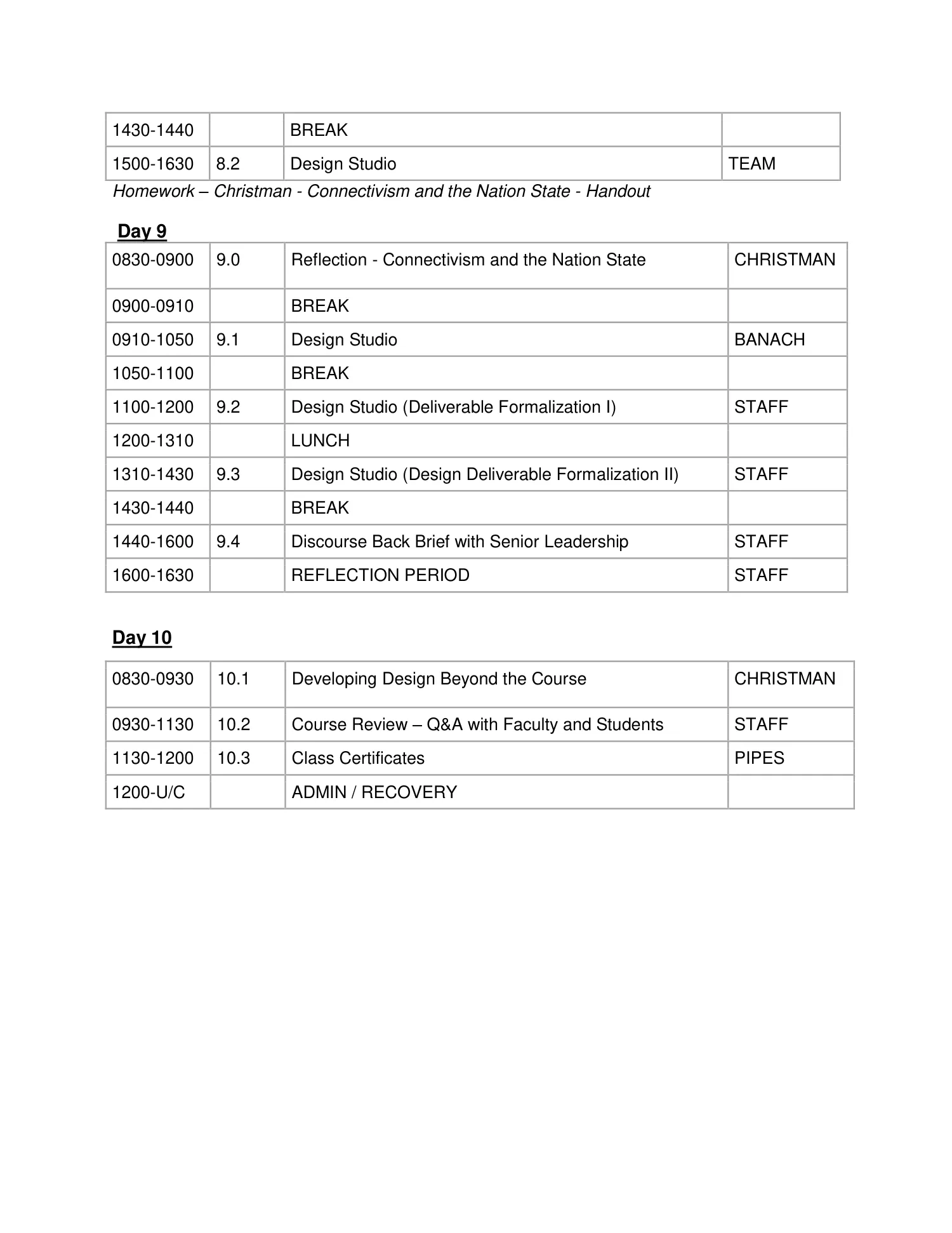
1430-1440 BREAK
1500-1630 8.2 Design Studio TEAM
Homework – Christman - Connectivism and the Nation State - Handout Day 9
0830-0900 9.0 Reflection - Connectivism and the Nation State CHRISTMAN
0900-0910 BREAK
0910-1050 9.1 Design Studio BANACH
1050-1100 BREAK
1100-1200 9.2 Design Studio (Deliverable Formalization I) STAFF
1200-1310 LUNCH
1310-1430 9.3 Design Studio (Design Deliverable Formalization II) STAFF
1430-1440 BREAK
1440-1600 9.4 Discourse Back Brief with Senior Leadership STAFF
1600-1630 REFLECTION PERIOD STAFF
Day 10
0830-0930 10.1 Developing Design Beyond the Course CHRISTMAN
0930-1130 10.2 Course Review – Q&A with Faculty and Students STAFF
1130-1200 10.3 Class Certificates PIPES
1200-U/C ADMIN / RECOVERY
Page 9 of 14
Read page 9 as text
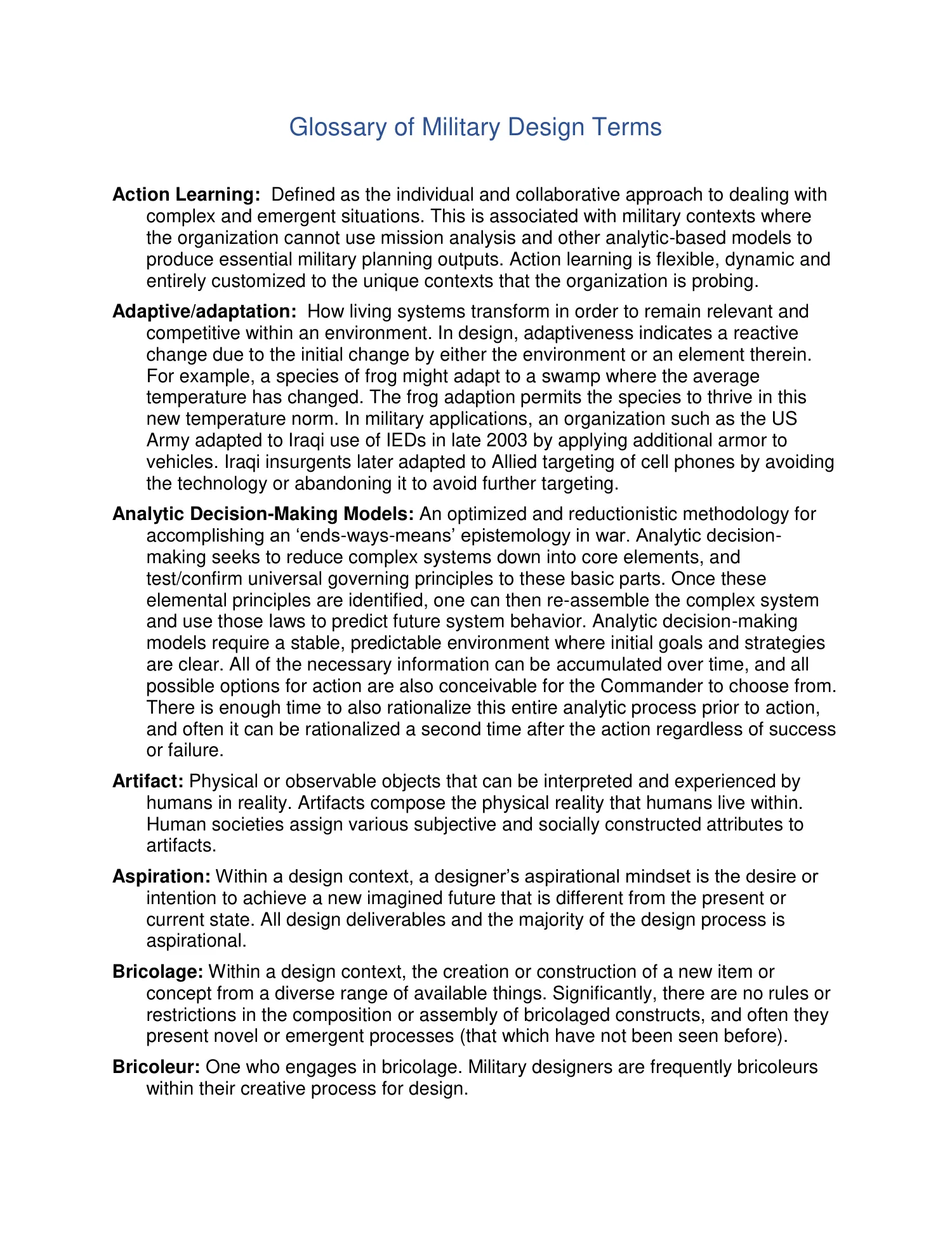
Glossary of Military Design Terms Action Learning: Defined as the individual and collaborative approach to dealing with
complex and emergent situations. This is associated with military contexts where the organization cannot use mission analysis and other analytic-based models to produce essential military planning outputs. Action learning is flexible, dynamic and entirely customized to the unique contexts that the organization is probing.
Adaptive/adaptation: How living systems transform in order to remain relevant and
competitive within an environment. In design, adaptiveness indicates a reactive change due to the initial change by either the environment or an element therein. For example, a species of frog might adapt to a swamp where the average temperature has changed. The frog adaption permits the species to thrive in this new temperature norm. In military applications, an organization such as the US Army adapted to Iraqi use of IEDs in late 2003 by applying additional armor to vehicles. Iraqi insurgents later adapted to Allied targeting of cell phones by avoiding the technology or abandoning it to avoid further targeting.
Analytic Decision-Making Models: An optimized and reductionistic methodology for
accomplishing an ‘ends-ways-means’ epistemology in war. Analytic decision- making seeks to reduce complex systems down into core elements, and test/confirm universal governing principles to these basic parts. Once these elemental principles are identified, one can then re-assemble the complex system and use those laws to predict future system behavior. Analytic decision-making models require a stable, predictable environment where initial goals and strategies are clear. All of the necessary information can be accumulated over time, and all possible options for action are also conceivable for the Commander to choose from. There is enough time to also rationalize this entire analytic process prior to action, and often it can be rationalized a second time after the action regardless of success or failure.
Artifact: Physical or observable objects that can be interpreted and experienced by
humans in reality. Artifacts compose the physical reality that humans live within. Human societies assign various subjective and socially constructed attributes to artifacts.
Aspiration: Within a design context, a designer’s aspirational mindset is the desire or
intention to achieve a new imagined future that is different from the present or current state. All design deliverables and the majority of the design process is aspirational.
Bricolage: Within a design context, the creation or construction of a new item or
concept from a diverse range of available things. Significantly, there are no rules or restrictions in the composition or assembly of bricolaged constructs, and often they present novel or emergent processes (that which have not been seen before).
Bricoleur: One who engages in bricolage. Military designers are frequently bricoleurs
within their creative process for design.
Page 10 of 14
Read page 10 as text
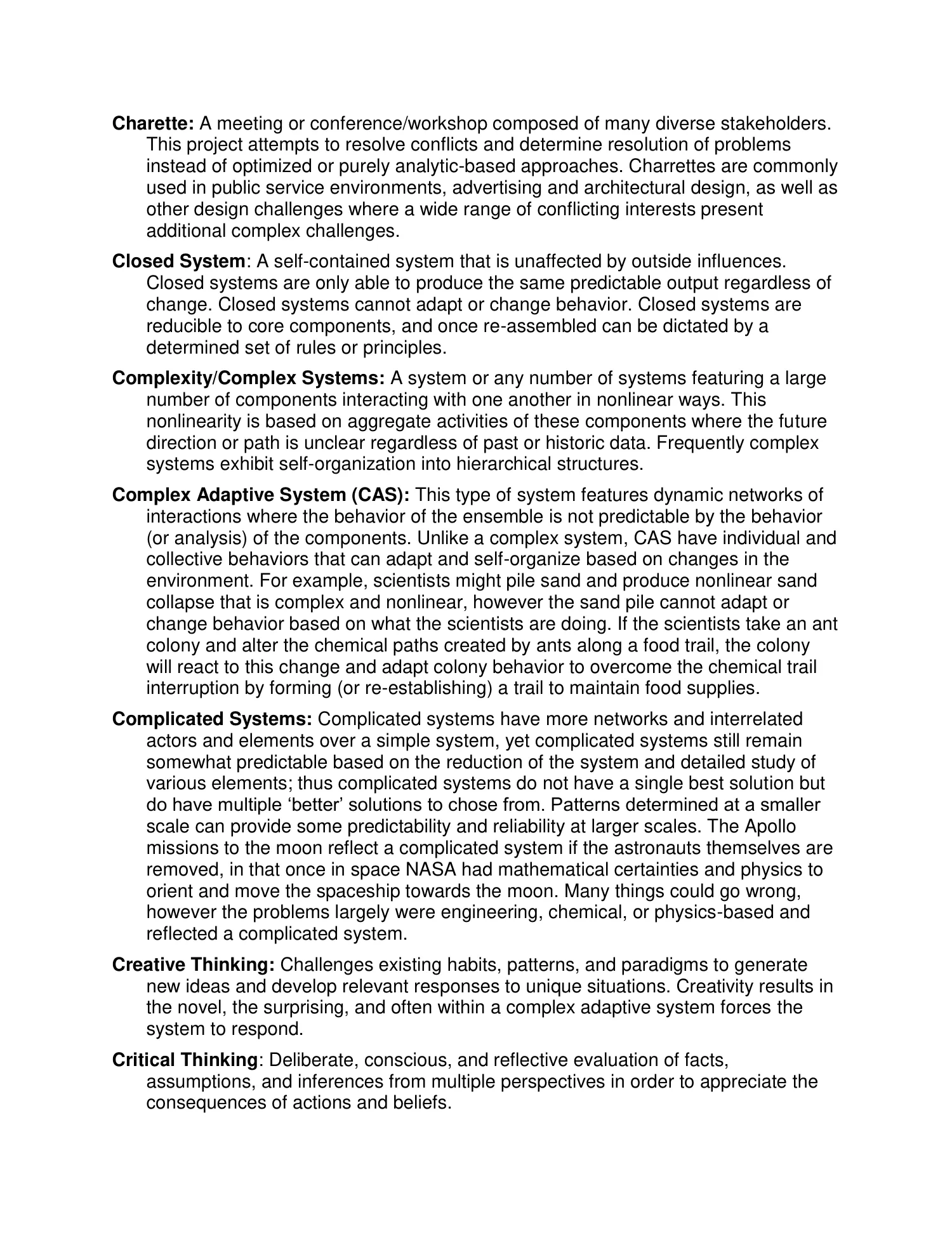
Charette: A meeting or conference/workshop composed of many diverse stakeholders.
This project attempts to resolve conflicts and determine resolution of problems instead of optimized or purely analytic-based approaches. Charrettes are commonly used in public service environments, advertising and architectural design, as well as other design challenges where a wide range of conflicting interests present additional complex challenges.
Closed System: A self-contained system that is unaffected by outside influences.
Closed systems are only able to produce the same predictable output regardless of change. Closed systems cannot adapt or change behavior. Closed systems are reducible to core components, and once re-assembled can be dictated by a determined set of rules or principles.
Complexity/Complex Systems: A system or any number of systems featuring a large
number of components interacting with one another in nonlinear ways. This nonlinearity is based on aggregate activities of these components where the future direction or path is unclear regardless of past or historic data. Frequently complex systems exhibit self-organization into hierarchical structures.
Complex Adaptive System (CAS): This type of system features dynamic networks of
interactions where the behavior of the ensemble is not predictable by the behavior (or analysis) of the components. Unlike a complex system, CAS have individual and collective behaviors that can adapt and self-organize based on changes in the environment. For example, scientists might pile sand and produce nonlinear sand collapse that is complex and nonlinear, however the sand pile cannot adapt or change behavior based on what the scientists are doing. If the scientists take an ant colony and alter the chemical paths created by ants along a food trail, the colony will react to this change and adapt colony behavior to overcome the chemical trail interruption by forming (or re-establishing) a trail to maintain food supplies.
Complicated Systems: Complicated systems have more networks and interrelated
actors and elements over a simple system, yet complicated systems still remain somewhat predictable based on the reduction of the system and detailed study of various elements; thus complicated systems do not have a single best solution but do have multiple ‘better’ solutions to chose from. Patterns determined at a smaller scale can provide some predictability and reliability at larger scales. The Apollo missions to the moon reflect a complicated system if the astronauts themselves are removed, in that once in space NASA had mathematical certainties and physics to orient and move the spaceship towards the moon. Many things could go wrong, however the problems largely were engineering, chemical, or physics-based and reflected a complicated system.
Creative Thinking: Challenges existing habits, patterns, and paradigms to generate
new ideas and develop relevant responses to unique situations. Creativity results in the novel, the surprising, and often within a complex adaptive system forces the system to respond.
Critical Thinking: Deliberate, conscious, and reflective evaluation of facts,
assumptions, and inferences from multiple perspectives in order to appreciate the consequences of actions and beliefs.
Page 11 of 14
Read page 11 as text
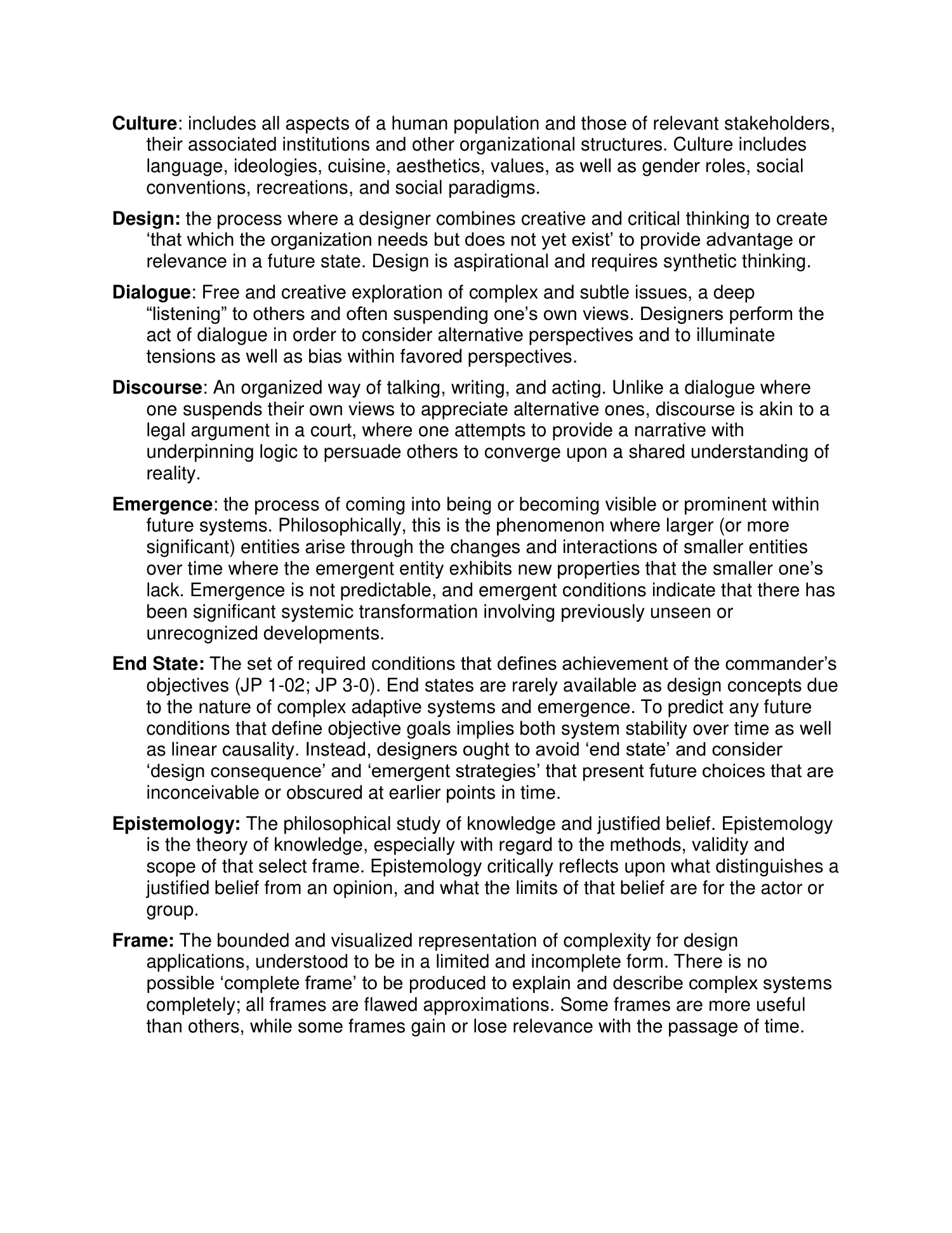
Culture: includes all aspects of a human population and those of relevant stakeholders,
their associated institutions and other organizational structures. Culture includes language, ideologies, cuisine, aesthetics, values, as well as gender roles, social conventions, recreations, and social paradigms.
Design: the process where a designer combines creative and critical thinking to create
‘that which the organization needs but does not yet exist’ to provide advantage or relevance in a future state. Design is aspirational and requires synthetic thinking.
Dialogue: Free and creative exploration of complex and subtle issues, a deep
“listening” to others and often suspending one’s own views. Designers perform the act of dialogue in order to consider alternative perspectives and to illuminate tensions as well as bias within favored perspectives.
Discourse: An organized way of talking, writing, and acting. Unlike a dialogue where
one suspends their own views to appreciate alternative ones, discourse is akin to a legal argument in a court, where one attempts to provide a narrative with underpinning logic to persuade others to converge upon a shared understanding of reality.
Emergence: the process of coming into being or becoming visible or prominent within
future systems. Philosophically, this is the phenomenon where larger (or more significant) entities arise through the changes and interactions of smaller entities over time where the emergent entity exhibits new properties that the smaller one’s lack. Emergence is not predictable, and emergent conditions indicate that there has been significant systemic transformation involving previously unseen or unrecognized developments.
End State: The set of required conditions that defines achievement of the commander’s
objectives (JP 1-02; JP 3-0). End states are rarely available as design concepts due to the nature of complex adaptive systems and emergence. To predict any future conditions that define objective goals implies both system stability over time as well as linear causality. Instead, designers ought to avoid ‘end state’ and consider ‘design consequence’ and ‘emergent strategies’ that present future choices that are inconceivable or obscured at earlier points in time.
Epistemology: The philosophical study of knowledge and justified belief. Epistemology
is the theory of knowledge, especially with regard to the methods, validity and scope of that select frame. Epistemology critically reflects upon what distinguishes a justified belief from an opinion, and what the limits of that belief are for the actor or group.
Frame: The bounded and visualized representation of complexity for design
applications, understood to be in a limited and incomplete form. There is no possible ‘complete frame’ to be produced to explain and describe complex systems completely; all frames are flawed approximations. Some frames are more useful than others, while some frames gain or lose relevance with the passage of time.
Page 12 of 14
Read page 12 as text
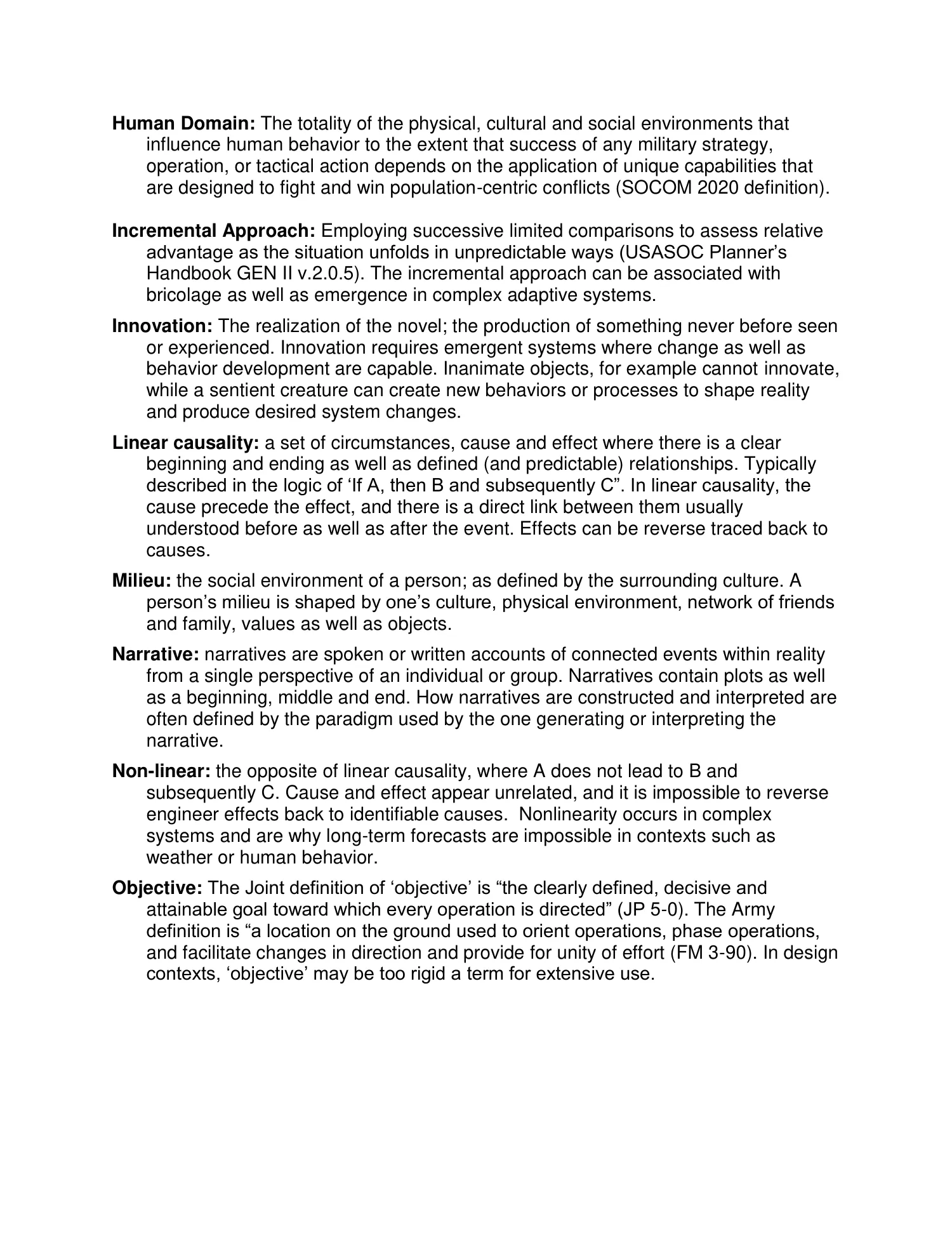
Human Domain: The totality of the physical, cultural and social environments that
influence human behavior to the extent that success of any military strategy, operation, or tactical action depends on the application of unique capabilities that are designed to fight and win population-centric conflicts (SOCOM 2020 definition). Incremental Approach: Employing successive limited comparisons to assess relative
advantage as the situation unfolds in unpredictable ways (USASOC Planner’s Handbook GEN II v.2.0.5). The incremental approach can be associated with bricolage as well as emergence in complex adaptive systems.
Innovation: The realization of the novel; the production of something never before seen
or experienced. Innovation requires emergent systems where change as well as behavior development are capable. Inanimate objects, for example cannot innovate, while a sentient creature can create new behaviors or processes to shape reality and produce desired system changes.
Linear causality: a set of circumstances, cause and effect where there is a clear
beginning and ending as well as defined (and predictable) relationships. Typically described in the logic of ‘If A, then B and subsequently C”. In linear causality, the cause precede the effect, and there is a direct link between them usually understood before as well as after the event. Effects can be reverse traced back to causes.
Milieu: the social environment of a person; as defined by the surrounding culture. A
person’s milieu is shaped by one’s culture, physical environment, network of friends and family, values as well as objects.
Narrative: narratives are spoken or written accounts of connected events within reality
from a single perspective of an individual or group. Narratives contain plots as well as a beginning, middle and end. How narratives are constructed and interpreted are often defined by the paradigm used by the one generating or interpreting the narrative.
Non-linear: the opposite of linear causality, where A does not lead to B and
subsequently C. Cause and effect appear unrelated, and it is impossible to reverse engineer effects back to identifiable causes. Nonlinearity occurs in complex systems and are why long-term forecasts are impossible in contexts such as weather or human behavior.
Objective: The Joint definition of ‘objective’ is “the clearly defined, decisive and
attainable goal toward which every operation is directed” (JP 5-0). The Army definition is “a location on the ground used to orient operations, phase operations, and facilitate changes in direction and provide for unity of effort (FM 3-90). In design contexts, ‘objective’ may be too rigid a term for extensive use.
Page 13 of 14
Read page 13 as text
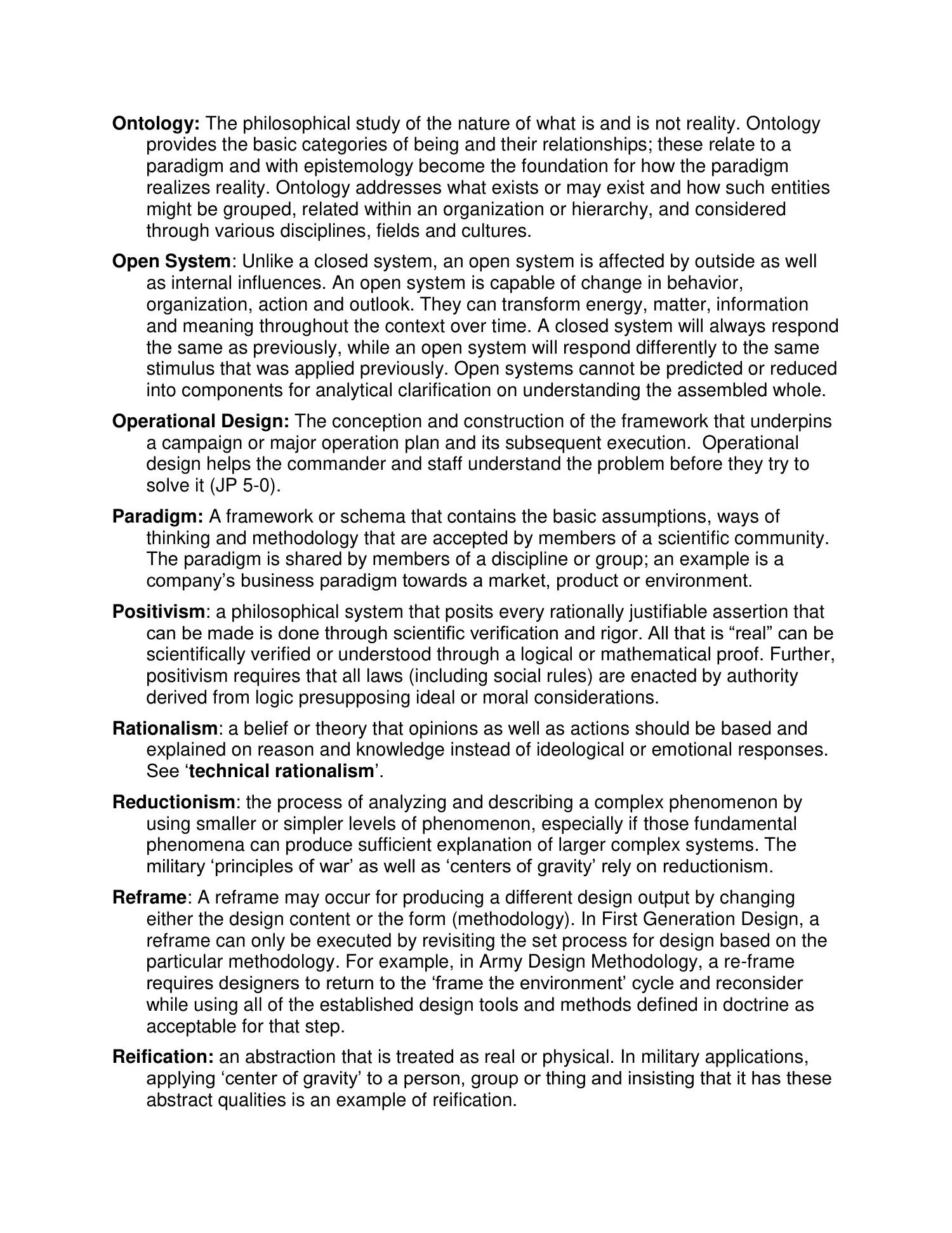
Ontology: The philosophical study of the nature of what is and is not reality. Ontology
provides the basic categories of being and their relationships; these relate to a paradigm and with epistemology become the foundation for how the paradigm realizes reality. Ontology addresses what exists or may exist and how such entities might be grouped, related within an organization or hierarchy, and considered through various disciplines, fields and cultures.
Open System: Unlike a closed system, an open system is affected by outside as well
as internal influences. An open system is capable of change in behavior, organization, action and outlook. They can transform energy, matter, information and meaning throughout the context over time. A closed system will always respond the same as previously, while an open system will respond differently to the same stimulus that was applied previously. Open systems cannot be predicted or reduced into components for analytical clarification on understanding the assembled whole.
Operational Design: The conception and construction of the framework that underpins
a campaign or major operation plan and its subsequent execution. Operational design helps the commander and staff understand the problem before they try to solve it (JP 5-0).
Paradigm: A framework or schema that contains the basic assumptions, ways of
thinking and methodology that are accepted by members of a scientific community. The paradigm is shared by members of a discipline or group; an example is a company’s business paradigm towards a market, product or environment.
Positivism: a philosophical system that posits every rationally justifiable assertion that
can be made is done through scientific verification and rigor. All that is “real” can be scientifically verified or understood through a logical or mathematical proof. Further, positivism requires that all laws (including social rules) are enacted by authority derived from logic presupposing ideal or moral considerations.
Rationalism: a belief or theory that opinions as well as actions should be based and
explained on reason and knowledge instead of ideological or emotional responses. See ‘technical rationalism’.
Reductionism: the process of analyzing and describing a complex phenomenon by
using smaller or simpler levels of phenomenon, especially if those fundamental phenomena can produce sufficient explanation of larger complex systems. The military ‘principles of war’ as well as ‘centers of gravity’ rely on reductionism.
Reframe: A reframe may occur for producing a different design output by changing
either the design content or the form (methodology). In First Generation Design, a reframe can only be executed by revisiting the set process for design based on the particular methodology. For example, in Army Design Methodology, a re-frame requires designers to return to the ‘frame the environment’ cycle and reconsider while using all of the established design tools and methods defined in doctrine as acceptable for that step.
Reification: an abstraction that is treated as real or physical. In military applications,
applying ‘center of gravity’ to a person, group or thing and insisting that it has these abstract qualities is an example of reification.
Page 14 of 14
Read page 14 as text
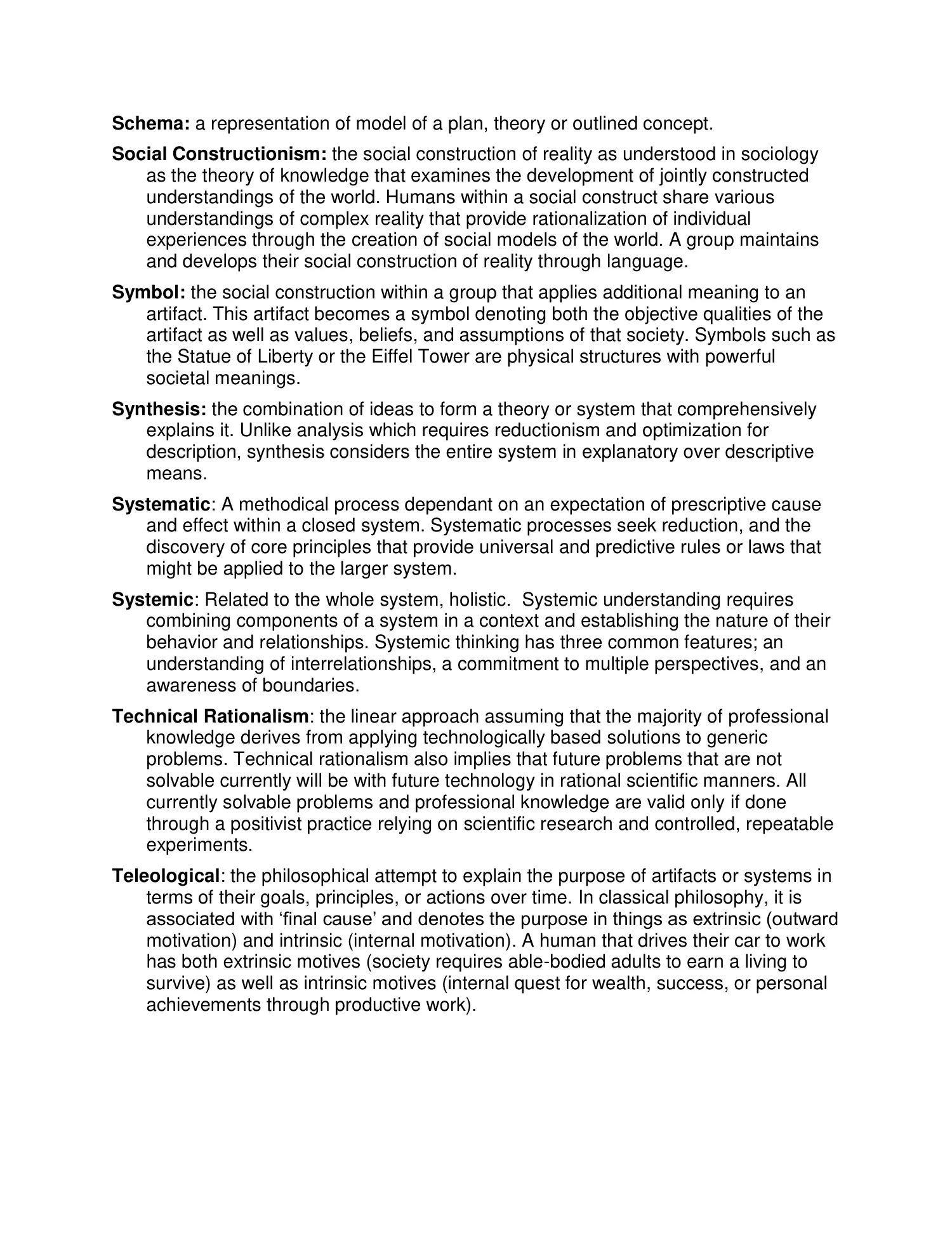
Schema: a representation of model of a plan, theory or outlined concept.
Social Constructionism: the social construction of reality as understood in sociology
as the theory of knowledge that examines the development of jointly constructed understandings of the world. Humans within a social construct share various understandings of complex reality that provide rationalization of individual experiences through the creation of social models of the world. A group maintains and develops their social construction of reality through language.
Symbol: the social construction within a group that applies additional meaning to an
artifact. This artifact becomes a symbol denoting both the objective qualities of the artifact as well as values, beliefs, and assumptions of that society. Symbols such as the Statue of Liberty or the Eiffel Tower are physical structures with powerful societal meanings.
Synthesis: the combination of ideas to form a theory or system that comprehensively
explains it. Unlike analysis which requires reductionism and optimization for description, synthesis considers the entire system in explanatory over descriptive means.
Systematic: A methodical process dependant on an expectation of prescriptive cause
and effect within a closed system. Systematic processes seek reduction, and the discovery of core principles that provide universal and predictive rules or laws that might be applied to the larger system.
Systemic: Related to the whole system, holistic. Systemic understanding requires
combining components of a system in a context and establishing the nature of their behavior and relationships. Systemic thinking has three common features; an understanding of interrelationships, a commitment to multiple perspectives, and an awareness of boundaries.
Technical Rationalism: the linear approach assuming that the majority of professional
knowledge derives from applying technologically based solutions to generic problems. Technical rationalism also implies that future problems that are not solvable currently will be with future technology in rational scientific manners. All currently solvable problems and professional knowledge are valid only if done through a positivist practice relying on scientific research and controlled, repeatable experiments.
Teleological: the philosophical attempt to explain the purpose of artifacts or systems in
terms of their goals, principles, or actions over time. In classical philosophy, it is associated with ‘final cause’ and denotes the purpose in things as extrinsic (outward motivation) and intrinsic (internal motivation). A human that drives their car to work has both extrinsic motives (society requires able-bodied adults to earn a living to survive) as well as intrinsic motives (internal quest for wealth, success, or personal achievements through productive work).