
JSOU Press · May 2017
Enhancing the Global SOF Enterprise: A Consortium Concept
Walter Christman’s occasional paper for Joint Special Operations University describes a consortium for professional learning.
Page 1 of 24
Read page 1 as text
Enhancing the Global
SOF Enterprise: A Consortium Concept
by
Walter L. Christman, Ph.D.
Joint Special Operations University
Center for Special Operations Studies and Research
JSOU Press Occasional Paper
May 2017
Page 2 of 24
Read page 2 as text
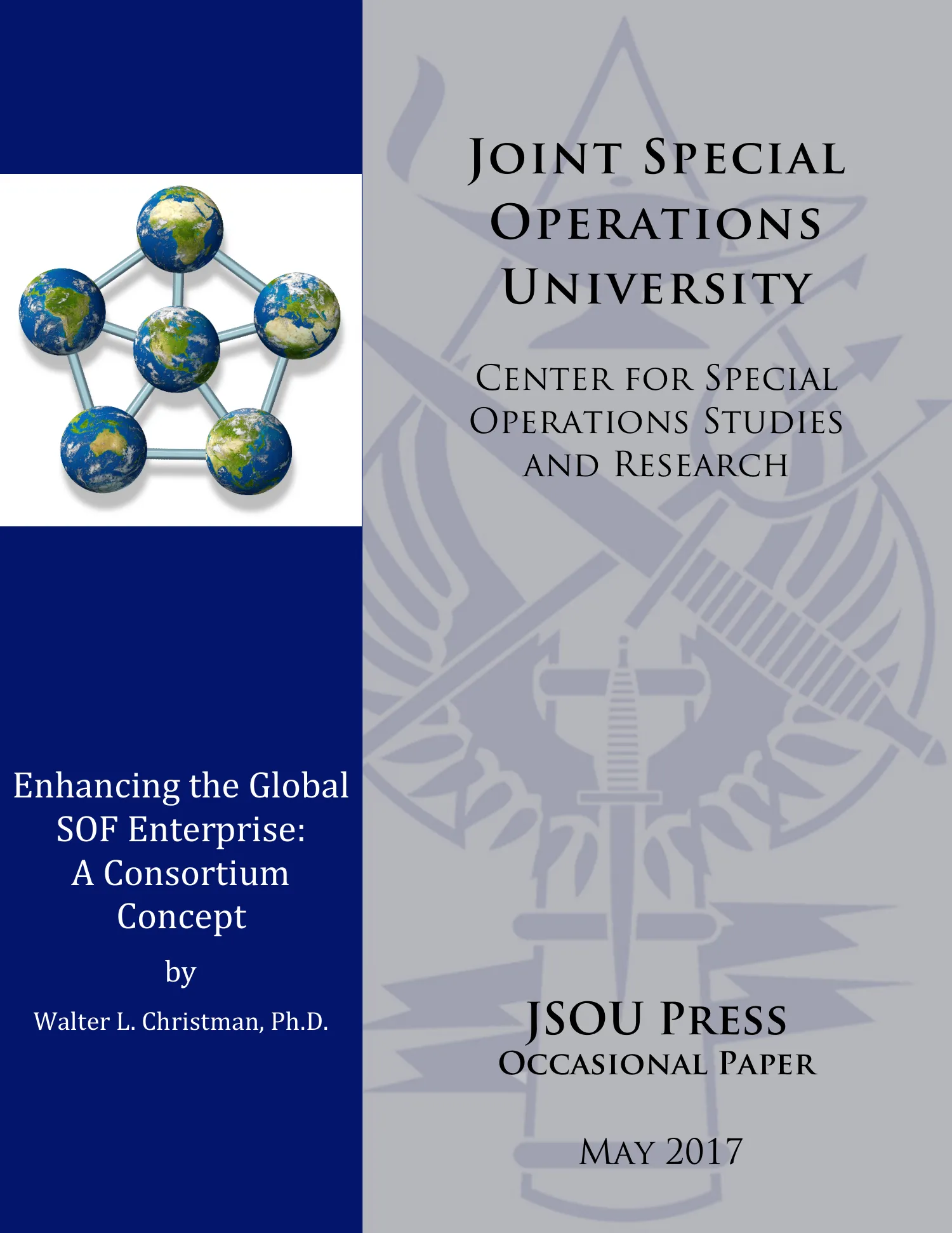
On the cover: The Global Special Operations Consortium model must support all United States Special Operations Command theater special operations commands worldwide, helping them orchestrate sub-networks as a collaborative mechanism for education, networking, and coordination to gain regional insights and forge viable solutions for regional problems. SOURCE: Can Stock Photo/focalpoint
JSOU Press Publications are available to view or download at:
http://jsou.libguides.com/jsoupublications
The views expressed in this publication are entirely those of the author and do not necessarily reflect the views, policy or position of the United States Government, Department of Defense, United States Special Operations Command, or the Joint Special Operations University.
Authors are granted academic freedom provided their work does not disclose classified information, jeopardize operations security, or misrepresent official U.S. policy. Such academic freedom empowers authors to offer new and sometimes controversial perspectives in the interest of furthering debate on key issues.
Page 3 of 24
Read page 3 as text
Walter L. Christman, Ph.D. Dr. Walter L. Christman is a pioneer in the global adoption of new ventures in defense cooperation to enable enhanced regional and global security. He is the principal architect of seven Secretary of Defense initiatives, three of which were endorsed by a United States president.
He is chairman and CEO of the Global Challenges Forum Foundation, an organization of think tanks, research centers, and academic institutions contributing to the much-needed resolution of existing and future global security challenges. In collaboration with the United Nations Institute for Training and Research, he recently launched the Global Knowledge Networking Initiative to foster innovation in next-generation leadership development.
As president of Global Strategic Analysis, LLC, a forward-thinking professional services firm headquartered in San Luis Obispo, California, he offers confidential analytic support and creative services to worldwide clients who seek to foster innovative solutions for a secure and sustainable world. Its subsidiary, the LEADS Institute (Leadership Education and Analysis for Development and Security) promotes innovative learning and leader development.
Dr. Christman’s 30-year career with the U.S. government spanned service in the Armed Forces, U.S. Congress, the Pentagon, the State Department, and the White House, with travel to more than 50 countries, and more than 10 years of service as a U.S. diplomat in the international community of Geneva, Switzerland. His academic career includes service as associate professor of global public policy with the Naval Postgraduate School; visiting distinguished research fellow of the Institute for National Strategic Studies at the National Defense University; senior fellow at the Middlebury Institute of International Studies; and visiting scholar at Shanghai Jiao Tong University in China.
He has overseen strategic collaboration efforts, supporting the Office of the Secretary Defense and U.S. Joint Forces Command in collaboration with the United Nations, the North Atlantic Treaty Organization (NATO), and through bilateral agreements with partner nations in Europe, the Middle East, and Asia. He was principal architect and negotiator for multiple Secretary of Defense memoranda of understanding with foreign partners. He was awarded the Secretary of Defense Medal for Meritorious Civilian Service for his role in conceiving and establishing the George C. Marshall European Center for Security Studies in Garmisch, Germany, and was principal architect of NATO’s Partnership Training policies.
Dr. Christman holds a Ph.D. in international relations from the University of Geneva, a master’s in public administration from Harvard University, a master’s in international affairs from Columbia University, and a bachelor’s from Duke University. He served four years active duty on a U.S. Army Special Forces A-Team trained in the delivery of man-portable nuclear weapons. He is Airborne-, Ranger-, and Special Forces–qualified, and was awarded a medal for heroism for risking his life to save others during a peacetime training incident. Dr. Christman is the 2017 Inductee to the Army ROTC Hall of Fame at Duke University.
Page 4 of 24

Read page 4 as text
Blank page in the original publication.
Page 5 of 24
Read page 5 as text
1
“The conditions of 2014 are different than those of 1944, and the tools with which unconventional warfare is waged today differ greatly. We must advance from the nostalgic vision of remote guerrilla bases in denied territory and adapt to a world of split-second communications and data transfer, non-violent resistance, cyber and economic warfare, and the manipulation of international law to undermine national sovereignty … In our era, unconventional warfare is more likely to take the form of a civil resistance movement, perhaps manipulated by foreign powers, that seeks to provoke a violent government response in order to destroy that government’s legitimacy in the eyes of the international community. Waging and countering this new unconventional warfare demands great sophistication and agility.”1 As we look ahead, it is increasingly clear that the solutions to the complex, multi-faceted challenges that the United States Special Operations Command (USSOCOM) faces around the globe are beyond the scope of a single actor (be it the military) or a single nation or multilateral organization. Globalization’s increasing tendency to undermine the sovereignty of nation-states results in governments, in general, and militaries, in particular, facing an increasingly broad gamut of challenges to established governance and security. Russia’s ‘New Generation Warfare’ similarly and deliberately fosters a condition of hyper-tension among and within nations to accrue asymmetric benefits to itself without going to war. As humankind moves toward a knowledge- based smart society, successful Special Operations Forces (SOF) solutions will require new partnerships, new approaches, and new skills, leveraging new technologies to build trust and foster a new kind of smart collaboration. It is strategically imperative for U.S. and partner forces to build the capacity for resilience needed to succeed in the ‘gray zone,’ characterized by “intense political, economic, informational, and military competition more fervent in nature than normal steady-state diplomacy, yet short of conventional war.”2
This paper addresses the means for connecting the global SOF enterprise (meaning the collective capacities of all friendly SOF on a worldwide basis) and promotes education for interoperability, bringing together the USSOF in collaboration with the SOF from any nation willing to work with the U.S. and its regional partners. The argument builds upon an outstanding seminal article, “The Future of SOF Education: A Vision for Global Special Forces Education” by the Hungarian, Imre Porkoláb.3 Whether addressing complex challenges in Afghanistan, France, Syria, or Ukraine (or anywhere else from A to Z), the challenges are increasing. We need to
1 Major General Gregory J. Lengyel, Commander, United States Special Operations Command Europe (SOCEUR), Opening Remarks to the “Resistance and Resilience” Seminar (Baltic Defence College, Tartu, Estonia, 4 November 2014). 2 Joseph L. Votel, Charles T. Cleveland, Charles T. Connett, and Will Irwin, “Unconventional Warfare in the Gray Zone,” Joint Forces Quarterly 80 (2016): 101–105. 3 Colonel Imre Porkoláb, “The Future of SOF Education: A Vision for Global Special Forces Education,” CTX 3, No. 4 (2013): 50–60, https://globalecco.org/the-future-of-sof-education-a-vision-for-global-special-forces-education.
Page 6 of 24
Read page 6 as text
2
coordinate comprehensive responses to humanitarian disasters, cope with emerging complex threats posed by terrorism and international crime, engage networked populations empowered through social media, and contend with increased tensions due to changing climatic, environmental, and resource issues everywhere. This means that the foreign policy and national security sector organizations involved must increasingly manage a process for interplay among varied actors beyond anyone’s direct control. A whole array of new security risks accompanies the problems of globalization and hybrid warfare, and results in “wicked problems”4 that are highly resistant to resolution.
Our global and collective brew of wicked problems is part of what this paper calls ‘a world of panarchy,’ which is defined here to mean the competition of new actors in the gray zone, as
described by SOF leaders, and accelerated even more by the unpredictable consequences of continuously evolving technology. In short, game change is everywhere, all the time, and cannot be constrained by old paradigms. Designing a competitive strategy to deal with this challenge begins with establishing the goals (or ends) for the strategy. It needs to be coupled with an assessment of the operating environment, as well as participants’ assets and vulnerabilities. The response must assemble an array of defense, development, and diplomacy tools (for ‘3D’ security) within a framework for success, creating a value chain-linking actions to goals for strategic effect.
Within USSOCOM, this vision was originally articulated as a Global SOF Network (GSN).5 The GSN was meant to provide the nexus between regional historical/cultural understandings and language capabilities, while providing a means to engage fellow SOF organizations and interagency partners worldwide through regional coordination centers. It also was meant to build trust and confidence while operating forward by maintaining a small, low-cost footprint. The original elements of a global SOF strategy came together and coalesced around the understanding, as then USSOCOM commander Navy Admiral William McRaven noted in 2012, “you cannot surge trust.”6 The USSOCOM GSN concept (which this paper seeks to improve upon) went through a start-up phase with the initial proposed end-state being a global network of operational centers.7 Instead, the author proposes an alternate next-generation approach that is provisionally named the Global Special Operations Consortium (GSOC). Leaning away from formal command-and-control structures, it suggests international collaboration in developing a
4 Horst W. J. Rittel and Melvin M. Webber, “Dilemmas in a General Theory of Planning,” Policy Sciences 4, No. 2 (1973): 155–169. 5 The Global SOF Network (GSN) Concept of Operations (entitled “Expanding Global SOF Network CONOPS,” dated 29 July 2013) was endorsed by Joint Requirements Oversight Council Memorandum (JROCM) 165-13, 16 October 2013. The CONOP describes the framework of the GSN and the links to strategic guidance, GCC-validated requirements for joint SOF, and international SOF mission partners. 6 David Trulio, “You Can’t Surge Trust—Insights from the Opening of the Aspen Security Forum,” Security Debrief, 27 July 2012, http://securitydebrief.com/2012/07/27/you-cant-surge-trust-insights-from-the-opening-of-the-aspen-security-forum/. 7 One of the original concepts was to establish ‘Regional SOF Coordination Centers’ (RSCCs) based upon the model of the NATO SOF Coordination Center, which eventually led to the establishment of the NATO SOF Headquarters. This approach did not win universal approval from other stakeholders for other regions and has not been implemented.
In short, game change is everywhere, all the time, and cannot be constrained
by old paradigms.
Page 7 of 24
Read page 7 as text
3
global and integrated virtual education, training, simulation, and gaming capability as a better way to fulfill the vision of a GSN.
The key to success will be involving international partners early in the design of a consortium approach, to avoid the U.S. showing up with a solution and presenting it to our friends who likely will say, ‘Thanks, but no thanks.’ Our international partners have opinions, preferences, and ideas—especially related to learning opportunities and how to approach education—and, if we listen, they might come up with a better solution. We need a process to seek them out, and a mechanism to incorporate their views on sensitive topics, such as interoperability, integration, and interdependence between SOF and conventional forces, interagency, and/or international forces. We need a new mechanism for the GSN to be enhanced and better connect U.S. regional combatant commands with regional SOF partners.
In support, this paper proposes the establishment of a small GSOC planning cell to identify the best pathways for the creation of regionally based, pilot-project elements of the initiative. The proposed planning team could help USSOCOM and its theater special operations commands (TSOCs), aligned with each U.S. regional combatant command, seek out and identify interoperability problems that should be fixed.8 Particular attention should be given to addressing transregional synchronization requirements and related support of enabling activities, such as conference planning, exercises, and war games.9 It would also help the U.S. improve transregional synchronization along the seams of the various combatant commands, enabling better cross- boundary coordination.
The primary purpose of the proposed consultation and collaboration process with TSOCs would be to facilitate an exploration of the ways and means by which individuals, organizations, and nations through GSOC can employ new methods of inclusiveness, transparency, and self-differentiation to build ‘networked resilience’ in the gray zone. If the concept takes hold, it would likely remain thinly staffed at the center, with robust applications at the edge. The GSOC could be a key enabler for the next generation of SOF coalition interoperability and training. It could transform the process by enabling ‘smart-pull, power to the edge,’ meaning experiential learning responses extending beyond military collaboration and interagency civilian- military (civ-mil) cooperation, including the incorporation of public-private partnerships. It would foster a learning ecosystem for collaborative sensemaking—a shared consciousness leading to empowered execution.
8 United States Joint Chiefs of Staff, Joint Publication 3-05, Special Operations, 16 July 2014 (page ix), defines a TSOC as a subordinate unified command of USSOCOM. TSOCs perform broad, continuous missions uniquely suited to SOF capabilities. SecDef has assigned operational control (OPCON) of the TSOCs and attached SOF tactical units to their respective geographic combatant commander (GCC) via the Global Force Management Implementation Guidance. A GCC normally exercises OPCON of attached SOF through the commander, theater special operations command (CDRTSOC). 9 The author thanks Colonel Matthew M. McHale, Director of USSCOM J3-I for this recommendation.
The GSOC could be a key
enabler for the next
generation of SOF coalition interoperability
and training.
Page 8 of 24
Read page 8 as text
4
In developing the GSOC model, it must be carried out in a manner that can support all USSOCOM TSOCs worldwide. The proposed GSOC concept development team should work to help TSOCs orchestrate sub-networks, not as operational nodes, but rather as a collaborative mechanism for education, networking, and coordination to gain regional insights and forge viable solutions for regional problems. The proposed team would foster the co-development of a concept design to empower regional cooperation through SOF communities, offering innovative possibilities for next-generation configuration of strategy, structure, technology, and leadership. Client-centered, digitally-powered training, analysis, and simulation would emerge for: disaster preparedness and protection of critical infrastructure; border, maritime, and cyber security; energy security; and most particularly, the challenges posed by terrorism and hybrid warfare. The global SOF enterprise would connect through online collaboration and fuel enhanced continuing education for graduates of SOF-related training and education.
The GSOC Overarching Framework in a World of Panarchy
A fundamental principle undergirding the GSOC concept is that the transformation of security cooperation in the Information Age is a process that takes place at the edge of conceptual and organizational boundaries, from which a newly constructed and shared identity emerges as a by-product. The primary new identity that the GSOC model brings into focus is one in which a global community of SOF shares responsibility for co-evolving organization, command concepts, and doctrine among many nations in order to promote an ‘interoperability of the mind’ and take advantage of advances in technology to win in a complex world of panarchy and wicked problems.
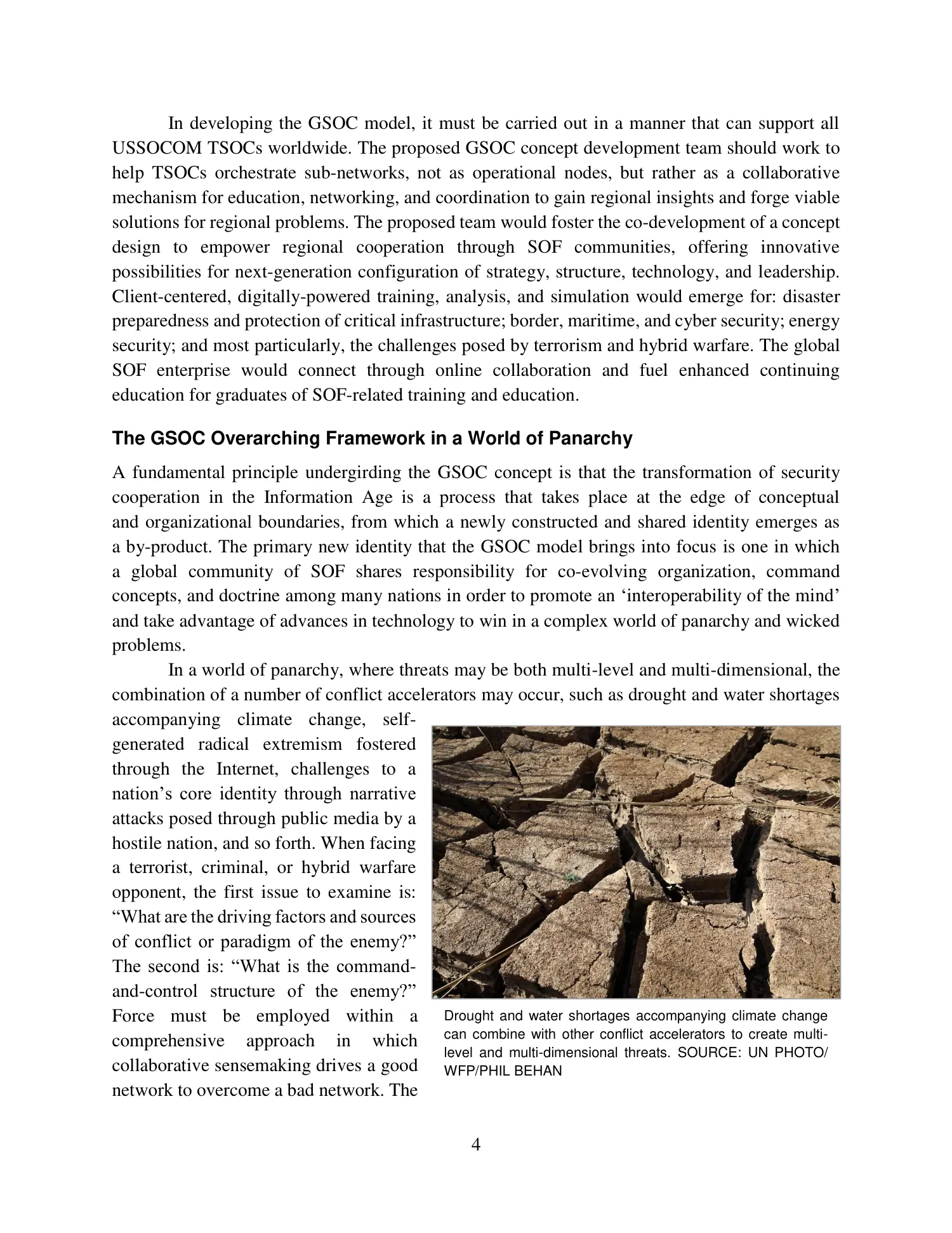
In a world of panarchy, where threats may be both multi-level and multi-dimensional, the combination of a number of conflict accelerators may occur, such as drought and water shortages accompanying climate change, self- generated radical extremism fostered through the Internet, challenges to a nation’s core identity through narrative attacks posed through public media by a hostile nation, and so forth. When facing a terrorist, criminal, or hybrid warfare opponent, the first issue to examine is: “What are the driving factors and sources of conflict or paradigm of the enemy?” The second is: “What is the command- and-control structure of the enemy?” Force must be employed within a comprehensive approach in which collaborative sensemaking drives a good network to overcome a bad network. The
Drought and water shortages accompanying climate change can combine with other conflict accelerators to create multi- level and multi-dimensional threats. SOURCE: UN PHOTO/ WFP/PHIL BEHAN
Page 9 of 24
Read page 9 as text
5
GSOC concept addresses the need for a new, more comprehensive approach to unconventional warfare (UW) that brings forth all elements of national power through horizontal escalation in times of crisis (i.e., DIMEFIL [Diplomatic, Information, Military, Economic, Financial, Intelligence, Law Enforcement] in Phase 0 [zero], the Shape component of the military joint planning six-phase model).10
To enhance the global SOF enterprise, the GSOC would help bring more academic and intelligence community attention to the security environment in any region of the world where nations are besieged by terrorism, crime, or hybrid warfare. The key is to focus on the socio- technical infrastructure of a given partner nation’s stage of development with the goal of enhancing its resilience to complex emergencies, however they may arise. Co-development of a resilience strategy means, by definition, that the partner nation leads. Fighting back means transforming to a more resilient society. This cannot be achieved through strategic communications alone. The essential capability that must be achieved is the strengthened resilience in a nation through training and exercises that increase its capacity for horizontal escalation.
An essential element of successful operations in the gray zone concerns the issue of territorial control. If the governing authorities and associated civil protection and police are not in control of a particular place, then the ungoverned space will be controlled by someone else. This could be a right-wing paramilitary organization, a radical extremist group with religious connotations, a leftist insurgency in league with criminal cartels, or a foreign power working through ethnic or ideological surrogates. The national strategy to employ UW to assume control over the battle space and reassert sovereignty can only be based upon the goal of assuring the protection of all of its citizens. This is a fundamental aspect of assuring legitimacy in governance, bringing together defense, development, and diplomacy in working harmony. Therefore, in any resilience-to-resistance strategy, what is really at stake is the battle for legitimacy and control of the population through consent, enhanced by support from the international community.
So, the central task is to build partnerships for smart security and community resilience at the leading edge of the knowledge revolution. This could be considered the core mission statement for the GSOC. Progress in security will bring progress in development. This understanding should be the essence of next-generation SOF leader development to assist partners in building military capacity to resist internal as well as external threats.
Making Knowledge Actionable by Building Networked Resilience
Smart security builds on actionable knowledge and enhanced readiness. Dealing effectively with contemporary emerging and converging non-traditional threats and risks requires prepared
10 United States Joint Chiefs of Staff, Joint Publication 5-0, Joint Operation Planning, 11 August 2011. This publication includes the six-phase operational planning model of shape, deter, seize the initiative, dominate, stability, and enable civil authority.
An essential element of successful operations in the gray zone concerns the
issue of territorial control.
Page 10 of 24
Read page 10 as text
6
coalitions of partners that are able to plan, coordinate, and operate together rapidly and decisively. Fundamental to the USSOF strategic vision are capable, enduring, and resilient partnerships.
In support of this, the GSOC is envisioned to be a versatile virtual hub linking a wide array of regional educational and operational partners with a large range of integrated services that enable participants to share knowledge, collaborate, plan, and execute together. It would help
foster communities of practice to bring about rapid, decisive responses to complex emergencies. The design challenge would be to ensure it was carried out in a manner that builds trust and confidence in support of forward-deployed education and training, powered by additional capabilities for virtual interaction. A technologically linked educational delivery system would be the backbone. Transregional synchronization between geographic regions could share successes and enhancements so that one region’s innovative tactics, techniques, and procedures (TTP) or unique political-military (pol-mil) perspective could assist another region in the advancement of its security.
The GSOC would, therefore, provide a sustainable means for TSOCs to work together in building persistent engagement programs to best enhance the capabilities of U.S. regional combatant commanders. It would also help develop a global SOF educational philosophy or approach. Each TSOC would collaborate with the GSOC planning team to devise pilot projects and innovative approaches tailored to the specific challenges of their region. The GSOC key organizing principle should be that co-developing next-generation USSOF together with international partners, organizations, and individuals can produce sharable experiences. It can bring together best practitioner experiences, technical capabilities, and interactive learning programs to pinpoint the most effective TTP, as well as information technology solutions and applications in which realistic training scenarios and experiential learning can lead to more effective defense and crisis response capability. This translates into capacity building for resilience.
It is recommended that the GSOC neither replicates nor duplicates existing networks or platforms. Rather, it is suggested that it become an integrator of existing platforms and networks. There is no need for additional centers of excellence or islands of knowledge. There is, however, a greater need for increased connectivity and systems thinking that allows for better outcomes. Implementation of pilot projects and further analysis by each TSOC would allow the GSOC to be a nimble integrated architecture that evolves more easily along with the commercial technology market and is more adaptive to stakeholders’ needs. It should evolve into a global, one-stop-shop educational technology platform allowing practitioners to compose their own solutions. By this principle, the GSOC’s added value stems from the trust and collaboration developed as a result of the synergy created between technologies, people, and ideas, and that enables the cultivation of new partnerships better able to bring swift resolution to complex crises. Decentralized execution occurs as each TSOC develops distinctive approaches. The GSOC can help aggregate and
[The GSOC] would help
foster communities of practice to bring about rapid, decisive responses to complex emergencies.
Page 11 of 24
Read page 11 as text
7
disseminate best practices, building a body of knowledge and best practices for networked resilience that can be shared on a global basis, advancing the frontier of knowledge on how best to respond to complex emergencies anywhere in the world.
The GSOC Vision: A ‘Composable Organization’ for Purposeful Partnerships
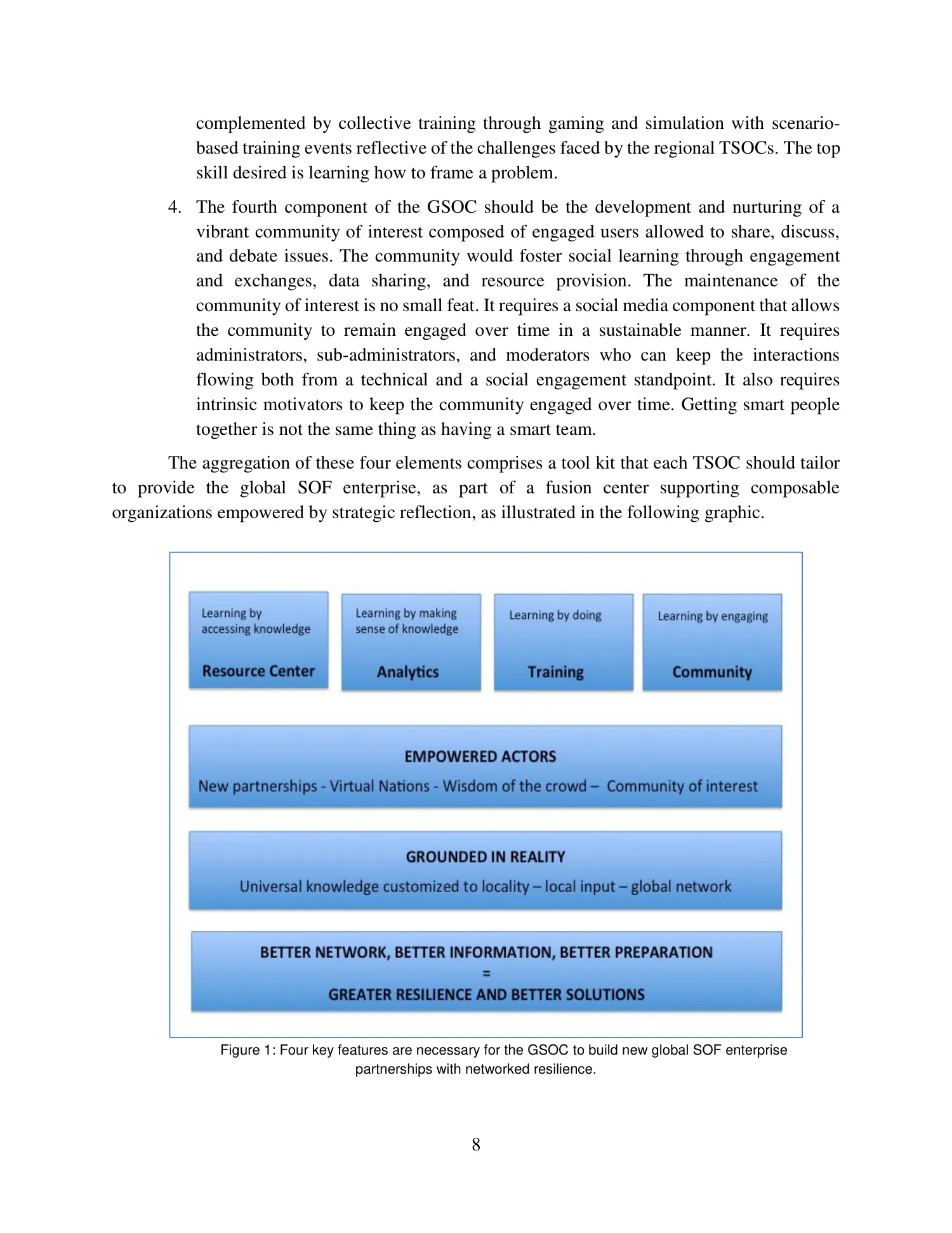
The GSOC vision is predicated upon two ideas. First, we can better leverage the vast amount of existing (and future) knowledge through open, accessible, interactive, and persistent networks that allow people to access what they need when they need it to enhance their situational awareness. Second, the need for collaboration is no longer simply about information sharing, deliberation, or reaching consensus. It is about fostering unity of effort through actual integrated action between and within multi-stakeholder partnerships. These should be elements of an agile ‘composable organization,’ which can be modified or reorganized based on the needs of the moment. To achieve the ambitious agenda of promoting new global SOF enterprise partnerships to enhance resilience and bring about rapid, decisive responses to complex emergencies, the following key features are envisioned for the GSOC:
1. The GSOC should offer a resource center to each TSOC and its regional partners where
key knowledge can be easily accessed. Considering the rapid speed at which knowledge accumulates, an actionable resource center should be designed with the goal of making the right content available to the right person at the right time. Here, knowledge curation through artificial intelligence, automated multi-lingual capabilities, and universal knowledge grounded in localized experience are key desirable technical features. Otherwise, greater access to information does not necessarily lead to greater discernment.
2. The GSOC should also offer a strong analytics and visualization component to help
users throughout the global SOF enterprise rapidly make sense of the vast knowledge available. The increasing amount of knowledge and volume of data available can lead to information overload. Having the ability to make sense of it through data analytics and visualization is key to making knowledge actionable. Analytics and visualization can also help break down information silos and bring about holistic and systems approaches necessary to imagine the creative solutions to tomorrow’s challenges. These are fundamental to anticipating, detecting, and understanding wicked problems. Data driven learning must be ready for situated assessment. Pockets of ignorance could become tremendous failure points. Advanced situational awareness is the goal, starting with a baseline of knowing what ‘right’ looks like.
3. A third component of the GSOC should focus on education and training modules that
allow users to learn by doing. Training is the component that allows users to get better through practice, self-perfection, and minor innovations and adjustments, otherwise designed as the learning curve. Past experiences in NATO’s Partnership for Peace attest to the validity of such an approach. Individual education and training should be
Page 12 of 24
Read page 12 as text
8
complemented by collective training through gaming and simulation with scenario- based training events reflective of the challenges faced by the regional TSOCs. The top skill desired is learning how to frame a problem.
4. The fourth component of the GSOC should be the development and nurturing of a
vibrant community of interest composed of engaged users allowed to share, discuss, and debate issues. The community would foster social learning through engagement and exchanges, data sharing, and resource provision. The maintenance of the community of interest is no small feat. It requires a social media component that allows the community to remain engaged over time in a sustainable manner. It requires administrators, sub-administrators, and moderators who can keep the interactions flowing both from a technical and a social engagement standpoint. It also requires intrinsic motivators to keep the community engaged over time. Getting smart people together is not the same thing as having a smart team.
The aggregation of these four elements comprises a tool kit that each TSOC should tailor to provide the global SOF enterprise, as part of a fusion center supporting composable organizations empowered by strategic reflection, as illustrated in the following graphic.
Figure 1: Four key features are necessary for the GSOC to build new global SOF enterprise
partnerships with networked resilience.
Page 13 of 24
Read page 13 as text
9
Enabling the SOF Operator through ‘Unity of Effort’ and Purposeful Partnerships
By its very nature, the GSOC will depend on connected centers and hubs of knowledge, activity, planning, training, exercises, etc., that host collaborative efforts between the U.S., NATO, other key SOF partners in other countries, and GSOC personnel. The following explains the general architecture of what the GSOC could look like at end-state, building upon existing resources, but it will require active partner participation in the design development and implementation stage.
• A GSOC exercise element, perhaps as part of the USSOCOM J3-I division,11 could provide a global SOF enterprise virtual joint command (VJC) that could be situated as an exercise command center, bringing together commanders and staff for distributed simulation, war gaming, and joint exercise training.
• The GSOC could be complemented by a smart leaders center (SLC) for education, to be situated at the Joint Special Operations University (JSOU) in support of the global SOF enterprise. The SLC could serve as the educational clearinghouse and common institutional reference and venue for all global SOF education activities. The VJC and SLC are also institutional infrastructures to help the GSOC enable one or more global SOF enterprise participating states to become a global security partner for training and education. Note: While such coalition training infrastructures do not yet exist, the participation by partner SOF forces in the U.S.-led international coalition to fight the Islamic State in Iraq and Syria is an example of such a possibility that could be enhanced in collaboration with the United States Central Command TSOC.
• Operationally, the GSOC VJC and the JSOU SLC would operate in both classified and unclassified environments. Situated at JSOU, the SLC could discuss more openly the strategic leadership issues, without the necessity of safeguarding information of a sensitive operational nature. It could also be the nucleus of future educational activity and orientation for cross-national relationships and associations that may provide a research-based foundation for enhancing the technical aspects of the learning, training, and practical experience that may be gained through collective training and simulation.
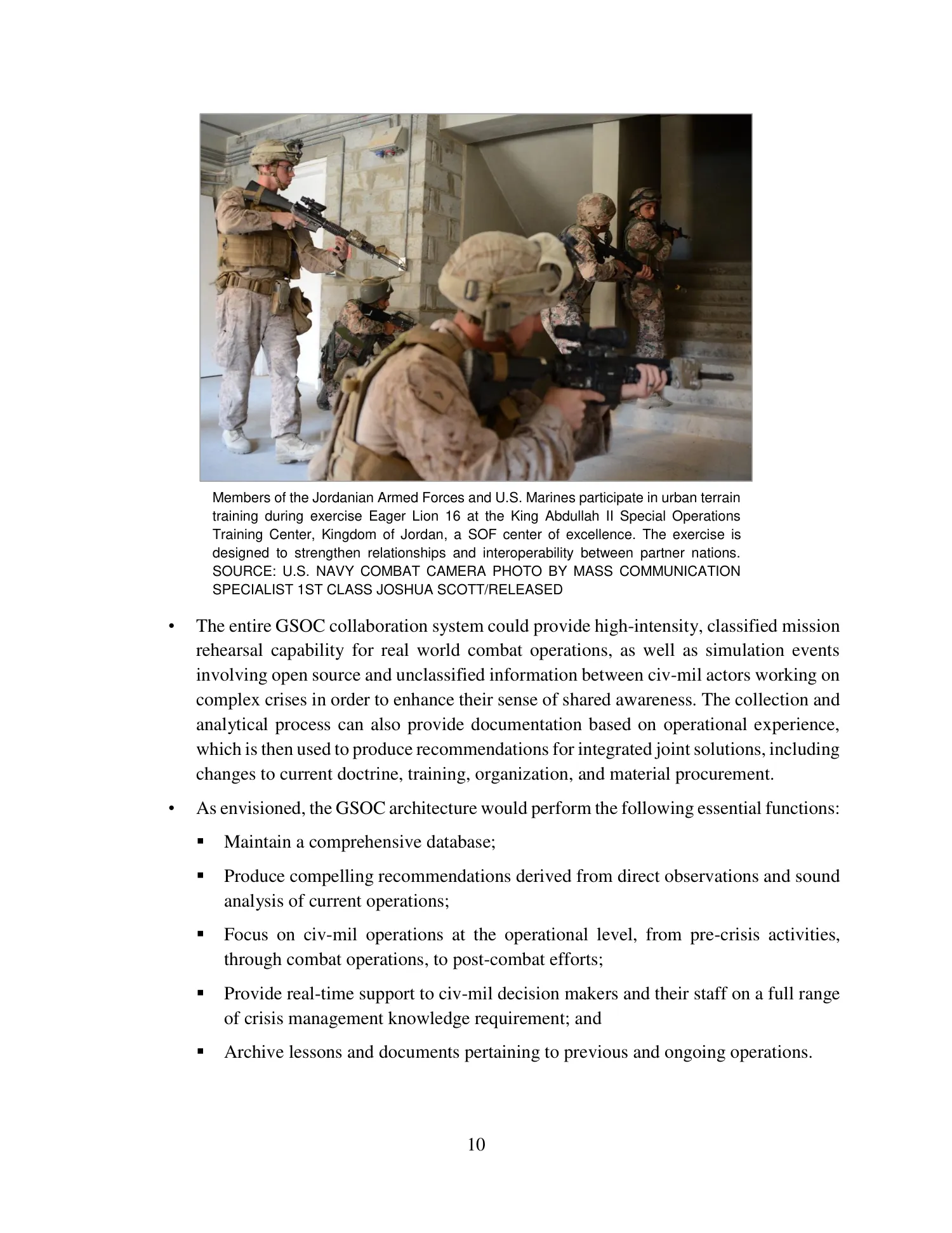
• A series of connected collaboration centers could be established within the other member states of the global SOF enterprise (e.g., through the GSOC) and within other regional U.S. combatant command strategic partner states, and could provide centers of excellence in various topics. In particular, Jordan has taken a leading role in developing a SOF center of excellence.
11 J3-I is the USSOCOM J3 staff component with responsibility for managing the participation of assigned Special Operations Liaison Officers (SOLOs) from nations contributing personnel to staff the GSN.
Page 14 of 24
Read page 14 as text
10
• The entire GSOC collaboration system could provide high-intensity, classified mission rehearsal capability for real world combat operations, as well as simulation events involving open source and unclassified information between civ-mil actors working on complex crises in order to enhance their sense of shared awareness. The collection and analytical process can also provide documentation based on operational experience, which is then used to produce recommendations for integrated joint solutions, including changes to current doctrine, training, organization, and material procurement.
• As envisioned, the GSOC architecture would perform the following essential functions:
Maintain a comprehensive database;
Produce compelling recommendations derived from direct observations and sound
analysis of current operations;
Focus on civ-mil operations at the operational level, from pre-crisis activities,
through combat operations, to post-combat efforts;
Provide real-time support to civ-mil decision makers and their staff on a full range
of crisis management knowledge requirement; and
Archive lessons and documents pertaining to previous and ongoing operations.
Members of the Jordanian Armed Forces and U.S. Marines participate in urban terrain training during exercise Eager Lion 16 at the King Abdullah II Special Operations Training Center, Kingdom of Jordan, a SOF center of excellence. The exercise is designed to strengthen relationships and interoperability between partner nations. SOURCE: U.S. NAVY COMBAT CAMERA PHOTO BY MASS COMMUNICATION SPECIALIST 1ST CLASS JOSHUA SCOTT/RELEASED
Page 15 of 24
Read page 15 as text
11
The VJC exercise element would link the friendly partner nations of a global SOF enterprise. The SLC would focus on SOF-unique education as a core information node in regional and global distributed hubs and knowledge networks. This combination would be a fusion center to facilitate the sharing of ideas and best practices among global SOF enterprise members.
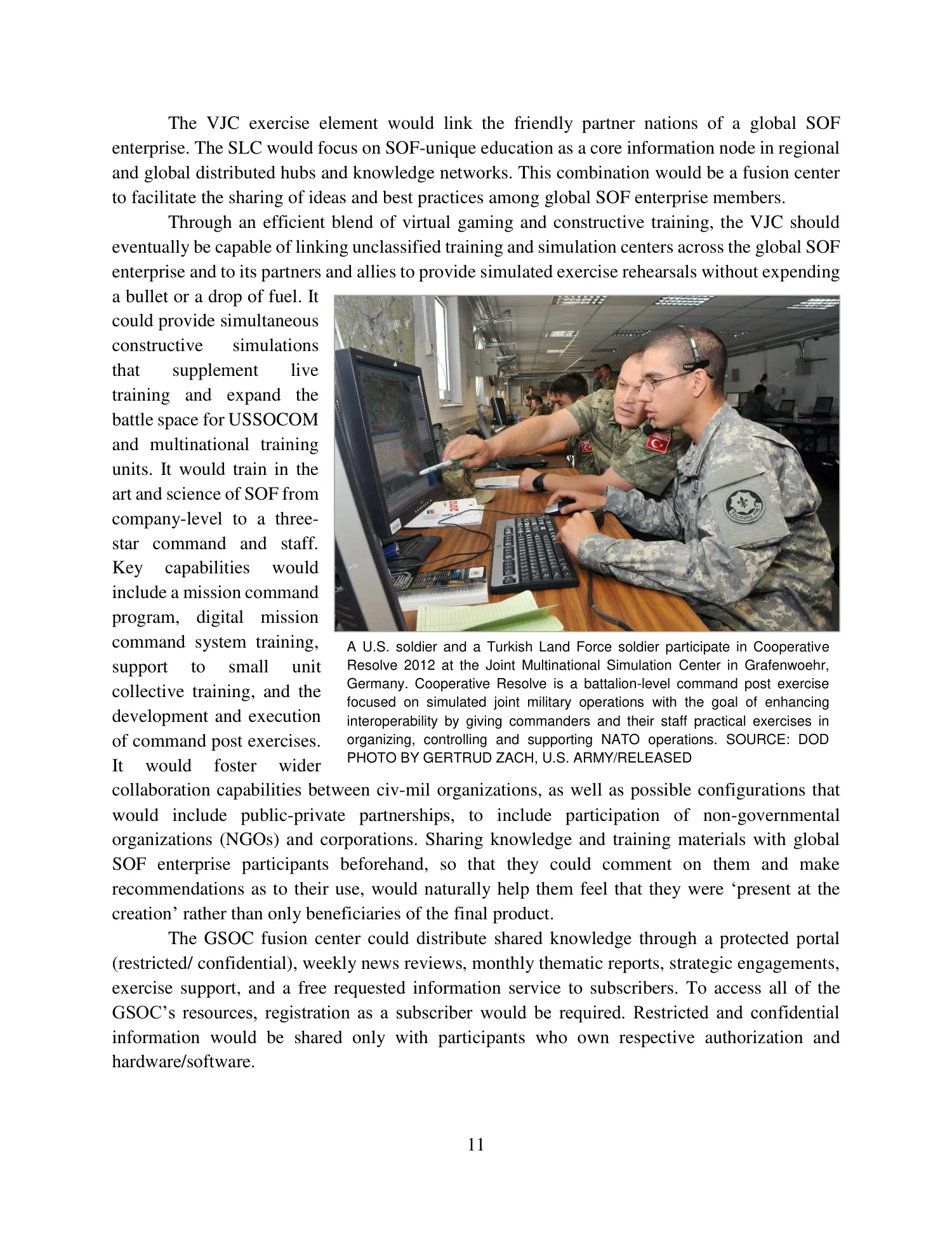
Through an efficient blend of virtual gaming and constructive training, the VJC should eventually be capable of linking unclassified training and simulation centers across the global SOF enterprise and to its partners and allies to provide simulated exercise rehearsals without expending a bullet or a drop of fuel. It could provide simultaneous constructive simulations that supplement live training and expand the battle space for USSOCOM and multinational training units. It would train in the art and science of SOF from company-level to a three- star command and staff. Key capabilities would include a mission command program, digital mission command system training, support to small unit collective training, and the development and execution of command post exercises. It would foster wider collaboration capabilities between civ-mil organizations, as well as possible configurations that would include public-private partnerships, to include participation of non-governmental organizations (NGOs) and corporations. Sharing knowledge and training materials with global SOF enterprise participants beforehand, so that they could comment on them and make recommendations as to their use, would naturally help them feel that they were ‘present at the creation’ rather than only beneficiaries of the final product.
The GSOC fusion center could distribute shared knowledge through a protected portal (restricted/ confidential), weekly news reviews, monthly thematic reports, strategic engagements, exercise support, and a free requested information service to subscribers. To access all of the GSOC’s resources, registration as a subscriber would be required. Restricted and confidential information would be shared only with participants who own respective authorization and hardware/software.
A U.S. soldier and a Turkish Land Force soldier participate in Cooperative Resolve 2012 at the Joint Multinational Simulation Center in Grafenwoehr, Germany. Cooperative Resolve is a battalion-level command post exercise focused on simulated joint military operations with the goal of enhancing interoperability by giving commanders and their staff practical exercises in organizing, controlling and supporting NATO operations. SOURCE: DOD PHOTO BY GERTRUD ZACH, U.S. ARMY/RELEASED
Page 16 of 24
Read page 16 as text
12
With rapidly evolving military threats and fast-paced technological developments becoming the norm, civ-mil crisis management increasingly relies on computer-based war gaming and training programs. Modeling and simulation technologies and methods can help organizations train to high-consequence scenarios, exercise, and verify readiness. To this end, the GSOC VJC and SLC could become a world-class continuing education program for both individual and collective learning. It would provide dynamic online leadership training as it prepares civ-mil decision-makers, including attached units, to execute civ-mil multinational operations and contingencies in support of crisis management in national and multinational formats, including cooperation with NATO.
Building Networked Resilience through ‘Cooperability’
In a networked enterprise, authentic trust results from social bonds and shared identities developed between individual participants. This requires understanding and valuing the stakeholders’ cultural beliefs. Too often, leaders in multi-partner environments are not well prepared to deal with the complex challenges they encounter, operationally or culturally. They must quickly build rapport with counterparts whose culture and traditions they don’t understand, negotiate with counterparts whose organizations may have differing agendas, and solve unfamiliar problems by collaborating. In short, as Admiral McRaven noted, trust cannot be surged. To be successful, leaders from all partnering nations will need a knowledge of joint and partner capabilities; skills in building rapport, negotiating, and influencing; and positive attitudes toward ambiguity and unfamiliar approaches. These competencies are not well developed by current training and education programs.
The kind of interoperability that the GSOC seeks to address is best understood in reference to the term ‘cooperability.’ The term was coined by a French-German-British-American working group of the U.S.-CREST organization, which produced a report entitled, Coalition Military
Operations: The Way Ahead Through Cooperability.12 This seminal report helped to differentiate ‘cognitive interoperability’ from ‘technical interoperability’ and employed the term ‘cooperability’ to mean successfully bridging differences in military doctrine, organization, and culture. Achieving cooperability allows different coalition partners not only to exchange data, but also understand its implications and synchronize operations. It recognizes that interoperability is not limited to the narrow technical dimension of simply establishing hardware compatibility. It involves, as well, the ability of coalition partners to share information, create a shared understanding of the situation, collaborate on the development and selection of courses of action, communicate these to all forces or units, and allow forces to work together
12 U.S.-CREST, Coalition Military Operations: The Way Ahead Through Cooperability Report of a French-German-UK-U.S Working Group (Arlington, VA: U.S.-CREST, 2000).
Achieving cooperability allows different coalition
partners not only to exchange data, but also understand its implications and synchronize operations.
Page 17 of 24
Read page 17 as text
13
effectively. The report further held that the increasingly complex demands of modern military operations were making traditional coalition organizational solutions ineffective by themselves. To this end, greater cooperability will be achieved when:
• The GSOC can enable global access to content and experts, achieving knowledge sharing within a human network, not merely in unthinking databases. Within that human network, trust building will occur.
• The GSOC can help TSOCs improve local horizon scanning and monitoring, assessment of crisis situations, development of response options, operations planning, and crisis management.
• The GSOC can develop collaborative communities of practice while concurrently building trust to enable high-level cooperation in order to make knowledge actionable.
• A sustained effort emerges to bridge various discipline, capability, organizational, institutional process, and operational picture gaps.
• In essence, the GSOC is a force multiplier for SOF combat effectiveness in a world of panarchy.
Launching the Global Special Operations Consortium
The establishment of a GSOC would require support from a joint planning committee (JPC) composed of relevant U.S. and international stakeholders. Establishment of the JPC would likely benefit from the creation of a formal charter. The Assistant Secretary of Defense for Special Operations and Low-Intensity Conflict would be a logical champion. It is suggested that the JPC begin with the following initial premises:
• Emerging hybrid threats are becoming the drivers of defense innovation.
• Realistic scenarios and case studies are required.
• Next-generation approaches to knowledge capture, knowledge sharing, and knowledge distribution are critical.
• Training, education, and exercises remain highly valuable and are key facets in developing regional relationships and partnerships.
• A shared vision of the future transcending cultural and national barriers should be encouraged to promote a shared identity and collective meaning in global SOF military cooperation.
• Development of better relationships in each major geographic area will have a positive impact on international collaboration through the development of SOF global partnerships.
Page 18 of 24
Read page 18 as text
14
• The GSOC should work to fashion new approaches to integrate people, organizations, processes, and technology, and optimize opportunities within the global SOF enterprise for collaboration, knowledge sharing, and interoperability.
In sum, the GSOC initiative is inherently a proposal to develop a web-enabled, communicative, knowledge sharing network organized around various aspects of SOF training and education requirements and enhanced international security cooperation. It should draw together partners from around the world into a global collaboration framework, making knowledge actionable, and moving from challenges, to opportunities, to solutions.
Prototyping Possibilities for GSOC Collaboration with the Global SOF Enterprise Countries
The GSOC should approach its cooperation with the global SOF enterprise in a manner that heads off the most likely issues of concern arising from political, military, and cultural conditions at play in most participating nations. These are countries that consider themselves important friends and valued assets for U.S. national and strategic interests. Each of them has good relations with the U.S. and has contributed to these interests, but collectively, they see themselves as an alliance of like-minded and institutionally-endowed entities that can provide contributions to regional security. It is very important to empathize with the global SOF enterprise foreign partners, and understand the stress of the regional environment that weighs in on all of their decisions. No challenge is fully understood by outsiders, but it is still a challenge to the one dealing with it. Any GSOC cooperation with authorities has to have an essential understanding: they are acquiring not only knowledge, but potentially services, equipment, assets, etc., for the purpose of facing a challenge before it becomes a threat.
There is a deep concern for interoperability between most partner countries’ armed forces and the friendly nations in their region. In military matters, coordination is poor in many areas of
the world and common strategies are more difficult to codify. This is true because military institutions are more symbolic of national independence and their disjointedness is symbolic of the lack, so far, outside of Europe of a NATO-like integrator. Delivery of training and education will often need intermediaries. In summary, there is a good opportunity to work with the global SOF enterprise to enhance collaboration through a GSOC, as long as important principles of mutual trust and respect are safeguarded. In this endeavor, the U.S. should work with its international partners to co-develop and offer specific technical expertise to the participating global SOF enterprise partners in areas such as the ones outlined here.
In military matters, coordination is poor in many areas of the world and common strategies are
more difficult to codify.
Page 19 of 24
Read page 19 as text
15
Prototype #1: SOF Knowledge Online (SKO)
The global SOF enterprise and the proposed GSOC can be greatly enhanced and accelerated by a pilot project to enhance coalition responses through a global, network-enabled environment. The first building block could begin with a prototype endeavor that may provisionally be called SOF Knowledge Online, or SKO.13 Establishment of an SKO pilot project could help pioneer the development of online case studies for a specific geographic region of the world in collaboration with international partners.
The goal is to provide a collection of specialist reports on current regional concerns and topical issues of importance that pose challenges to international peace and stability. SKO must support the rapid integration of lessons from current events into education and training to help maintain decision-cycle dominance. This also is true across social networks, which may evolve into a ‘composable organization’ environment that would link participants in an information sharing framework. This would enhance ongoing operations and provide essential feedback to an interactive courseware library and training and exercise environment, enhancing both pre- deployment preparation and engaged response from a user-driven perspective. In support of that:
• SKO should offer access to a large number of online courses and other online learning material related to defense and security, especially concerning coalition building through the combined joint task force concept. Online courses should be developed in collaboration with the U.S. Department of Defense’s (DOD’s) Joint Knowledge Online program, as well as other international partners.
• SKO should help facilitate a comprehensive security sector training program offering the intelligence communities of the global SOF enterprise the means to strengthen their analytical tools to detect and grasp clues before attacks occur and before threats materialize. In addition to analytical skills and capacity building, it should look at fundamental policy and governance issues in the wider context of defense and security- related institutions and their reforms.
• SKO should incorporate news services that offer security-related news stories, reference and background information, and analyses every weekday. These resources should also be collected in subject-specific dossiers. SKO should offer an extensive collection of annotated links to international relations and security-related websites within the various geographic regions, as well. The collection should include links to government agencies and departments, international and regional organizations, NGOs and private groups, research institutes and their projects, journals, news and media, and other electronic resources.
13 Program development should incorporate lessons, both positive and negative, learned from Army Knowledge Online and Defense Knowledge Online, and incorporate sharable courseware from Joint Knowledge Online.
Page 20 of 24
Read page 20 as text
16
• SKO should have a dedicated search engine to perform full-text searches, with an integrated system of online databases that provides immediate access to essential facts and statistics relevant to international relations and global security, as well as the key knowledge sites most relevant to regional security issues of greatest concern to the regional combatant commands.
Prototype #2: A SOF Contribution in Establishing ‘Unified Cause’ Exercises
While the U.S. has achieved considerable technical interconnectivity between agencies, elements, and partners, there still needs to be more done to optimize the sharing and utility of current knowledge. The current knowledge sharing mechanisms are woefully inadequate. It is recommended to develop a pilot project in one or more regions of the world.
Strategic war-gaming has been played by the military for centuries. However, strategic role modeling now transcends the traditional sandbox model due to the emergence of new technologies for desktop, virtual simulations, and gaming. Global Knowledge Networking, an initiative of the Office of the Under Secretary of Defense for Personnel and Readiness, proposes the establishment of ‘unified cause’ capability demonstrations and exercises.14 The purpose is to improve upon the traditional exercise concept by integrating more co-developed knowledge gathering and knowledge sharing approaches, processes, and technologies in an innovative safe space of trust and sharing with partners. In this environment, U.S. participants and U.S. partners from different regions and areas of expertise can come together to learn, experiment with ideas, be innovative, and most importantly, trust each other, while implementing courses of action and developing solutions to meet wicked problems and associated hybrid threats. Unified cause will necessitate that leaders, decision-makers, subject matter experts, and participants work collaboratively to share knowledge, build trust, and develop the competencies required to respond together during times of crisis, man-made or natural.
Conclusion: The Global Special Operations Consortium Value Proposition
Increased military cooperation between the global SOF enterprise, and increased capability among and between all regional combatant commanders with the military and security institutions in their respective regions, would lead to an enhanced position for the United States. It would help assure the U.S. a prominent and enduring position through more effective responses to complex emergencies around the world. The GSOC promotes increased cultural awareness, knowledge, and training of DOD civ-mil personnel, while at the same time promoting a unified knowledge co- development process for the global SOF enterprise, in which participating members could encompass all the involved decision-makers and their respective staffs. Among the benefits are:
14 Booz Allen Hamilton, Inc. and Global Strategic Analysis, LLC, Global Knowledge Networking Strategic Roadmap (report, September 2015). Concepts were laid out in the report, which focused on “Challenges, Opportunities and Solutions for Enhanced DoD Collaboration with International Partners for Next Generation Training, Education and Leader Development.”
Page 21 of 24
Read page 21 as text
17
• The GSOC would help build international and regional trust. Today, the increasingly complex security and defense challenges confronting nations require cooperation and collaboration with partners, as well as innovation in the ways and means of learning for leader development. Personnel involved in multinational efforts must know and understand their counterparts and others within the context of security and defense capabilities and from a position of mutual trust and confidence.
• The GSOC immediately addresses the primary concerns of the nations in developing their security and defense strategies and national concepts. These concerns include, but are not limited to, terrorism, extremism, transnational organized crime, and illicit trafficking, as well as moving beyond providing humanitarian assistance and disaster relief to promoting disaster resilience.
• The GSOC helps bring unity of effort where unity of command is not feasible. Over the past two decades, various inter-regional systems have fractured as post–Cold War realities revealed that not all the nations of a specific region, such as the Western Hemisphere, still need the U.S. as they did during the Cold War. Former strong relationships waned for many reasons, two of which were the regional interest from external actors and many nations wanting more freedom of sovereign action to reflect their advancement in the pol-mil domain. In addition, new actors in the security domain, such as NGOs and private corporations, cannot be ‘commanded,’ but can be essential in building unified approaches and a unity of cause.
• The GSOC promotes greater awareness of past successes and promotes future capabilities through the spirit of co-developing best efforts. The U.S. and most nations enjoy a unique professional security and defense education and training system, and strong interpersonal professional relationship networks that have developed and been renewed over decades. Many regional education systems, some initially developed by the DOD, have seen the establishment and expansion of other regional security and defense institutions providing similarly oriented content. Over time, these nations have established their own formal and informal communities of interest and practice in order to collaboratively share information, analysis, and lessons on regional and international security and defense issues of mutual interest and importance. The consortium approach can help collect and share best practices on a global basis.
• The GSOC promotes a global SOF educational system that helps all partner nations develop similar paradigms to achieve unity of effort. It loosely represents the idea of a global, on-call, community-oriented knowledge development process that fosters collective awareness. The intent is to compose team-oriented responses using global knowledge assets in order to share best practices. To succeed at the operational level, the GSOC must provide robust mechanisms for fostering cooperability—the realistic leap to higher levels of interoperability and collaboration including co-evolved organization, command concepts, and doctrine, among many nations at many levels,
Page 22 of 24
Read page 22 as text
18
taking advantage of advances in technology. This means, in terms of the six-phase model of operational planning, to go from Phase 0 (shape) to Phase 1 (deter), we need cooperability to integrate the defense, development, and diplomacy elements of national power. Horizontal escalation to ‘resist armed attack,’ as one of many pre- rehearsed responses to terrorist acts, malicious cyber activities, hybrid warfare, and so on (many of which fall first within the province of national law enforcement, emergency managers, first responders, etc.), can thereby promote networked resilience.
In conclusion, the GSN established by USSOCOM is an important step forward in promoting enhanced global security to develop regional defensive capabilities, strengthen bilateral relationships among partner militaries in every region of the world, and help promote greater resilience amongst their armed forces. The strategic imperative is to promote a unity of effort in building networked resilience in a world of panarchy. A core planning team, working with regional TSOCs, would help shape the future of the global SOF enterprise through the co-development with regional partners of concepts and applications leading to a GSOC. The GSOC would be a transformational networking, education, and technology approach that can help USSOCOM and its TSOCs, as well as the global SOF community, better address the emerging, urgent, and compelling challenges of the 21st century.
Page 23 of 24

Read page 23 as text
Blank page in the original publication.
Page 24 of 24
Read page 24 as text
Back cover. Joint Special Operations University, Center for Special Operations Studies and Research, 7701 Tampa Point Blvd., MacDill AFB, FL 33621. Photograph of the university building and the JSOU Press mark.